Under an Eave That Sweats in Winter and Runs Wet in Summer
- 2026-11-26 18:02
- /
- Alan
A half-exposed fascia or cove deals with condensation in winter and rain in summer; the silicone grade, drainage and end-cap sealing have to survive both seasons rather than one.
Lighting run under an eave or soffit is neither fully indoor nor fully outdoor. It may drip with condensation on cold nights and run wet when summer rain blows under the overhang, so the product and sealing must cover both conditions.
Two different moisture problems
Winter condensation forms where warm damp air meets a cold underside, collecting as droplets that run along the run. Summer rain can blow under the eave during wind-driven showers, wetting the outside of the strip and joints.
A product chosen only for dry indoor coves will not cover either condition; the install has to account for the wetter of the two seasons.
Drainage and mounting
- Mount the run so water can run off rather than collect against the strip or profile.
- Avoid low points where moisture pools at a joint or end cap.
- Seal the ends and connectors so water cannot enter the extrusion.
- Keep the run off a surface that stays damp or sheds water onto it.
Silicone and sealing grade
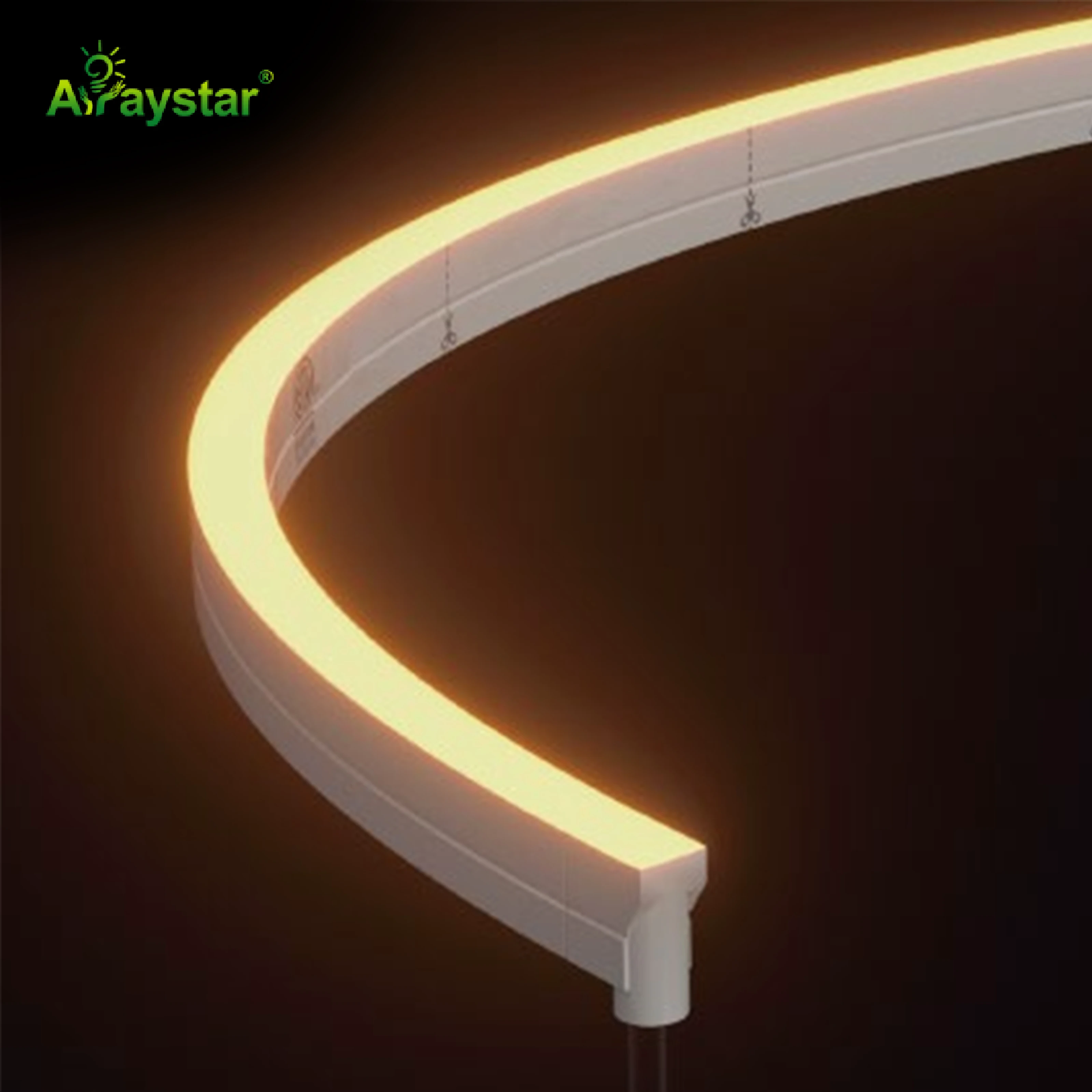
Silicone-extruded or sealed neon and strip tolerate damp and splash better than an open IP20 board. Match the enclosure rating to the worst-case exposure: sheltered under a deep eave needs less than a shallow overhang that catches driving rain.
Check that end caps and connectors share the same protection level; a sealed strip with an open connector is still a weak point.
Seasonal check
Inspect the eave run after the first wet season and again after cold weather. Look for water inside the extrusion, discoloured silicone or corrosion at joints, and clear any leaf or debris that traps moisture against the run.
If the location crosses from sheltered to exposed over its length, treat the exposed end with the higher protection rating rather than matching the most sheltered part.
Installation Checklist
- Confirm the strip voltage, per-metre load and total run length before sizing the supply or controller.
- Check the mounting position for moisture, heat, clearance and any obstruction before fixing the run.
- Test the sensor, receiver or controller in the finished position, with doors and panels closed.
- Keep drivers, joints and receivers reachable so the run can be serviced without reopening the finish.
Recommended Products
For this detail, the following Arraystarled products are listed in our current catalogue and can be matched to the run after the supply, enclosure and control requirements are confirmed:
- IP68 Full Silicon Extrusion LED Neon Strip ART-NS0612-IP68
- ART-TP1220-140-X-24 IP68 TPU Waterproof LED Strip
- IP68 Full Silicon Extrusion LED Neon Strip ART-NS1010-IP68
Silicone-extruded and IP68 neon and strip ranges suit sheltered-to-exposed outdoor positions; match the sealing to the wettest condition the eave sees through the year.
Talk to our application team with your strip length, voltage and ambient condition; we will match the supply, controller or sensor to the actual run rather than a generic rule.