LED Strip Warranty Decoded: Lumen Depreciation & What's Covered
- 2026-09-19 13:17
- /
- Arraystar
An LED warranty is only as good as its fine print: ‘5-year’ coverage usually applies under defined conditions and excludes labour, misuse and improper installation, and lifetime claims are based on lumen depreciation (L70/L80 at a rated case temperature), not sudden failure. Before buying, clarify warranty years, what is covered (product only vs labour), the rated Tc and operating conditions, failure thresholds, proof and RMA process, and whether drivers carry separate terms — then install within spec so the warranty actually holds.
What an LED Warranty Actually Covers
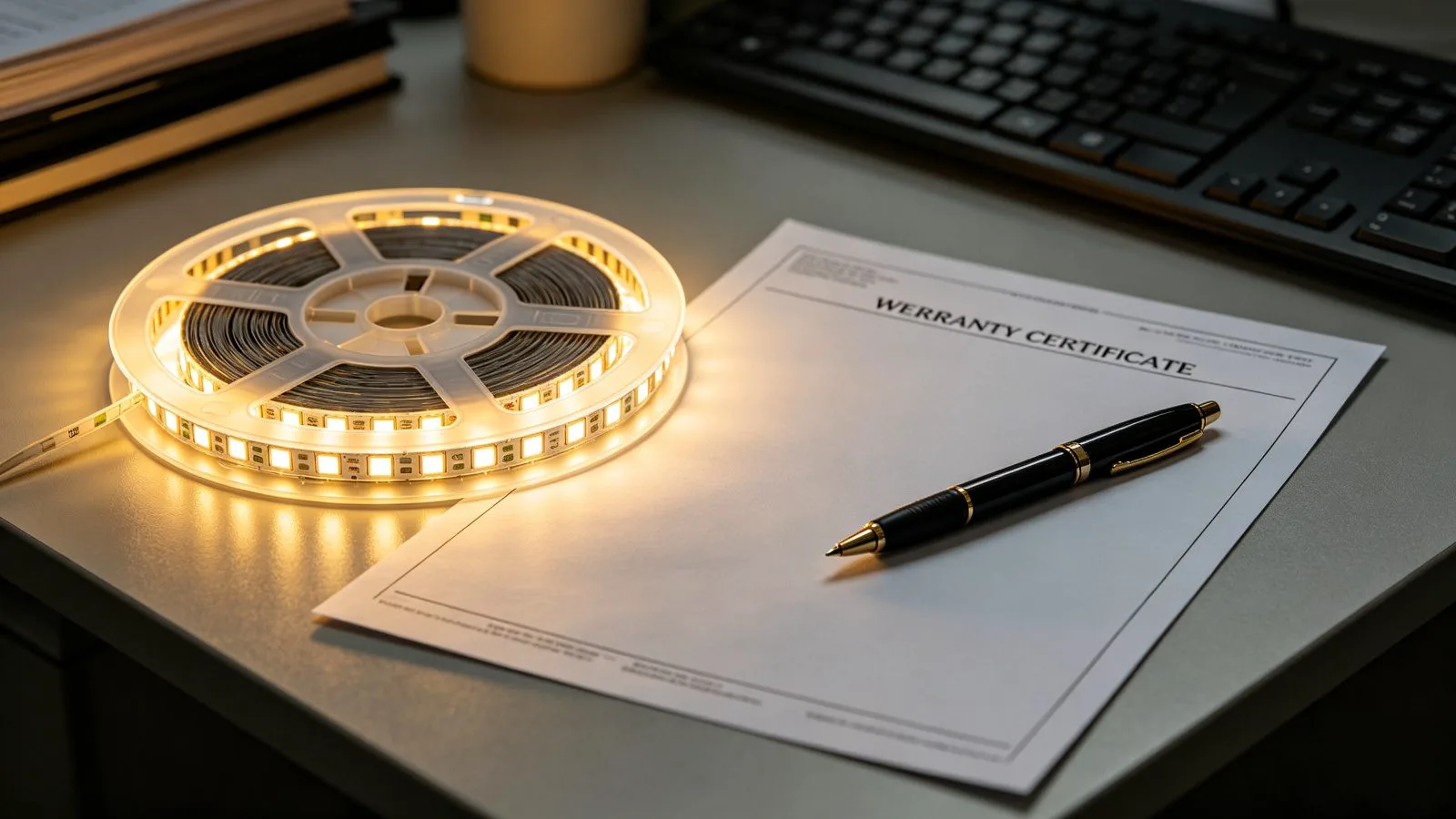
LEDs rarely ‘burn out’ like incandescent bulbs; they fade. Consequently warranty and lifetime are expressed around lumen maintenance — the L-rating (e.g. L70 = time until output falls to 70% of initial) at a specified case temperature (Tc), often with a B-value (e.g. B50 = 50% of units). A ‘50,000-hour’ or ‘5-year’ statement is meaningless without these conditions. The commercial warranty is a separate promise: for a defined period the manufacturer will repair or replace product that fails under proper use, subject to exclusions. Buyers are frequently surprised to find the warranty covers replacement product only, not the substantial labour of accessing and reinstalling strip in a finished ceiling or facade.
- Lifetime (L70/L80 at Tc) is an engineering projection; the warranty is the legal remedy period.
- Warranties usually cover product replacement/credit, often excluding labour and consequential loss.
- Coverage is conditional on correct voltage, thermal management, IP use, drivers and installation.
- Drivers/controllers often have shorter, separate warranties from the strip.
- Claims need proof of purchase, batch and (for depreciation) measurement.
Reading the Terms: Definitions to Pin Down
Warranty questions to answer before ordering
| Term | What to confirm |
|---|---|
| Warranty period | Years from purchase/invoice; start date |
| L-rating / Tc | L70 or L80, B-value, rated case temperature |
| Covered remedy | Replacement, credit or repair; who pays freight |
| Labour | Whether installation labour is included (often not) |
| Conditions | Voltage, profile/heat, environment, IP, drivers |
| Exclusions | Misuse, surge, water damage, modification, cuts |
| Driver terms | Separate warranty period and conditions |
| Claim process | Evidence, RMA number, testing, timeline |
Why Claims Are Rejected (and How to Avoid It)
- Overheating: running strip without adequate aluminum profile, in enclosed hot spaces, or above rated Tc voids terms and accelerates depreciation — the dominant real failure mode.
- Wrong voltage/current or poor drivers: over-voltage, ripple or incompatible dimmers cause failures excluded from cover.
- Improper IP use: installing IP20 strip outdoors, or IP65/67 product submerged beyond its rating, is misuse; cut ends left unsealed void waterproof cover.
- Unauthorised modification: field cuts in the wrong place, re-soldering, wrong connectors, chemical damage from adhesives or cleaners.
- Environmental damage: surge/lightning without SPDs, salt/chemical exposure beyond rating, mechanical damage.
- No evidence: inability to show purchase, batch number, correct installation or measured depreciation.
Protecting the warranty at installation
| Action | Benefit |
|---|---|
| Use adequate aluminum profile | Keeps Tc within rated life |
| Correct voltage + quality drivers | Prevents electrical failures |
| Match IP to environment & seal ends | Honours waterproof rating |
| Document install and batch | Supports any future claim |
| Add SPDs outdoors | Avoids surge-related exclusions |
| Follow maker's run/cut rules | Prevents self-inflicted faults |
Making a Lumen-Depreciation or Failure Claim
- Keep invoices, batch/lot numbers, the datasheet and installation records (driver model, profile, run lengths).
- Document the issue with dated photos/video and, for depreciation, measured output compared to rated initial lumens at the L-rating conditions.
- Understand that a warranty threshold is usually a defined percentage of a sample falling below L70/L80 at rated hours/Tc — a single dimmed section is assessed against the terms.
- Contact the supplier before removing product, obtain an RMA and follow their return/testing process; freight responsibility varies.
- Distinguish infant failures (early, often DOA/replaced readily) from gradual depreciation (later, assessed against L-rating).
- For large/commercial projects, negotiate enhanced terms, labour coverage or project warranties in the contract.
We offer written warranties with clearly stated L70/L80 ratings at defined Tc, separate driver terms, remedy and RMA process, and we engineer product (efficient chips, copper PCB, correct profiles and drivers) so installations stay within rated conditions. For projects we can discuss extended or project-specific terms; ask for the warranty document and rated conditions at quotation stage rather than after a problem.
Recommended Products
Frequently Asked Questions
What does a 5-year LED strip warranty actually cover?
Typically it promises repair, replacement or credit for product that fails within five years under specified proper-use conditions (correct voltage, thermal management, environment, drivers); it often excludes installation labour, freight, consequential loss and misuse. Read the rated Tc, L-rating, exclusions, driver terms and claim process — the headline number alone is not the promise.
What is the difference between L70 and the warranty period?
L70 is an engineering lifetime estimate — the hours (at a stated case temperature) before output depreciates to 70% of initial, often with a B-value for the percentage of units affected. The warranty period is the commercial time in which the supplier will remedy qualifying failures. A 50,000-hour L70 rating does not automatically mean a 50,000-hour full-replacement warranty.
Does LED strip warranty cover installation labour?
Usually not — most standard warranties cover replacement product or credit only and expressly exclude on-site labour, access costs and consequential losses, which can dwarf the strip's cost in a finished facade or ceiling. For large projects, negotiate project warranties or labour coverage up front and install within spec to keep cover valid.
What voids an LED strip warranty?
Common voids are overheating from inadequate profile/enclosure, wrong voltage or poor/ripple drivers, using IP20 outdoors or submerging beyond rating, unsealed cut ends, unauthorised cuts/modifications or wrong connectors, chemical damage, surge damage without protection and mechanical abuse. Keeping within rated voltage, temperature, IP and driver conditions preserves cover.
How do I prove a lumen-depreciation warranty claim?
Keep the invoice, batch/lot number, datasheet and installation records (driver, profile, run lengths), then provide dated evidence and measured output showing the installed product has fallen below the L70/L80 threshold at the rated hours and case temperature, assessed across the required sample per the terms. Contact the supplier for an RMA before removing product.
Need clear warranty terms for a project?
We provide written warranties with stated L70/L80 ratings at defined Tc, separate driver terms and a clear RMA process, plus engineering guidance to keep installs within rated conditions. Ask for the warranty document and project terms at quotation.
Email: info@arraystarled.com | Phone: +86-0755-2103-6746 | WhatsApp: 0086 1581 8514 077
Need to size your power supply? Use our LED Strip Power Calculator to find the right driver in seconds.