Hexagon Shop Ceiling Grid Throws Glare on a Reflective Floor - Spacing Fix
- 2026-11-02 15:55
- /
- Arraystar LED
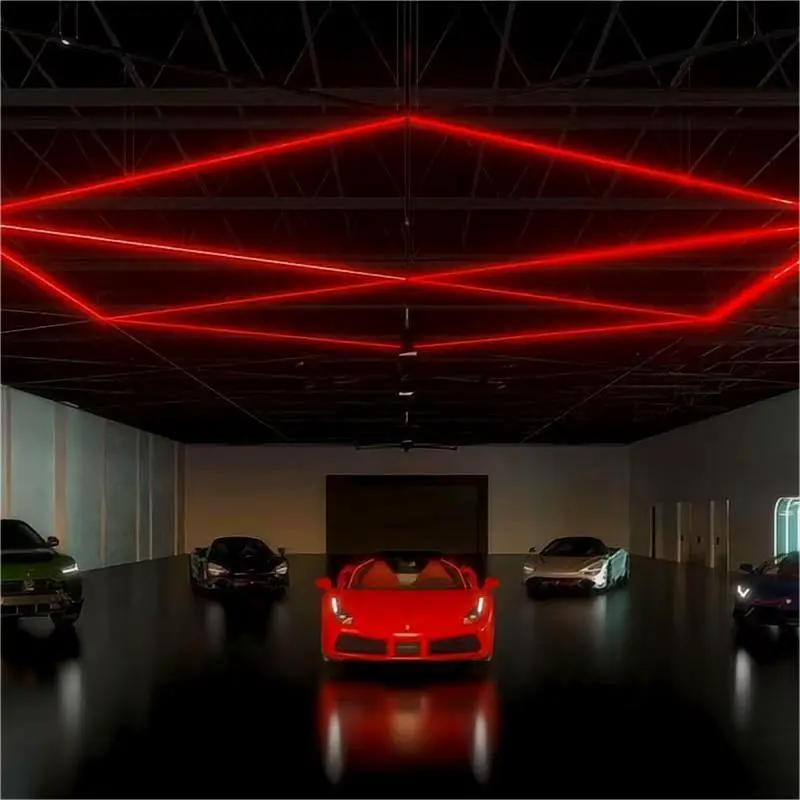
A hex ceiling grid looks great in a photo and blinding in real life on a polished floor. The problem is not the panels; it is the height, spacing and beam spread that bounce the hot spots straight back into the eye.
The glare that only shows up on a polished floor
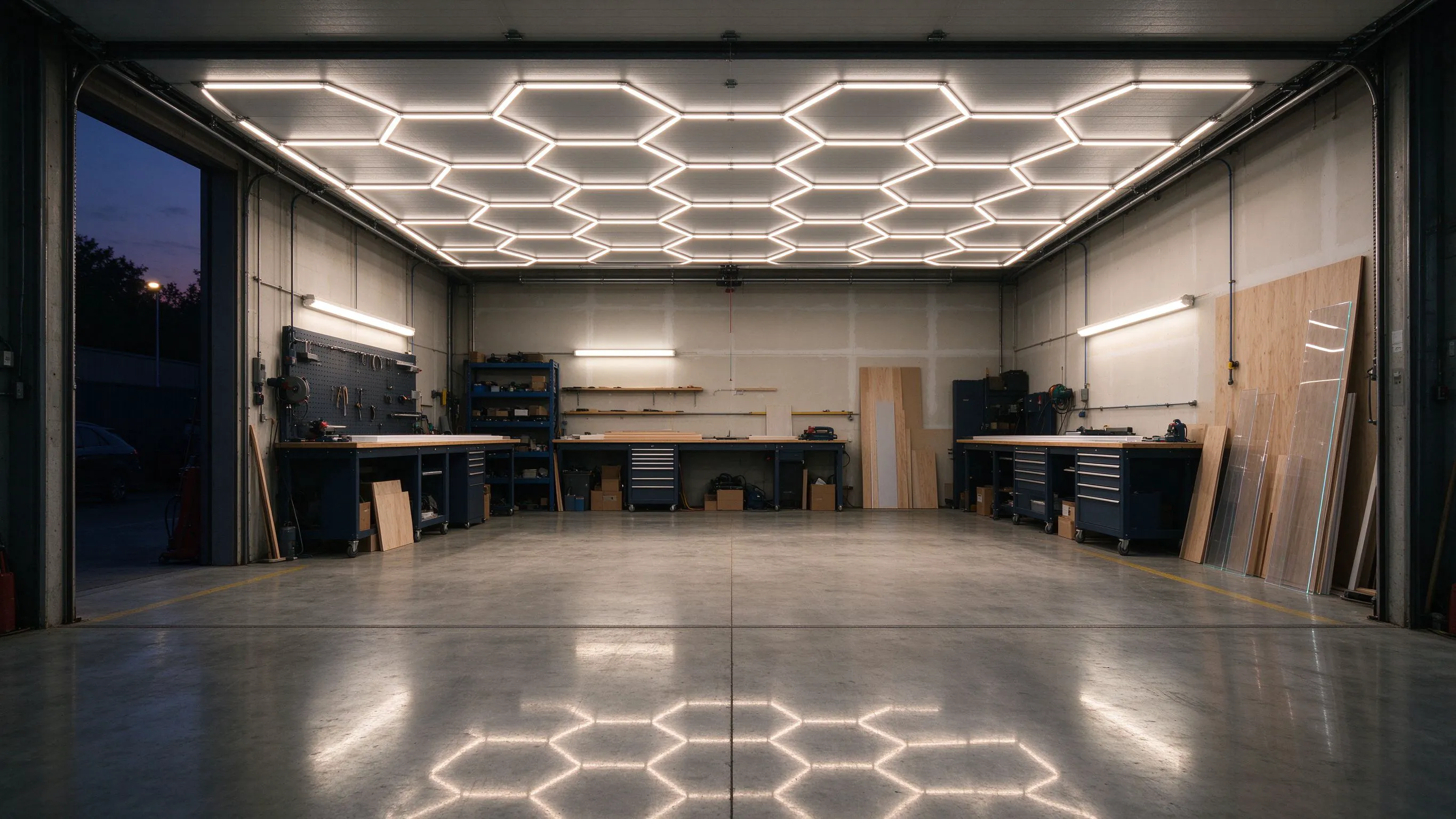
A client fits a hex honeycomb grid in his detailing garage, walks in the next morning and can barely look at the floor. Every hex panel is throwing a bright reflection straight back up, like standing between a dozen mirrors. He thinks the panels are too bright. They are not; the floor is the problem, and the panel spacing on top of it is making the reflection worse.
A polished concrete or epoxy floor has a reflectance of 40 to 70 percent. A matte tile floor reflects 10 to 20 percent. The same hex grid that looks soft on tile becomes a blinding array on epoxy, because the floor is acting like a second ceiling. The fix is not to dim the panels, it is to change the geometry so the reflected rays leave the eye line.
- The glare is worst when standing in the centre of the grid, not at the edge.
- It is worse on a wet or freshly polished floor than on a dusty one.
- It disappears if you stand sideways rather than under the panels.
Why a 2.4 m ceiling makes it worse
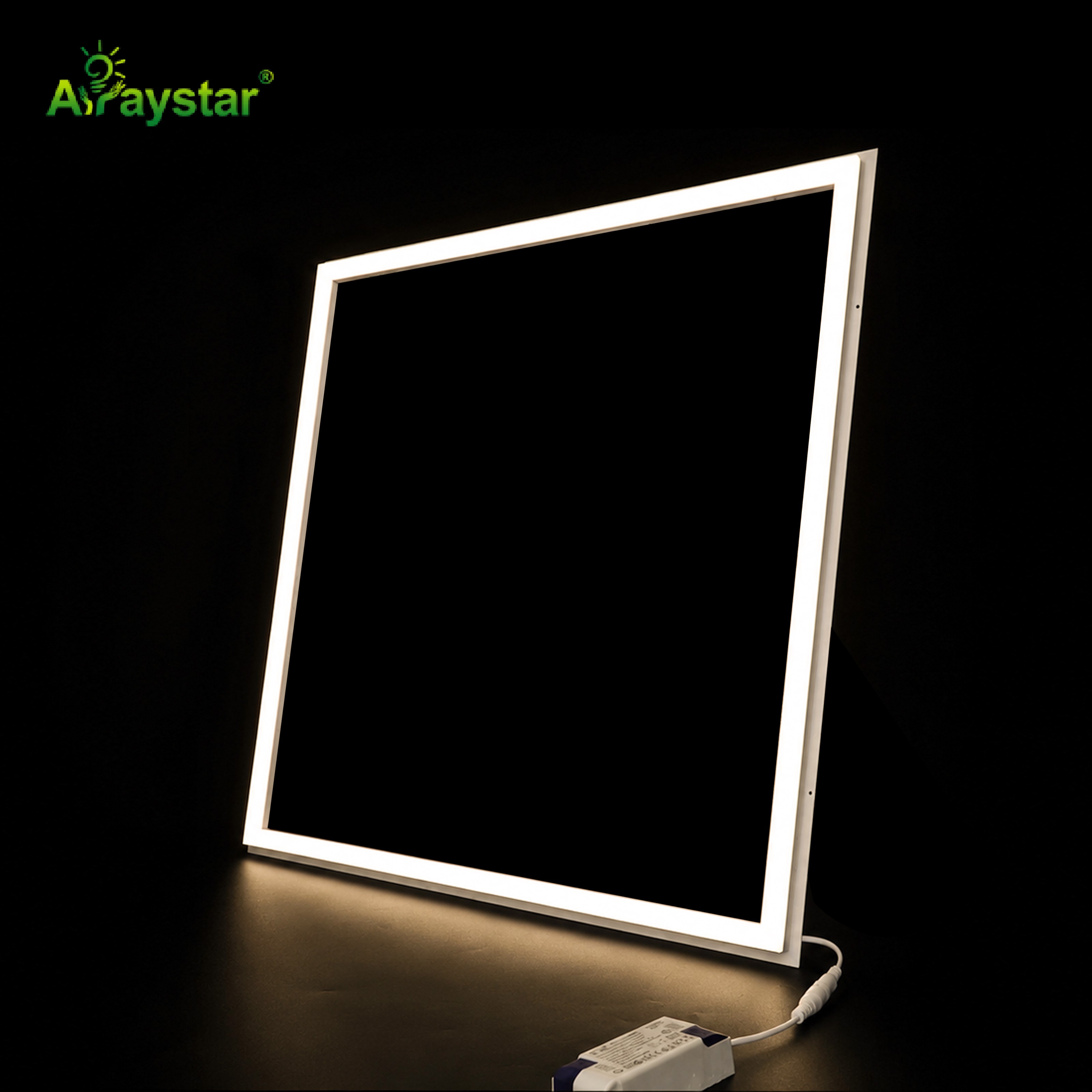
A hex panel mounted 2.4 m above the floor at a centre-to-centre spacing of 600 mm creates a dense pattern. On a reflective floor, that pattern repeats at floor level with the same density, and your eye sees two grids, one above and one below. Once you step back to 3 m spacing and lift the panels to 3 m height, the reflected grid spreads out and the hot spots stop lining up with your eye line.
The vertical relationship is simple trigonometry. A panel 3 m above the floor at a 30 degree downward beam angle reflects off the floor and reaches your eye at about a 15 degree upward angle. Lower the panels and the angle steepens, which is why a low garage ceiling amplifies glare so badly.
Numbers that kill the reflection
Lift, spread, and narrow the beam; do not just dim the panels.
| Ceiling height | Panel spacing | Beam angle | Floor glare |
|---|---|---|---|
| 2.4 m, low garage | 600 mm | 90 degree wide | High, blinding |
| 2.7 m, standard | 800 mm | 60 degree | Moderate |
| 3.0 m, higher bay | 1000-1200 mm | 40 degree narrow | Low, acceptable |
| Any height, matte floor | Any | Any | Low, fine |
Beam spread, CCT and floor finish
A wide 120 degree beam panel floods the floor and maximises reflection. A narrow 40 to 60 degree beam puts the light on the work surface, not on the floor bounce. On a detailing bench I also prefer 4000 K neutral white over 6000 K cold; the cooler CCT reads harsher on a reflective floor, even at the same lumen output.
If the floor is already poured and polished, I sometimes solve half the problem with a matte floor seal. A single coat of matte epoxy over a polished floor drops reflectance from 60 percent to 15 percent, which removes the reflection problem far more reliably than rearranging the grid.
Layout I spec now for reflective floors
My default layout for a reflective commercial floor is 1000 to 1200 mm centre spacing, panels lifted to at least 3 m, narrow-beam optics, and 4000 K CCT. I also offset the grid so the reflected hex pattern does not align with the working bay where people stand. A 15 degree rotation of the whole grid breaks the vertical line that makes the hot spots line up.
I walk the space on handover with the panels at full brightness. If I can still see a bright reflection in the floor while standing at the work bay, I adjust the spacing rather than turning the dimmer down. Dimming kills the useful light on the car; spacing removes the reflection without losing the work surface brightness. I also take a photo from the operator standing position, because that is the angle the client will judge on.
Recommended Products
Frequently Asked Questions
Why do my hex garage lights glare on the polished floor?
A polished epoxy floor reflects 40 to 70 percent of the light, so every hex panel bounces a hot spot straight back at eye level. Low ceiling height and tight 600 mm spacing make the reflected grid line up with the real grid.
Should I just dim the panels to reduce glare?
No. Dimming reduces the useful light on the work surface, not the reflection. The fix is to lift the ceiling height, spread the panels to 1000 to 1200 mm, and use a narrow 40 to 60 degree beam. You keep the work brightness and kill the floor bounce.
What floor reflectance is too high for a hex grid?
Above 35 percent. Polished concrete and epoxy run 40 to 70 percent; matte tile runs 10 to 20 percent. On a high-reflectance floor, spec narrow-beam panels at 3 m height and 1000 to 1200 mm spacing.
Does a matte floor seal help with glare?
Yes, dramatically. A single matte coat over polished epoxy drops reflectance from 60 percent to about 15 percent, which removes the reflected grid without touching the ceiling layout. It is often cheaper than rearranging the hex panels.
What CCT is easiest on a reflective floor?
4000 K neutral white reads softer on a reflective floor than 6000 K cold. The cooler CCT has more blue content, which scatters more on a glossy surface. Keep 4000 K on detailing bays; save 6000 K for matte warehouses.
Need help with your LED project?
Get factory-direct pricing, free samples and engineering support within 24 hours.
Email: info@arraystarled.com | Phone: +86-0755-2103-6746 | WhatsApp: 0086 1581 8514 077
Need to size your power supply? Use our LED Strip Power Calculator to find the right driver in seconds.