Shop Window Strip Connectors Corroding in Winter Condensation
- 2026-11-02 15:55
- /
- Arraystar LED
Shop window strip connectors that go green by January are not failing the strip. They are condensation victims: cold glass meets warm store air, water drips off the sill, and every unprotected connector sits right under it.
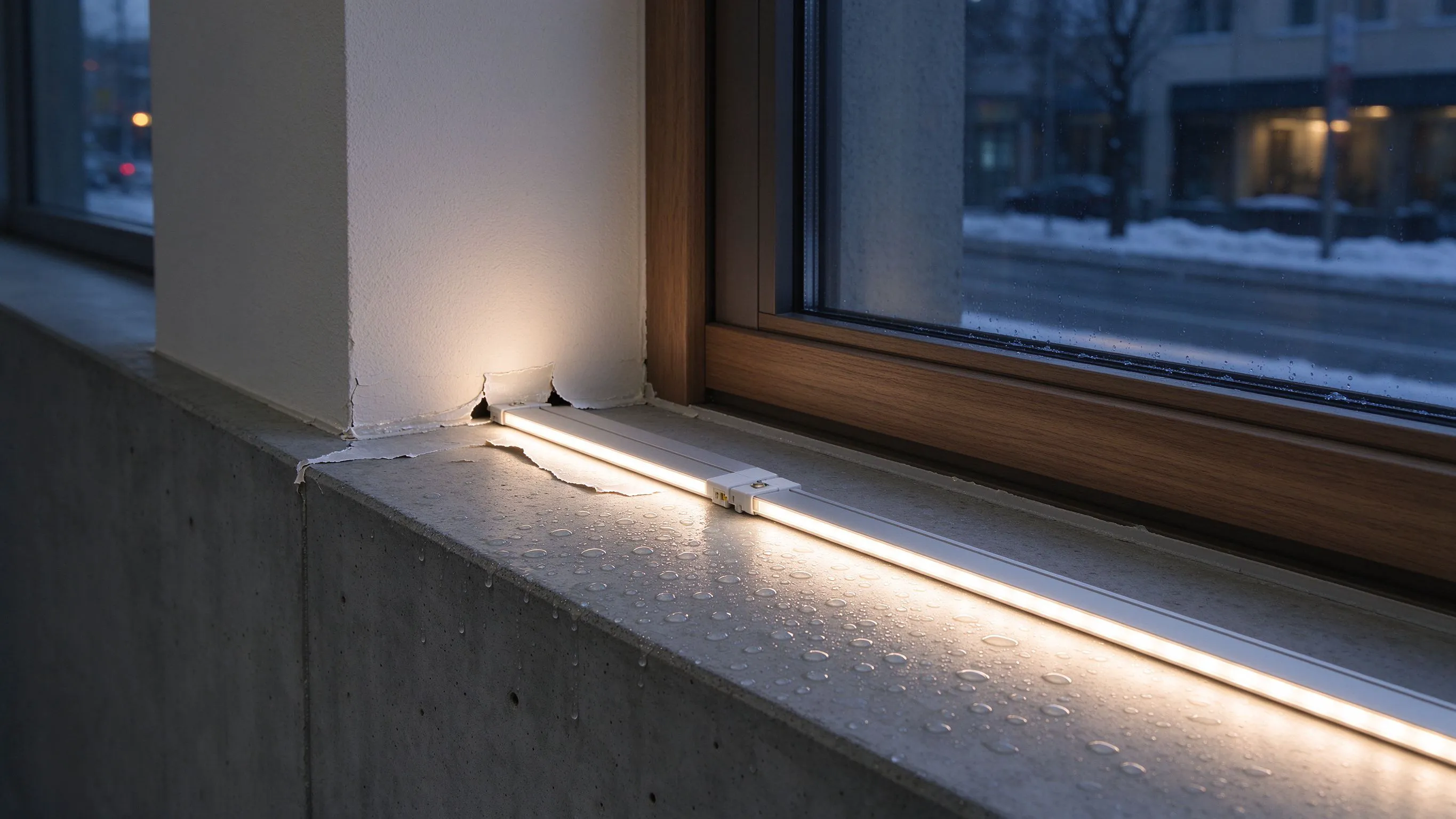
The green connector on the coldest sill in the shop
A retail client has a window display strip running along the sill. By January the connectors at the end of each run have gone white with corrosion, then green, then the light fails. He thinks the strip is faulty. The strip is fine. The connector is sitting in condensation. Double glazing meets a warm store at 21 degrees; the glass sill runs at 5 to 8 degrees; moisture from the store air condenses on the glass and runs down to the sill, where the connectors are.
That water is not clean rain. It is dissolved grease, dust, and cleaning spray residue from the store, and it sits on copper contacts for months. Copper oxide forms in weeks; green verdigris forms in a season. The strip itself, fully jacketed silicone, is untouched. The connector is the weak point, and it is always the connector that fails.
- The corrosion is always at the connector, never along the strip run.
- It is worst on mornings after a cold night.
- It clears if you move the connector off the sill.
Why the sill is the coldest surface in the shop
A double-glazed window conducts heat poorly, so the internal glass pane sits close to the outdoor temperature on a cold night. The sill below it is a thermal bridge: it is in contact with the cold frame, and it runs a full 10 to 15 degrees cooler than the rest of the display area. Any connector sitting on that sill is also cold, and any warm moist air reaching it condenses on its surface.
I measure it with an IR thermometer on a January morning. The strip itself is warm after an hour of running; the connector sitting on the cold sill is 6 degrees cooler than the strip. That temperature gap is exactly where condensation forms.
What kills the connector, step by step
Every joint needs to be above the drip line and off the coldest surface.
| Fault | Where it shows | Fix |
|---|---|---|
| Connector on cold sill | White oxide on contacts | Lift off the sill 50 mm |
| Driver inside the cold display | Green verdigris on terminals | Move driver inside store |
| Joints above the glass drip line | Water tracks down the wire | Seal and vent the box |
| No drip loop at entry | Water follows the cable in | Add a 50 mm U-bend |
Sealing, lifting and re-routing the joints
I re-route the run so every connector sits above the sill, not on it. The strip runs along the display, but the joints land inside a small IP65 box fixed to the display backing board, 100 mm above the glass drip line. The cable between the strip end and the box makes a 50 mm U-bend so any water on the cable drips off before the box. I also face every cable entry downward, never up or sideways.
The driver itself moves inside the store, not inside the cold display. A driver sitting in a 6 degree enclosure condenses internally within weeks. Once the driver is warm and the connectors are off the sill, the corrosion problem stops. I also coat the contacts with a thin dielectric grease before I close the box.
What I spec for a permanent window display
For a permanent window display I spec an IP65 sealed connector box, a 3 mm weep hole with a Gore vent, and all cable entries pointing downward. The strip itself is IP67 silicone, which handles the occasional drip; the box handles the condensation. I also add a small trace heater pad behind the sill in extreme climates, which keeps the surface above dew point and stops the condensation forming in the first place.
I hand the client a maintenance note: open the box once a year, check the connectors, reapply dielectric grease, clear the weep vent. That is a five-minute visit. A corroded connector replaced every winter costs more in labour than a properly routed joint does to build once, and the first failure usually happens right before the busy December window display period.
Recommended Products
Frequently Asked Questions
Why do my window LED strip connectors corrode in winter?
Cold glass meets warm store air and condenses water on the sill. Any connector sitting on that sill sits in dissolved grease and dust water for months, and copper oxide or verdigris forms. The strip jacket itself is unaffected.
Should I use IP67 connectors on the window strip?
IP67 helps, but the real fix is moving the connector off the cold sill and into a sealed box above the drip line. An IP67 connector sitting in condensation still wicks water through the gland over time.
Where should I mount the driver in a cold window display?
Inside the store, not inside the cold display. A driver in a 6 degree enclosure condenses internally within weeks. Keep the driver warm, and use a short cable run to the strip end.
Does dielectric grease stop connector corrosion?
It slows it dramatically. A thin coating on the copper contacts stops oxygen and water reaching the metal, which prevents oxide forming. Reapply once a year when you open the box. It does not fix a connector that is already submerged in water.
Should I add a heater behind the window sill?
In extreme climates yes. A small trace heater pad keeps the sill surface above dew point, which stops condensation forming in the first place. For milder winters, lifting the connector off the sill and sealing the box is enough.
Need help with your LED project?
Get factory-direct pricing, free samples and engineering support within 24 hours.
Email: info@arraystarled.com | Phone: +86-0755-2103-6746 | WhatsApp: 0086 1581 8514 077
Need to size your power supply? Use our LED Strip Power Calculator to find the right driver in seconds.