How to Choose LED Neon Flex for Signs: Top vs Side Bend, Sizes & Cut Lengths
- 2026-09-19 16:16
- /
- Arraystar
Most LED neon sign failures are decided before a single clip is screwed in: the bend axis (top vs side), the cross-section size and the cut type are fixed at the factory and cannot be corrected on site. Decide the bend direction from your artwork, match the size code to the letter stroke and viewing distance, then choose fixed-cut or free-cut and the right IP rating. This guide turns a confusing list of codes like 0306, 0612 and 1212 into a clear ordering checklist, with real factory specs.
Why Most Neon Sign Problems Start at the Ordering Stage
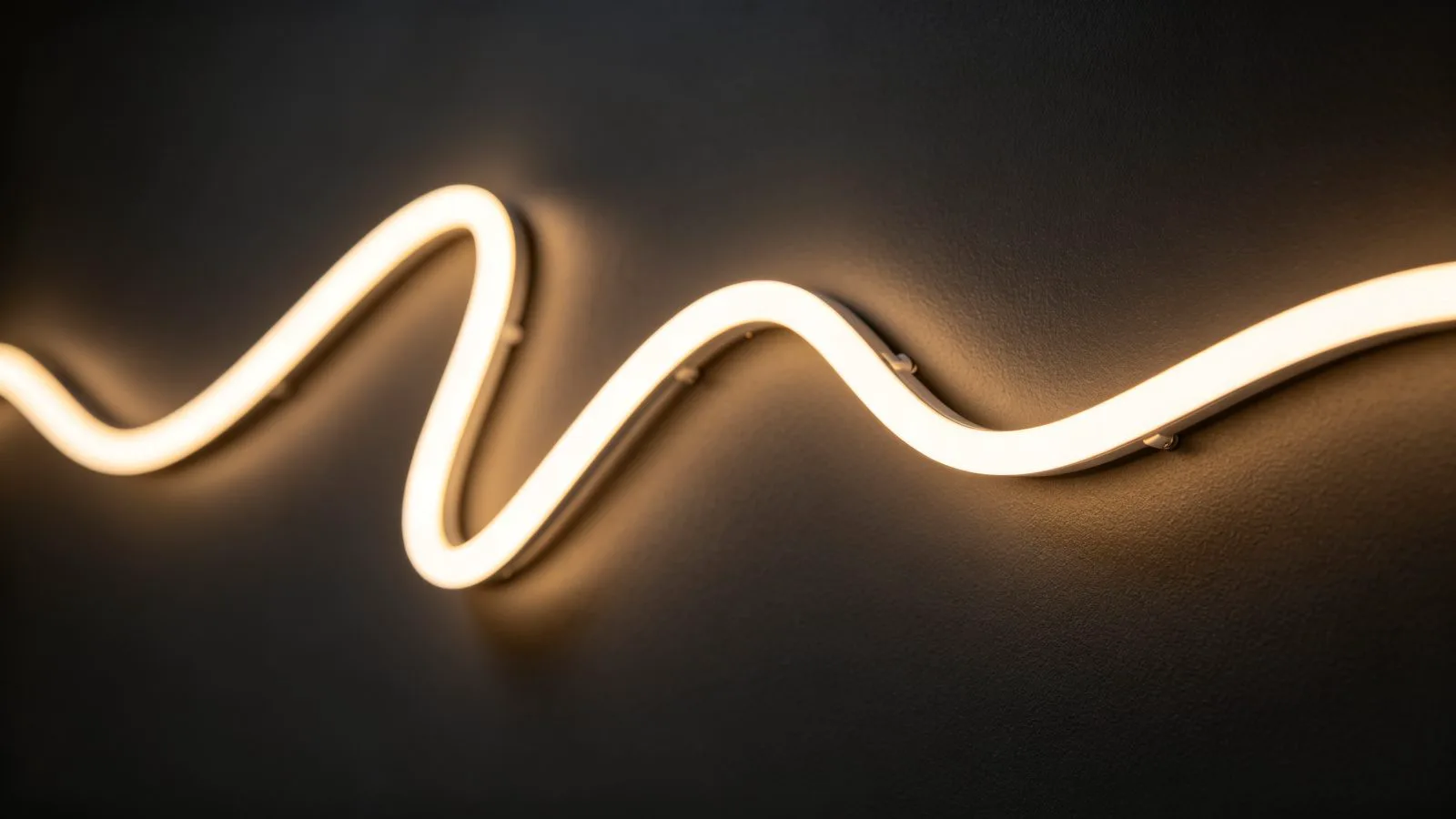
On lighting forums, a surprising number of neon-sign repair posts are not really repair problems. People receive a sign where only part lights up, or they try to shape a fresh roll and find it will not follow the letterform, and the cause usually traces back to one thing: LED neon flex bends on only one axis, and that axis is set when the strip is made. It is not a plain LED strip that you can curve any way you like.
The two standard types are side-bend (also called horizontal or flat bend) and top-bend (vertical or back bend). Side-bend neon flexes left and right while the glowing face stays pointing forward - exactly what flat wall letters and logos need. Top-bend neon curves toward and away from the glowing face, so it can climb over edges, follow arches and step between planes. They are not interchangeable: forcing a side-bend strip through a vertical curve (or vice versa) twists the housing, creates dark spots at the corner and can crack the internal LED board.
Choose the bend type from the artwork, not from what is in stock:
| Type | Bends | Glowing face | Best for | Typical use |
|---|---|---|---|---|
| Side bend | Left-right, in the face plane | Stays facing forward | Flat letters, logos, outlines on a wall | Channel letters, wall signs, 2D patterns |
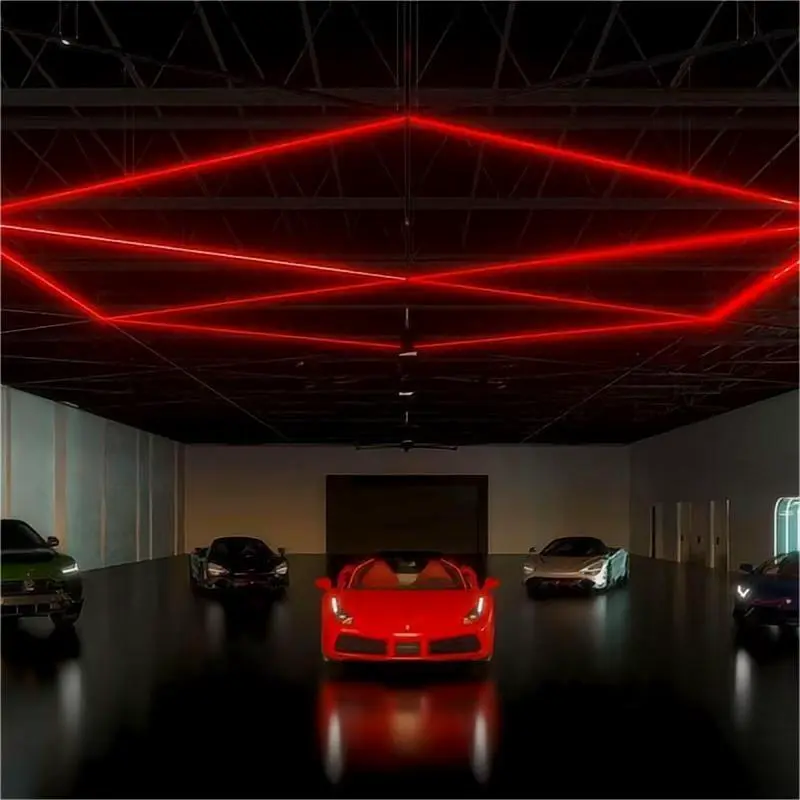
| Top bend | Up-down, toward/away from face | Curves with the surface | Arches, edges, depth changes, 3D shapes | Storefront contours, ceiling/edge runs |
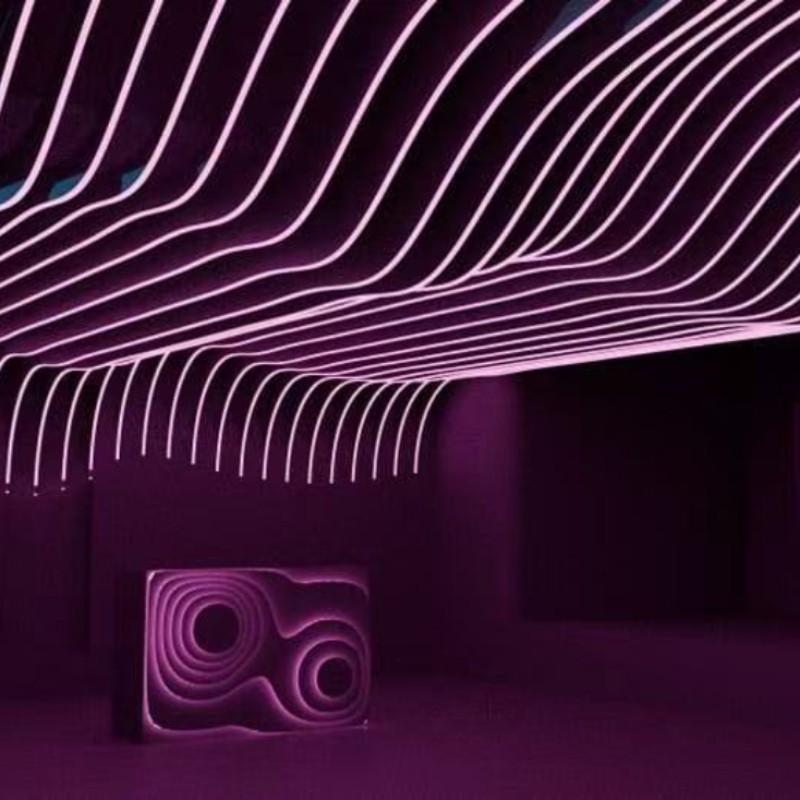
| 360 neon | Round profile, emits on all sides | Visible from every angle | Hanging outlines, sculptures, open ceilings | Suspended signs, decorative 3D forms |
A good rule from working sign makers: if the whole design sits flat on one wall, it is almost always side-bend. The moment the line leaves the plane - wrapping a column, rolling over an arch, stepping between two surfaces - you need top-bend. For something that must read from all directions, a round 360 neon such as the 8mm 360° COB neon is the correct tool rather than a bent flat strip.
Decode the Size Code and Match It to the Letter Stroke
Codes like 0306, 0410, 0612, 1010, 1212 and 1616 look technical but they simply describe the cross-section in millimetres: 0612 is roughly 6mm wide by 12mm tall, 1212 is a 12x12mm square profile, and so on. The cross-section sets three things at once - how wide the glowing line appears, the minimum bend radius (bigger profiles cannot make tight corners), and how far away the sign remains readable.
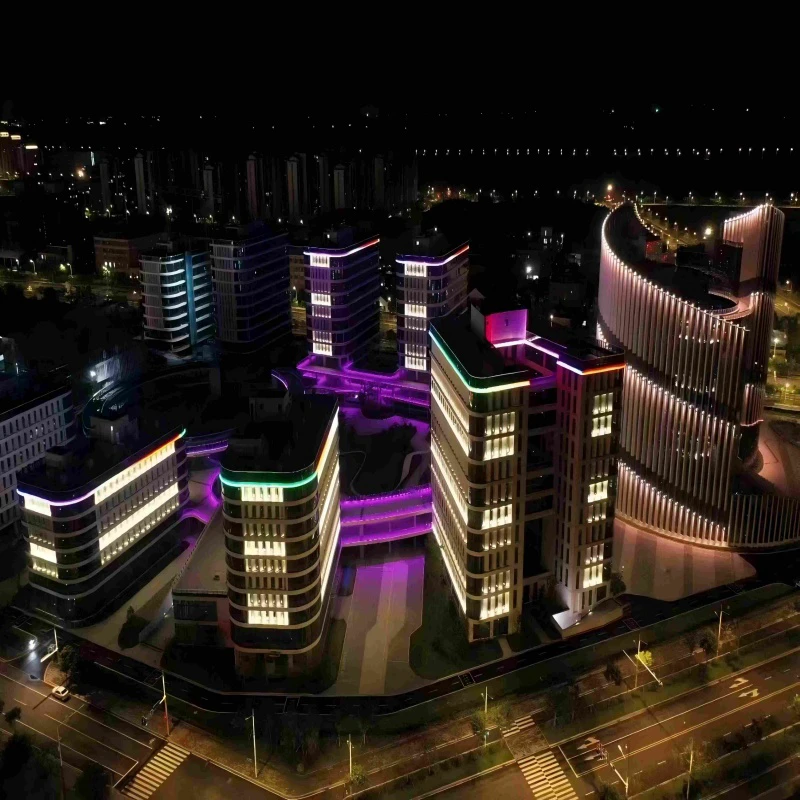
Pick the smallest profile that still gives a clean line at the viewing distance. Tiny 0306/0410 neon is made for small indoor letters and tight script; 0612 is the versatile mid-size for most channel letters; 1010-1212 suits bold signage and longer viewing distances; 1616 is for large architectural outlines seen from across a street or a lobby. Pairing a 1616 profile with a 60mm-tall letter simply will not negotiate the strokes, while a 0306 on a rooftop sign disappears at distance.
How ArrayStar's real profiles map to sign scale (24V silicone neon):
| Profile | Type / key spec | Power | Line character | Typical sign |
|---|---|---|---|---|
| 0410 | IP67 free-cut, SMD2216 140/m | 8W/m | Very slim, sealed | Small outdoor letters, tight script |
| 0612 | Side-bend RGBW, SMD3535 4-in-1 120/m | 15W/m | Mid-width, colour + white | Channel letters, colour logos |
| 1010 | Top-bend free-cut, SMD2216 140/m | 10W/m | Bold, curves over edges | Storefront contours, 3D shapes |
| 8mm round | 360 COB, 800 LEDs/m | 12W/m | Glow on all sides | Hanging and sculptural outlines |
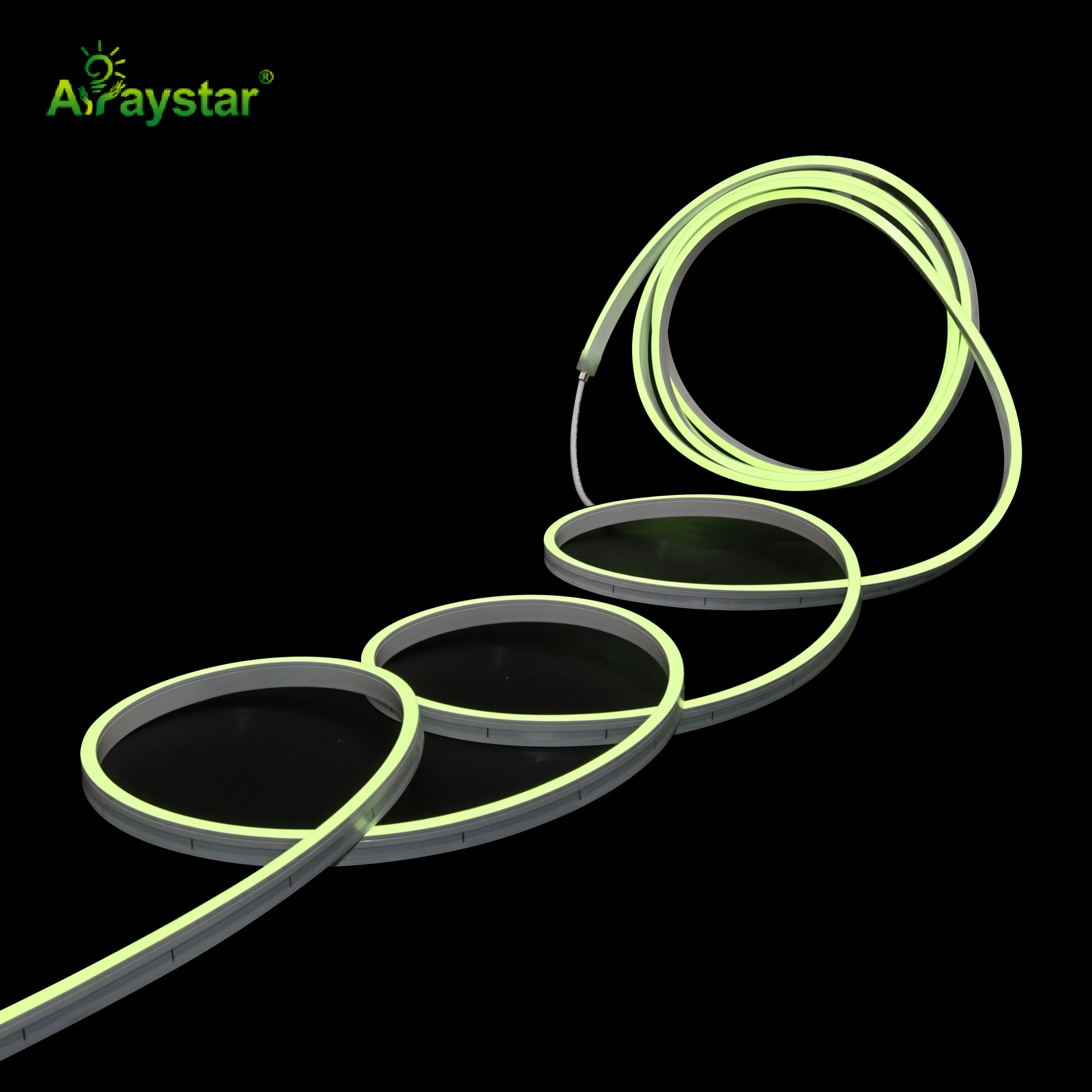
Notice the trade-off in the specs: the slim 0410 is rated around 30-40 lm/W because of its tiny housing and IP67 sealing, while a round COB 360 profile reaches 63-72 lm/W with 800 LEDs per metre. Size is therefore not just aesthetics - it changes heat, brightness and the minimum bend radius, so confirm all three against the artwork before ordering.
Fixed Cut vs Free-Cut, and Why One Dead Section Can Black Out a Run
Neon flex contains the LEDs on a continuous flexible board inside silicone, so it can only be cut where the circuit allows. Fixed-cut neon has cut marks at set intervals (commonly every 25mm, 50mm or 100mm depending on model); cut anywhere else and you sever a circuit. Free-cut (marked with an F in many part numbers, e.g. ART-NS1010F) uses parallel-style construction so it can be trimmed at almost any point, which is invaluable when a letter stroke does not divide evenly by the cut interval.
Which cut type your project needs:
| Fixed-cut neon | Free-cut neon | |
|---|---|---|
| Where it cuts | Only at printed cut marks | Almost anywhere along the run |
| Off-cut waste | Can be significant on short strokes | Minimal |
| Cost / availability | Lower cost, more options | Slightly higher, selected models |
| Best for | Long straight runs, repeat lengths | Custom letters, irregular script, tight layouts |
| Field repair | Section replacement at cut points | Easier to shorten/re-terminate on site |
This also explains the most common repair question - "one LED failed, did it kill the whole sign?" In a serially wired neon run, a bad solder joint, a pinched section or a failed segment can stop current reaching everything downstream, which is why forum signs often light only from the start up to one point. Quality neon uses robust internal connections and is installed with solderless connectors at joins so a section can be replaced without unwelding the whole letter. Ordering free-cut neon and a few spare connectors is the cheapest insurance you can buy for a custom sign.
Outdoor Sealing, Mounting and Power - the Last 10% That Decides Longevity
For exterior signage, specify genuinely sealed neon such as IP67 free-cut 0410 rather than relying on indoor silicone plus glue. Check the end caps and feed wires are factory-sealed, because water enters at terminations far more often than through the tube itself. UV-stable silicone resists the yellowing and embrittlement that cheaper PVC-style housings develop after a summer in direct sun.
Mounting and power checklist for a clean, reliable install:
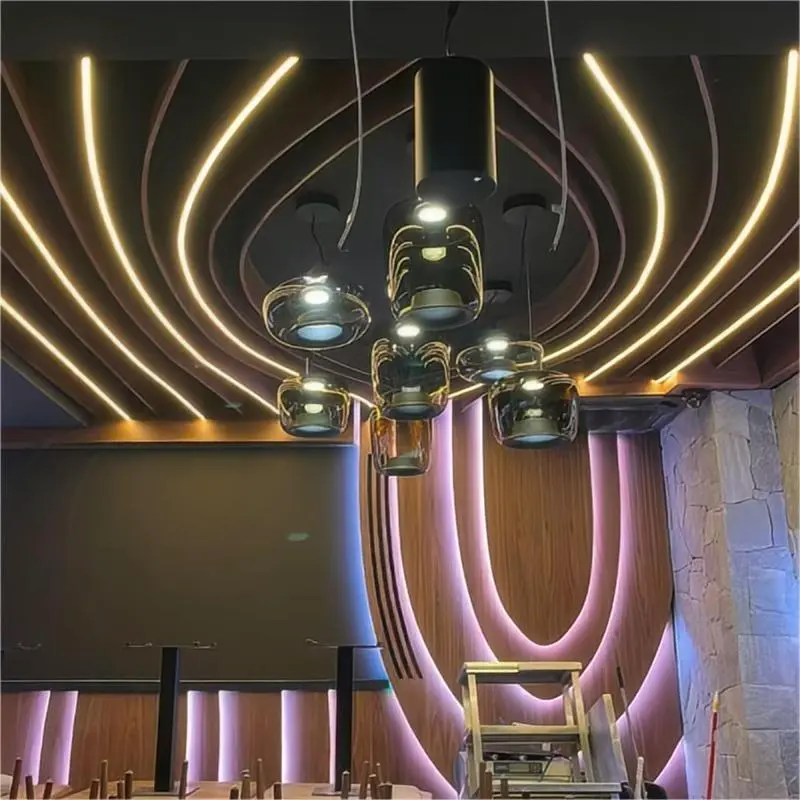
- Mount in dedicated clips or a flexible aluminum channel made for the profile (e.g. the recessed flex channels for 1010/1212 neon) - ordinary double-sided tape releases on hot corners.
- Pre-fit the full layout and mark bends before peeling any backing; never exceed the profile's minimum bend radius.
- Run 24V neon for longer signs and inject power on long runs to keep the far end the same colour and brightness.
- Size the driver with headroom (total metres x W/m, plus ~20%) and keep connections accessible for service.
- Decide neon vs COB vs rope light honestly: rope light looks dotted and cheap for text, bare COB is a slim line without a diffuser, and true silicone neon gives the smooth, bold, protective tube that signage needs.
The ordering checklist in one line: read the artwork to fix the bend axis → choose the cross-section from stroke width and viewing distance → choose free-cut for custom letters and IP67 for outdoors → add matching channels, connectors and an oversized 24V driver. Browse the full LED neon flex range with side-bend, top-bend, free-cut, 360 and pixel options, or send your artwork for a profile and cut-length recommendation.
Recommended Products
Frequently Asked Questions
What is the difference between top-bend and side-bend LED neon flex?
Side-bend (horizontal) neon curves left and right while the glowing face points forward, so it is used for flat letters, logos and outlines mounted on a wall. Top-bend (vertical) neon curves toward and away from the glowing face, letting it follow arches, edges and 3D depth changes. The axis is built into the strip and the two are not interchangeable.
Can I just bend a top-bend neon sideways, or force a tighter corner?
No. Bending a strip on the axis it was not designed for twists the silicone, pinches the LED board and produces dark spots or a cracked profile; exceeding the minimum bend radius does the same. If the artwork needs both flat and vertical curves, order both side-bend and top-bend sections and join them, or use round 360 neon for free-form shapes.
What size (0306, 0612, 1212) neon flex do I need for my letters?
The code is the cross-section in millimetres. Use slim 0306/0410 for small indoor letters and tight script, 0612 for most channel letters, 1010-1212 for bold signage and longer viewing distances, and 1616 for large architectural outlines seen from far away. Match the profile to the stroke width - an oversized profile cannot negotiate small letters.
What does free-cut mean and can I cut neon flex anywhere?
Standard fixed-cut neon can only be cut at printed marks (often every 25-100mm); cutting elsewhere severs the circuit. Free-cut neon (often marked F in the part number) uses parallel construction so it can be trimmed at almost any point, which minimises waste on custom letter strokes. Always seal or terminate cut ends properly.
One section of my neon sign is dark - did one bad LED kill the rest?
Neon runs are largely serial, so a bad solder joint, a pinched or water-damaged section can stop power reaching everything downstream of that point - so one physical fault can black out a whole tail. It is usually the joint or that segment rather than every LED. Solderless connectors and free-cut, serviceable designs let you replace just the affected section.
Tell us the artwork - we'll spec the neon
Send your sign design and viewing distance and our factory team will recommend the bend axis, profile size, free-cut layout, IP rating and driver for your LED neon project.
Email: info@arraystarled.com | Phone: +86-0755-2103-6746 | WhatsApp: 0086 1581 8514 077
Need to size your power supply? Use our LED Strip Power Calculator to find the right driver in seconds.