WS2812B vs WS2815 vs WS2811: Which Addressable LED Strip for Large Projects?
- 2026-09-19 16:16
- /
- Arraystar
WS2812B is the default for bench projects, not for installations. When you scale an addressable LED design up, the decisions that actually determine success are voltage (5/12/24V), pixels per metre versus LEDs per metre, single-point failure behaviour (break-point resume) and the control bus (SPI vs DMX). Get those four right and long runs stay the same colour end to end and survive a dead pixel; get them wrong and you get pink far ends, glitches and whole tails going dark. Here is how the common ICs compare, with real factory strip specs.
Why the 5V WS2812B Default Breaks Down on Real Installations
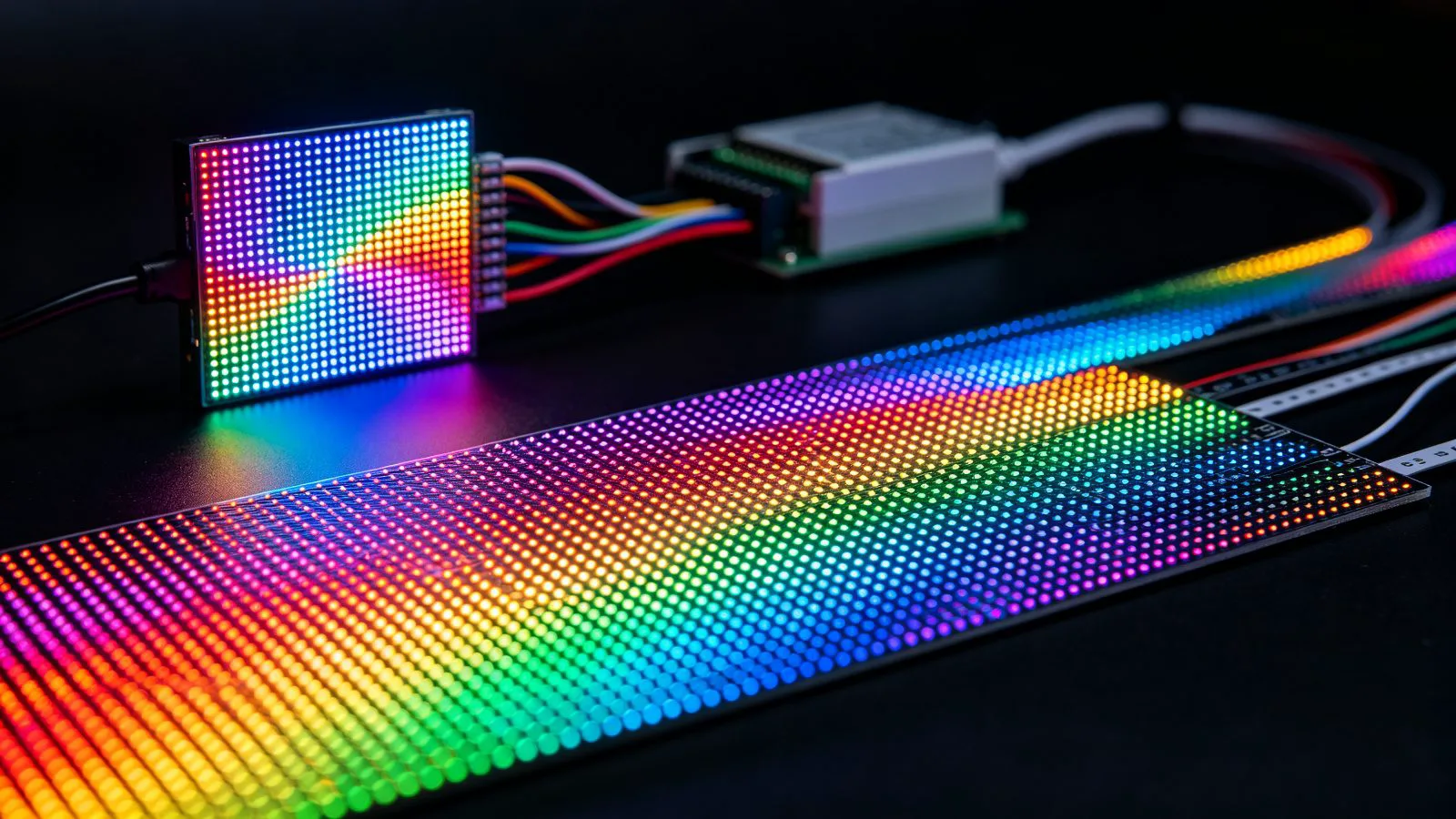
Most online tutorials start and end with the WS2812B because it is cheap, runs on 5V and every LED is its own pixel. That is perfect for a desk lamp or a small PC build. In project forums, though, the same failure pattern appears as soon as the strip gets long: the far end turns pink or yellow, sections flicker, or a 3.3V microcontroller such as an ESP32 drives the first metre fine and then glitches.
The physics behind those symptoms:
- At full white each 5050 RGB pixel can draw close to 60mA, so 5m of 60/m strip is roughly 18A - far beyond a USB port or small adapter.
- At 5V the thin copper traces lose voltage fast; even a 0.5V drop is 10% of the supply, so distant LEDs under-drive red/blue unevenly and shift colour.
- WS2812B data expects 5V logic; a 3.3V GPIO often needs a level shifter and a 220-470 ohm data resistor, and noisy environments (e.g. cars) need twisted data+ground pairs.
- Data flows one way (DIN to DOUT); wiring into the wrong end or one dead pixel can stop everything after it.
None of this makes WS2812B bad - it makes it a small-project part. Scaling the same architecture to a sign, a bar fit-out or a facade is where 12V and 24V pixel strips and differential buses earn their cost.
The Two Real Levers: Voltage and Pixels-per-Metre
When you compare addressable strips, separate two numbers that are often confused. LEDs per metre is the physical count of emitters; pixels per metre is how many are independently controlled. A strip can carry 120 LEDs/m but only 10 pixels/m, because one IC drives a group of 12 LEDs together. Higher voltage lets you run farther before injecting power; lower pixel count is fine (and far cheaper to drive) for chases and ambient washes, while true per-LED pixels are required for smooth, detailed video.
How the common IC families position themselves:
| IC | Voltage | Control | Break-point resume | Best scale |
|---|---|---|---|---|
| WS2812B / SK6812 | 5V | Per LED, single data line | No | Small props, desk/PC, short runs |
| WS2815 | 12V | Per LED, dual data line | Yes | Detailed effects over several metres |
| WS2811 | 12/24V | Often per LED group | On many versions | Long outlines, chases, signage |
| DMX512 / UCS / FW | 12-24V+ | Addressed bus, differential | Typically yes | Facades, large commercial jobs |
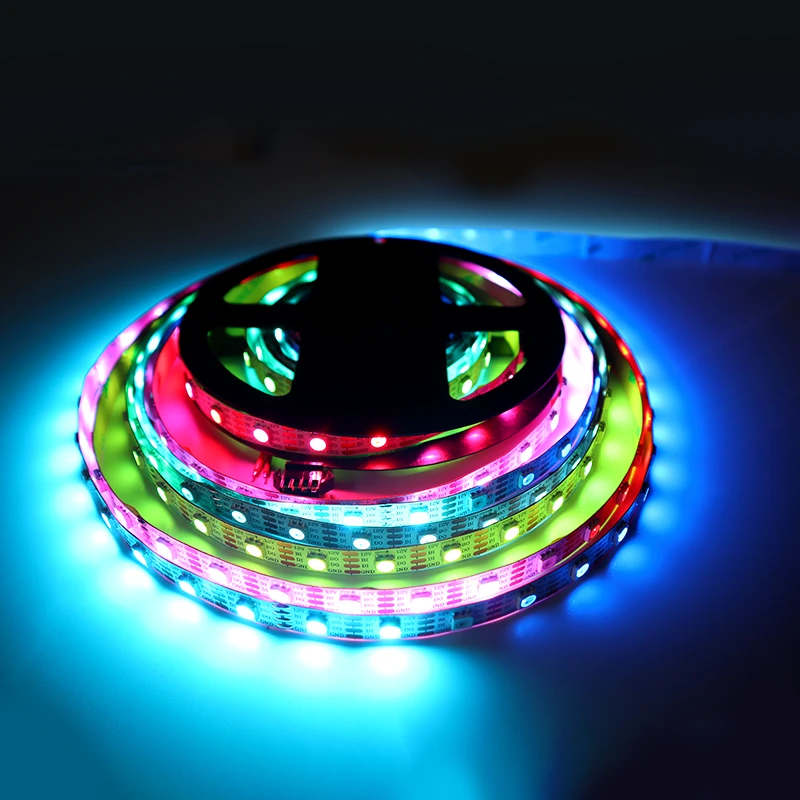
Real ArrayStar strips show the trade-off in the spec sheet:
| Strip | IC / voltage | LEDs/m | Pixels/m | Cut length | Suited to |
|---|---|---|---|---|---|
| 5050 WS2815 (12V) | WS2815 / 12V | 60 | 60 (per LED) | 16.6mm | Smooth detailed effects, moderate runs |
| 2835 WS2811 (24V) | WS2811 / 24V | 120 | 10 (1 IC : 12 LEDs) | 100mm | Long chases, coves, building outlines |
| Pixel point FW1935B | FW1935B / 12V | node string | 1 per node | Per node | Facade media grids, signage |
Read those rows carefully: the 24V WS2811 2835 looks denser (120 LEDs/m) yet gives only 10 controllable pixels/m on a 100mm cut, which is exactly right for a colour-chasing roofline but cannot render a fine image. The 12V WS2815 gives a true pixel every 16.6mm for video-grade effects. Choosing by LED count alone is the most common ordering mistake in this category. Browse both families under the SPI addressable strip range.
Single Points of Failure and Break-Point Resume
On a one-way single-data strip like WS2812B, the data is regenerated by each pixel and passed to the next. If one pixel or its input is damaged, the signal often cannot cross it, so an entire tail goes dark - a minor issue on a desk toy, a service call on a wall 6 metres up. Break-point resume (also called dual-signal or bypass) ICs carry a backup data line; when one pixel fails, the next one reconstructs the signal and the run keeps working with only that single point out.
Why reliability architecture matters more as the job gets bigger:
| Topology | When one node fails | Wiring / control | Typical application |
|---|---|---|---|
| 5V single-line SPI (WS2812B) | Tail after it can go dark | Single data, many power injections | Small, accessible builds |
| 12V dual-line SPI (WS2815) | Only that node is lost | Backup data line, fewer injections | Retail, hospitality, signs |
| DMX / differential (K1000C etc.) | Addressed, fault-isolated | RS485, cascade to ~150m, SD offline | Facades, stages, large grids |
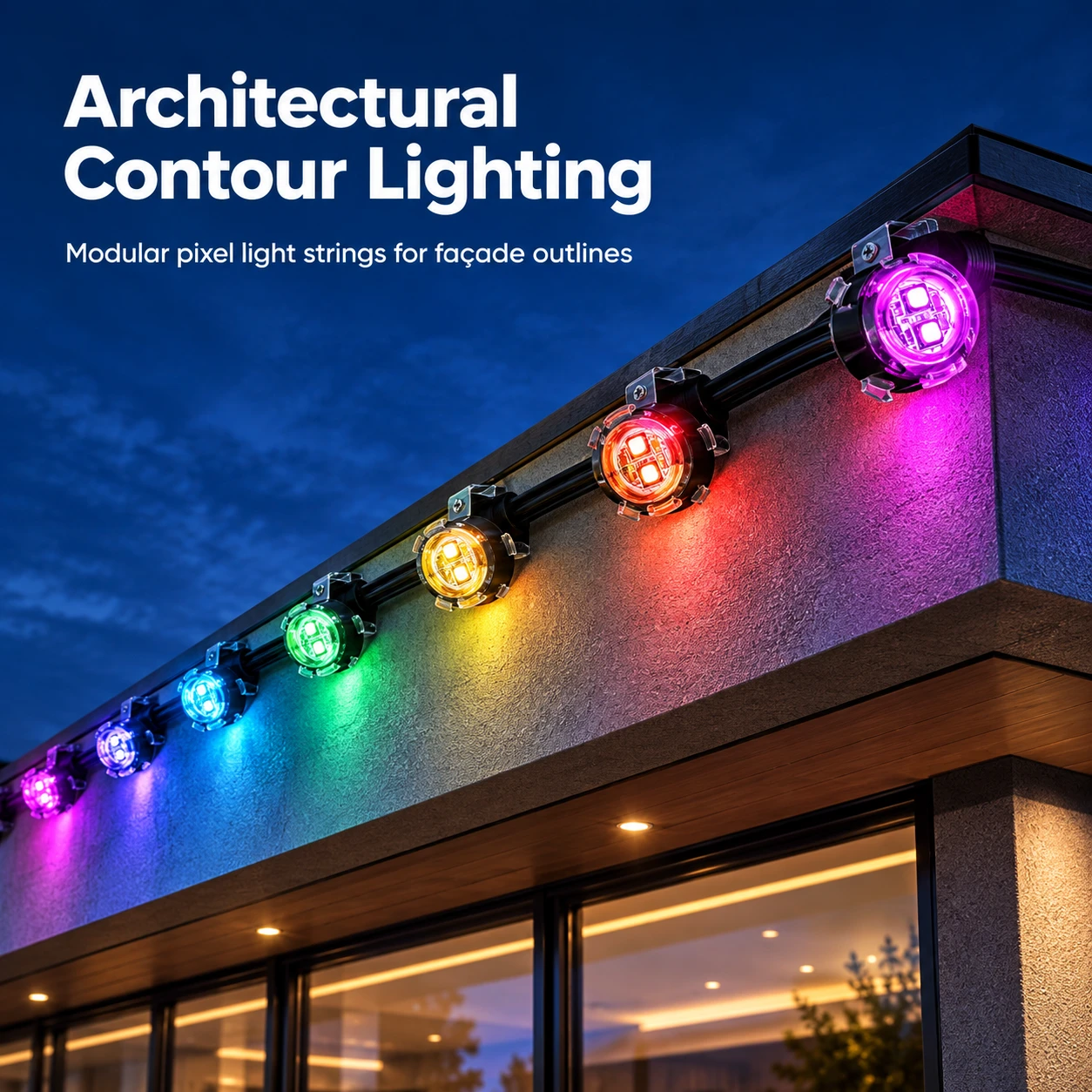
For architectural work the control layer matters as much as the strip. A factory-grade pixel controller such as the ART-K1000C DMX512 controller drives up to 512 pixels per DMX port (2048 over SPI), outputs differential RS485 that cascades around 150m, runs effects offline from an SD card and supports one-click DMX addressing across WS28xx, SK6812, UCS19xx and TM18xx ICs. Pair it with break-point-resume pixel point lights for a facade where a single failed node never takes a line offline.
How to Spec an Addressable Project End to End
Work through these in order before choosing a strip:
- Define the effect first: video/imagery needs true per-LED pixels (WS2815); chases and washes can use grouped 24V WS2811 at a fraction of the controller load.
- Calculate current at full white (~60mA per 5050 RGB pixel), size the supply with headroom, and inject power every 1m on 5V, roughly every 5m on 12V and ~10m on 24V.
- Keep controller and strip grounds bonded, add a 220-470 ohm resistor on data, and use twisted data+ground or differential RS485 for long or electrically noisy runs.
- Choose break-point resume and sealed IP-rated strips for anything mounted high or outdoors; spec spare nodes and accessible joins.
- Move to DMX512 and point-pixel grids for building media facades rather than chaining thousands of SPI pixels from one GPIO.
The simple decision tree: small and detailed → 5V WS2812B; smooth effects over metres with easy servicing → 12V WS2815 with break-point resume; long linear chases and outlines → 24V WS2811; large facades and commercial installations → break-point-resume pixel nodes on a DMX512 differential system. If you need a dot-free continuous line rather than visible pixels, a pixel COB strip blends addressable control with a seamless beam. Send your dimensions and the effect you want and we will spec the IC, voltage, controller and power-injection plan for you.
Recommended Products
Frequently Asked Questions
Is WS2815 better than WS2812B for long runs?
For anything beyond a short bench build, usually yes. WS2815 runs on 12V, so voltage drop is much gentler than on 5V WS2812B and you need far fewer power injections, and it uses a dual data line with break-point resume so one failed pixel does not black out the rest of the run. It still gives true per-LED control. WS2812B remains cheaper for small 5V projects.
What does break-point resume (dual-signal) mean?
Break-point resume ICs carry a second, backup data line alongside the main one. If a pixel fails, the following pixel rebuilds the signal from the backup, so only that single pixel is lost instead of the entire tail after it. It is standard on WS2815 and many engineering-grade DMX/FW pixel products and is highly recommended for anything hard to access.
Why is my 5V WS2812B strip dim or pink/yellow at the far end?
That is voltage drop. At 5V the copper traces lose voltage quickly under the high current of full-white (about 60mA per pixel), so distant LEDs receive less than 5V and the colours become uneven (often pink or yellow) and dim. Fix it by using thicker power wires, injecting 5V at the middle and far end, and sizing the power supply for the full current; moving to 12V/24V strip prevents it on long runs.
My WS2811 strip has 120 LEDs but only 10 pixels per metre - why?
Because one WS2811 IC controls a group of LEDs - on the 24V 2835 strip, 12 LEDs share one addressable pixel, giving 10 pixels/m on a 100mm cut even though there are 120 physical LEDs/m. This is intentional for long chases and ambient effects: the line is bright and runs far on 24V, but it cannot show fine per-LED video. Choose per-LED WS2815 if you need image resolution.
When should I use DMX512 instead of WS281x SPI for a facade?
Use DMX512 (or another differential addressed bus) for large or long commercial and facade work. SPI/WS281x timing degrades over distance and ties thousands of pixels to one timing chain, whereas DMX uses differential RS485 that cascades around 150m, addresses fixtures individually, runs offline from a controller and isolates faults - exactly what a serviceable media facade or stage installation needs.
Planning a pixel or facade project?
Share your run lengths, desired effects and mounting conditions and our engineering team will recommend the IC family (WS2815/WS2811/DMX), voltage, pixel density, controller and power-injection layout.
Email: info@arraystarled.com | Phone: +86-0755-2103-6746 | WhatsApp: 0086 1581 8514 077
Need to size your power supply? Use our LED Strip Power Calculator to find the right driver in seconds.