Why Your COB LED Strip Looks Dim: lm/m vs lm/W and Why It's Not Like a Bulb
- 2026-09-19 15:36
- /
- Arraystar
A COB strip is usually not dim at all — you are likely comparing lumens per watt with lumens per meter, and comparing a spread-out line source with a focused bulb. Size strip brightness by lumens per meter (W/m × lm/W), judge the result by lux on the surface, and verify claims with measured data — not the biggest number on the listing.
Why a COB Strip Can “Look” Dimmer Than a Light Bulb
A buyer recently posted a question that comes up constantly in lighting forums: he installed 5m of a 9W/m, 95 lm/W, 4000K COB strip, held it against two 806-lumen lamps, and the strip looked like less light. Power draw was correct, there was no voltage drop, and a second roll from the same factory looked the same. His question was simple: “Are the lumen ratings on strips different from lumens on lamps?” The answer is no — but three things are happening at once.
Lumens measure total light, not brightness in one direction
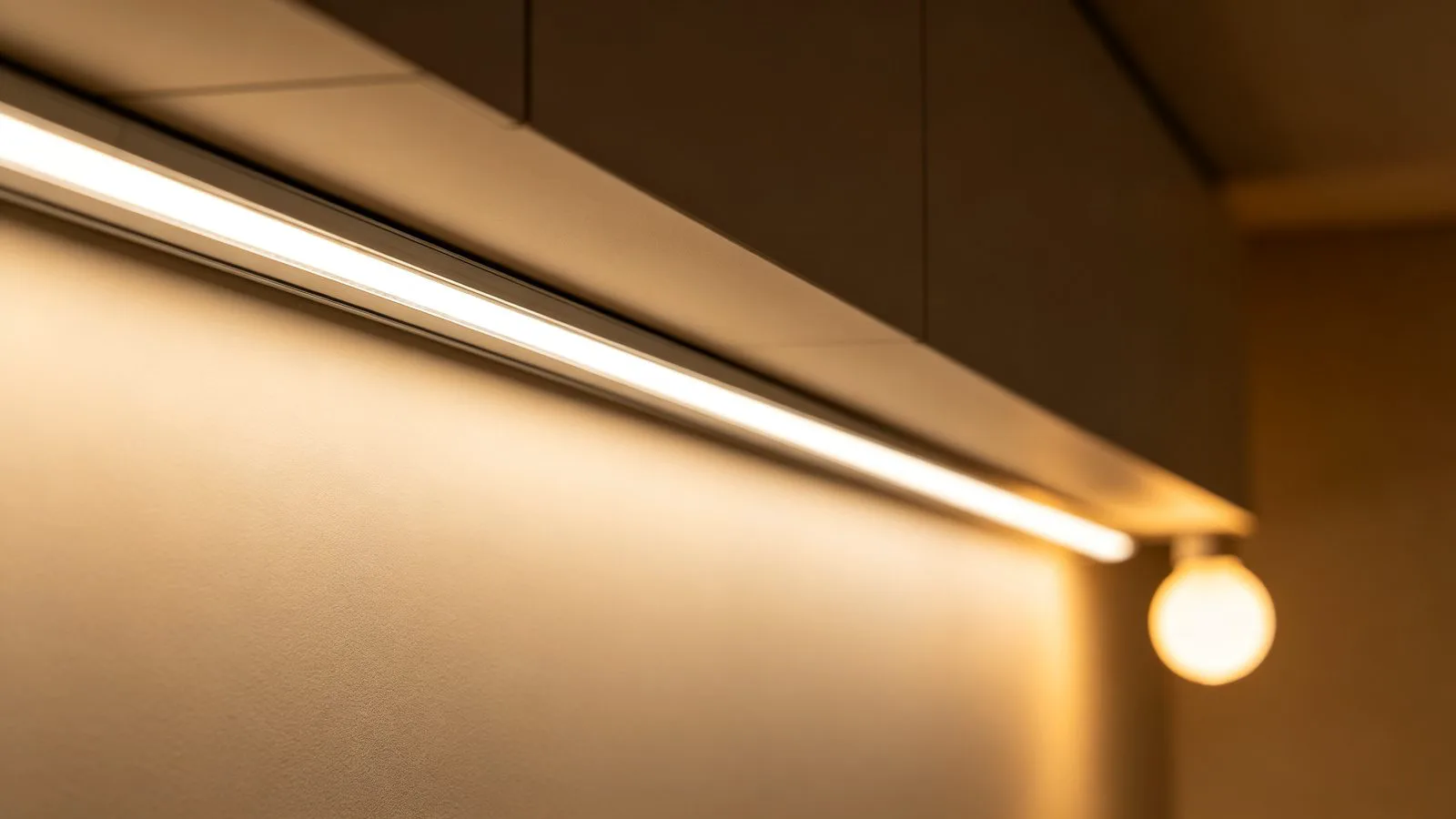
Lumens (luminous flux) count all the light a source emits in every direction. What you perceive as “brightness” on a wall is illuminance, measured in lux — how much of that light actually lands on one square meter. Most lamps sit in a fixture with a reflector that aims the beam, while a bare COB strip emits across a wide beam (often quoted as 170–180°, realistically closer to 140°). Same lumens, far less of it pointed at your wall.
A point source always looks brighter than the same lumens spread over 5 meters
Concentrate 1,600 lumens in one bulb and it is intense to look at. Spread the same 1,600 lumens along a 5-meter line and each meter emits a gentle, continuous glow. Your eye judges the concentrated source as “brighter” even though the total light is identical. A strip is meant to wash a surface evenly, not to stare into.
Dot-free COB is engineered to feel soft, which reads as “less intense”
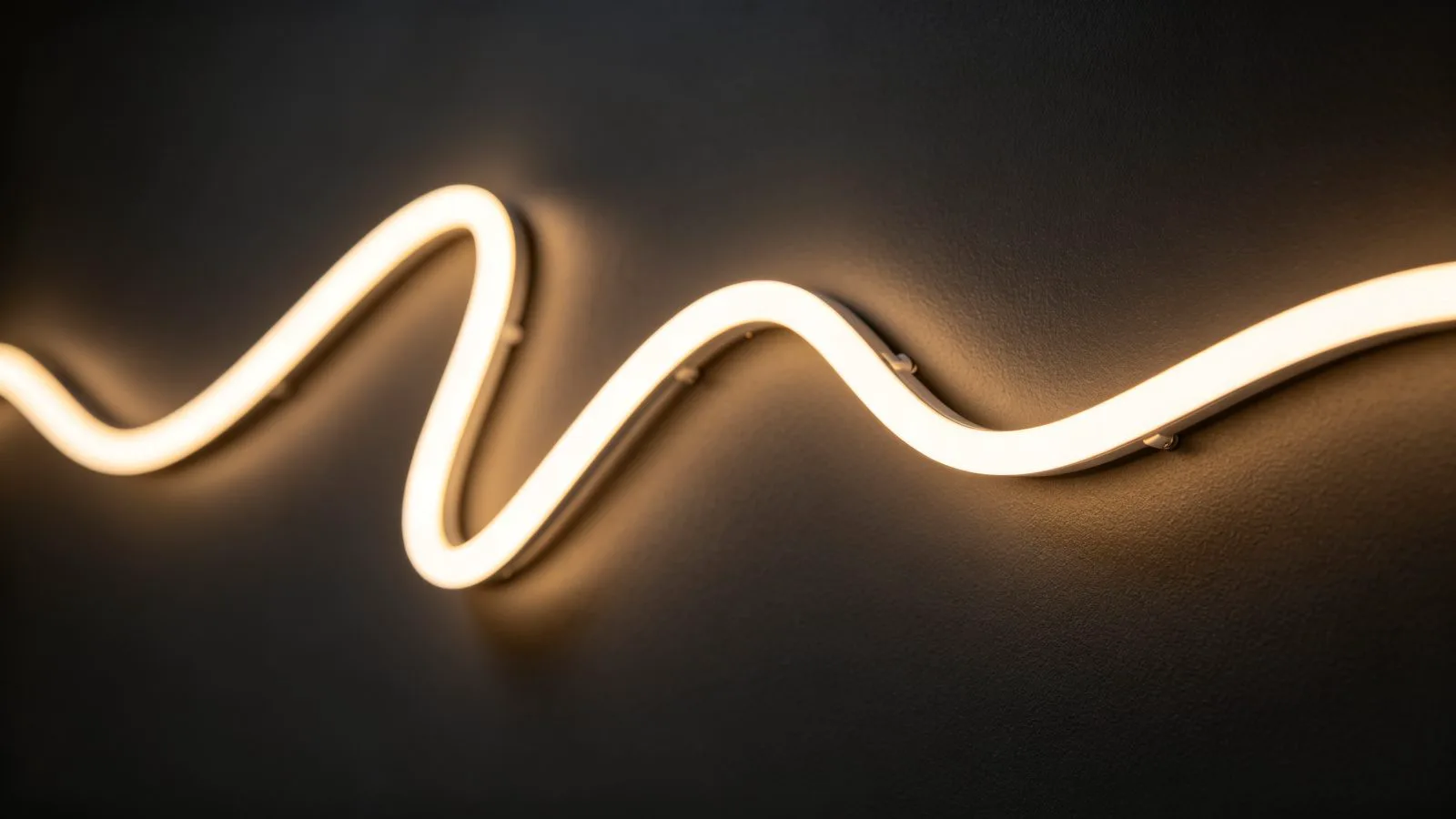
COB packs hundreds of chips under one continuous phosphor layer precisely so there are no hot spots and almost no glare. You can look straight at it comfortably. That glare-free, diffused quality is the goal — but compared with a bare, punchy bulb, our brains mistakenly label “comfortable” as “dim.”
- Same lumens ≠ same brightness on a surface: beam angle and reflectors decide where the light goes.
- A line source looks softer than a point source with identical total lumens.
- Glare-free COB is doing its job. Judge it on the lit surface, not by staring at the strip.
lm/W Is Not lm/m: The One Formula That Reveals Real Strip Brightness
The forum buyer’s second mix-up is the most common one in this industry. 95 lm/W is efficacy — how many lumens one watt produces. It is not how bright a meter of strip is. To get the number that actually matters, multiply by the power per meter:
Lumens per meter (lm/m) = Power per meter (W/m) × Efficacy (lm/W)
Total lumens for a run = lm/m × meters.
Worked example: a 10W/m strip at 120 lm/W = 1,200 lm/m. A 5m reel therefore emits about 6,000 lumens in total — far more than two 806-lumen lamps — but, as above, that light is spread along the line instead of being focused. Here is how real ArrayStar COB specifications translate into lm/m:
Real ArrayStar COB specifications. Approx. lm/m = W/m × lm/W; factory confirms final values by measurement.
| ArrayStar model | LEDs/m | Power (W/m) | Efficacy (lm/W) | Approx. lm/m | Best for |
|---|---|---|---|---|---|
| High-efficiency FCOB 320, 8mm | 320 | 8–10 | 120–140 | 960–1,400 | Efficient everyday cove/task |
| COB 384, 8mm | 384 | 10 | 90–100 | 900–1,000 | Value-friendly standard |
| COB 480, 8mm | 480 | 10 | 120 | ~1,200 | Best all-round balance |
| COB 480 CRI95, 10mm | 480 | 14.4 | 90–100 | 1,300–1,440 | Color-critical retail/art |
| COB 640, 10mm | 640 | 18 | 100–120 | 1,800–2,160 | High-output accents |
| Ultra-wide COB 1600, 30mm | 1,600 | 40 | 90 | ~3,600 | Maximum output, needs profile |
Notice that LED count alone does not predict brightness. An efficient 256-chip FCOB and an ordinary 384-chip COB can both land near 1,200 lm/m because efficacy and wattage differ. When comparing strips, the very first question to ask is “how many lumens per meter?” — not how many LEDs or how high the lm/W number looks.
Why Two “480-LED” COB Strips Don’t Have the Same Brightness
Spec sheets that both say “480 LEDs/m” can still produce very different amounts of light. Chip quality, color fidelity, waterproofing and system voltage all move the real lm/m number — and that is before you account for sellers who simply exaggerate.
Why identical-looking COB specifications deliver different lumens per meter.
| Factor | Effect on real lm/m | Example in our range |
|---|---|---|
| LED efficacy & bin | Better dies convert more watts into light | 120–140 lm/W FCOB vs 90–100 standard |
| High CRI | CRI 95 can cost ~10–15% in efficacy vs CRI 90 | CRI95 480 needs 14.4W/m for similar lm/m |
| IP / encapsulation | Solid silicone absorbs some light (~15–25%) | IP67 & 48V at 80–90 lm/W vs ~120 bare |
| System voltage | 48V trades a little efficacy for very long runs | 48V 480: 80–90 lm/W, up to 30m one feed |
| Over-driving | Cheap strips push current for headline numbers then fade | Runs hot; lm/m collapses within months |
| Inflated specs | No-name high lm/W often fails real testing | Ask for LM-79 report and measured W/m |
How to spot inflated lumen claims
- Ask for lumens per meter, not just a big lm/W figure.
- Request an LM-79 test report (and TM-21 for lifetime) from an independent lab.
- Order a sample and measure real power draw with a watt meter; W/m × lm/W should match the claimed lm/m.
- Be suspicious of exceptionally high efficacy at a rock-bottom price — and of strips that run very hot.
- Check that the datasheet is internally consistent (voltage, watts, lumens, current all agree).
If a strip seems impossibly bright for the price, the extra “lumens” usually come from over-driving the chips — overdriving that produces exactly the rapid discoloration and early failure buyers complain about.
How Many lm/m You Actually Need — and How to Make It Look Bright
There is no single “bright enough.” The right lm/m depends on the application, mounting distance, the reflectance of the surface and the beam angle. More lm/m is not always better — an over-bright under-cabinet strip simply causes glare.
Starting-point lumens-per-meter targets for common COB applications (confirm with a layout/lux calculation).
| Application | Typical target (lm/m) | What to watch |
|---|---|---|
| Under-cabinet / task | 500–900 | Mount close; avoid glare on shiny counters |
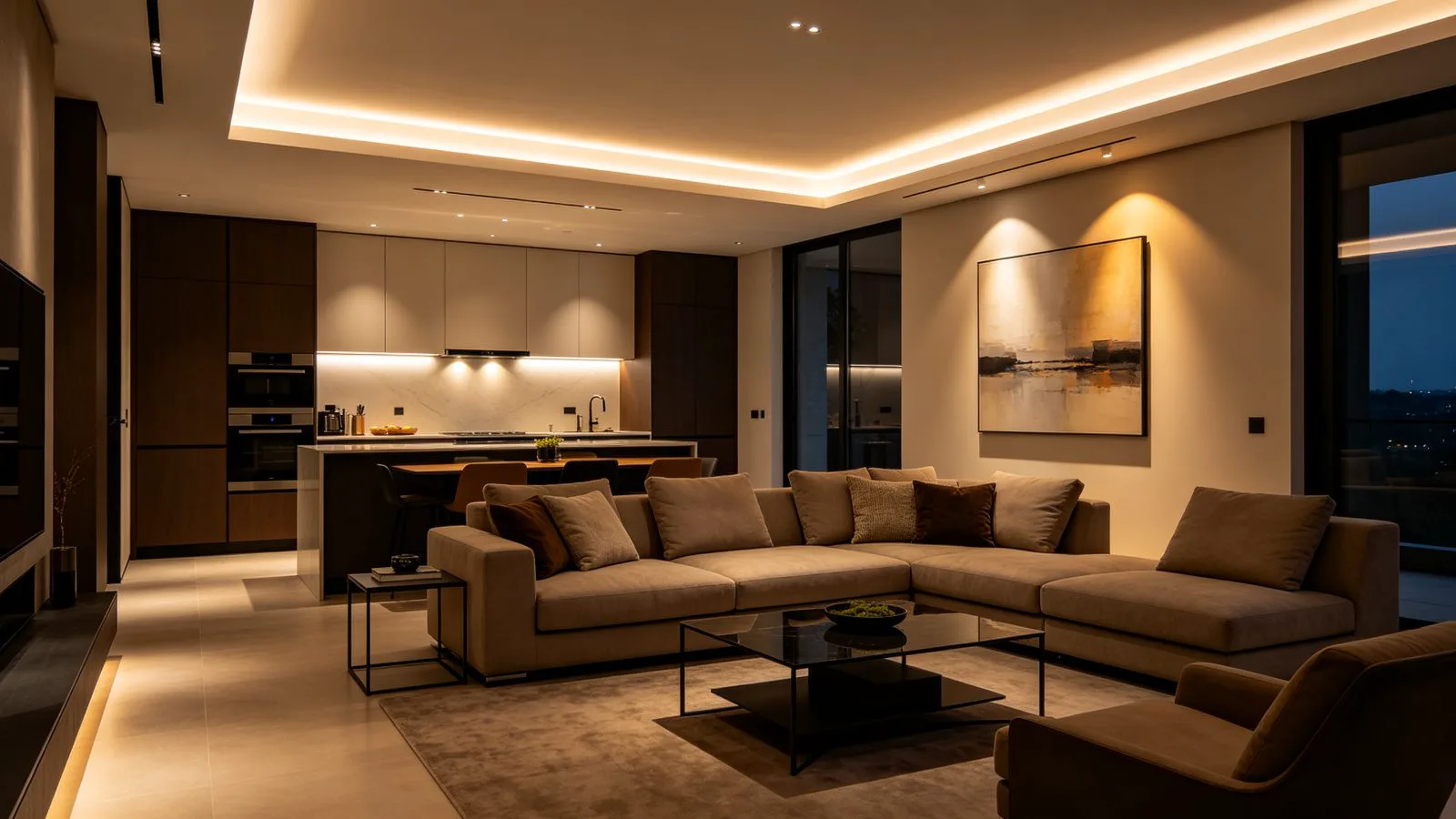
| Cove / indirect ambient | 300–700 | Heavily dependent on white, reflective surfaces |
| Shelf / display accent | 600–1,000 | Higher for jewelry, glass and dark interiors |
| Visible architectural line | 900–1,500 | Dot-free COB in a diffuser profile |
| High ceiling / commercial wash | 1,500–3,600 | Mandatory aluminum heatsinking; use 24/48V |
Make the light land where you want it
- Mount COB in an aluminum profile with the right diffuser — it finishes the dot-free look and acts as a heatsink.
- For indirect cove light, aim at a white, matte, reflective surface; a dark or wood ceiling soaks up output.
- For task lighting, mount close to the work plane and judge lux on the counter, not the strip itself.
- Anything above ~15W/m should be treated as high-output and requires aluminum heatsinking to hold its rated life.
- On long runs, use 24V or 48V and power injection so the far end does not dim.
One important distinction: if only the far end of your strip is dim or yellow, that is voltage drop, not a misleading lumen rating — it is fixed with thicker wire, dual-end feed or a higher-voltage strip. Use our LED Strip Power Calculator to size the driver and run length.
Recommended Products
Frequently Asked Questions
Are COB LED strips less bright than normal LED strips?
No. At the same wattage and quality, COB and SMD strips produce similar total lumens; COB simply blends the chips into one dot-free, diffused line that looks softer. Compare lumens per meter, not the number of visible dots. A 10W/m COB at 120 lm/W gives about 1,200 lm/m, which is ample for most indoor accent and task lighting.
Why does my LED strip look dimmer than a light bulb even though the lumens are similar?
Because lumens measure total light in all directions. A bulb in a reflector concentrates that light toward your wall or eye, while a strip spreads it across a wide beam over several meters. The same lumens as a focused point source will always look more intense than as a 5m line. Judge the lighting by illuminance (lux) on the surface, not by which source appears brighter.
What is the difference between lm/W and lumens per meter?
lm/W (efficacy) is how efficiently each watt becomes light; lumens per meter (lm/m) is how much light one meter of strip actually emits. Convert with lm/m = W/m × lm/W. For example a 95 lm/W strip at 9W/m is only about 855 lm/m. Always ask suppliers for lm/m, because lm/W alone tells you nothing about brightness without the wattage.
How many lumens per meter do I need for under-cabinet or cove lighting?
Rough starting points: under-cabinet task lighting 500–900 lm/m, indirect cove/ambient 300–700 lm/m, shelf and display 600–1,000 lm/m, visible architectural lines 900–1,500 lm/m, and high-ceiling or commercial washes 1,500–3,600 lm/m with mandatory aluminum heatsinking. The exact figure depends on mounting distance, surface reflectance and beam angle, so request a layout and lux calculation for your specific space.
How can I tell if LED strip lumen ratings are fake?
Ask for lumens per meter and an independent LM-79 test report rather than trusting a single large lm/W number. Order a sample, measure its real power draw with a watt meter, and check that W/m × lm/W matches the claimed lm/m. Compare color and brightness against a reputable strip. Suspiciously high efficacy at a very low price, missing test data, or a strip that runs hot usually indicate over-driving and inflated lumen claims.
Not sure how many lumens per meter your project needs?
Send us your dimensions, mounting height and surface color. Our engineers will recommend the right lm/m, voltage and aluminum profile, with free samples and a factory-direct quote within 24 hours.
Email: info@arraystarled.com | Phone: +86-0755-2103-6746 | WhatsApp: 0086 1581 8514 077
Need to size your power supply? Use our LED Strip Power Calculator to find the right driver in seconds.