How to Read an LED Strip Spec Sheet Without Being Misled
- 2026-09-19 13:17
- /
- Arraystar
A datasheet is only trustworthy if it states test conditions. When reading an LED strip spec sheet, focus on actual wattage and lumens per metre at the rated voltage/temperature (not LED-package claims), efficacy (lm/W), CCT and CRI with bin tolerance, beam/IP/CRI details, PCB and voltage-drop run length, dimming and lifetime L70/L80 at Tc — and cross-check whether figures are ‘per LED’, theoretical at 25 °C or measured on the finished strip. Missing conditions are a red flag.
Why Many Spec Sheets Mislead
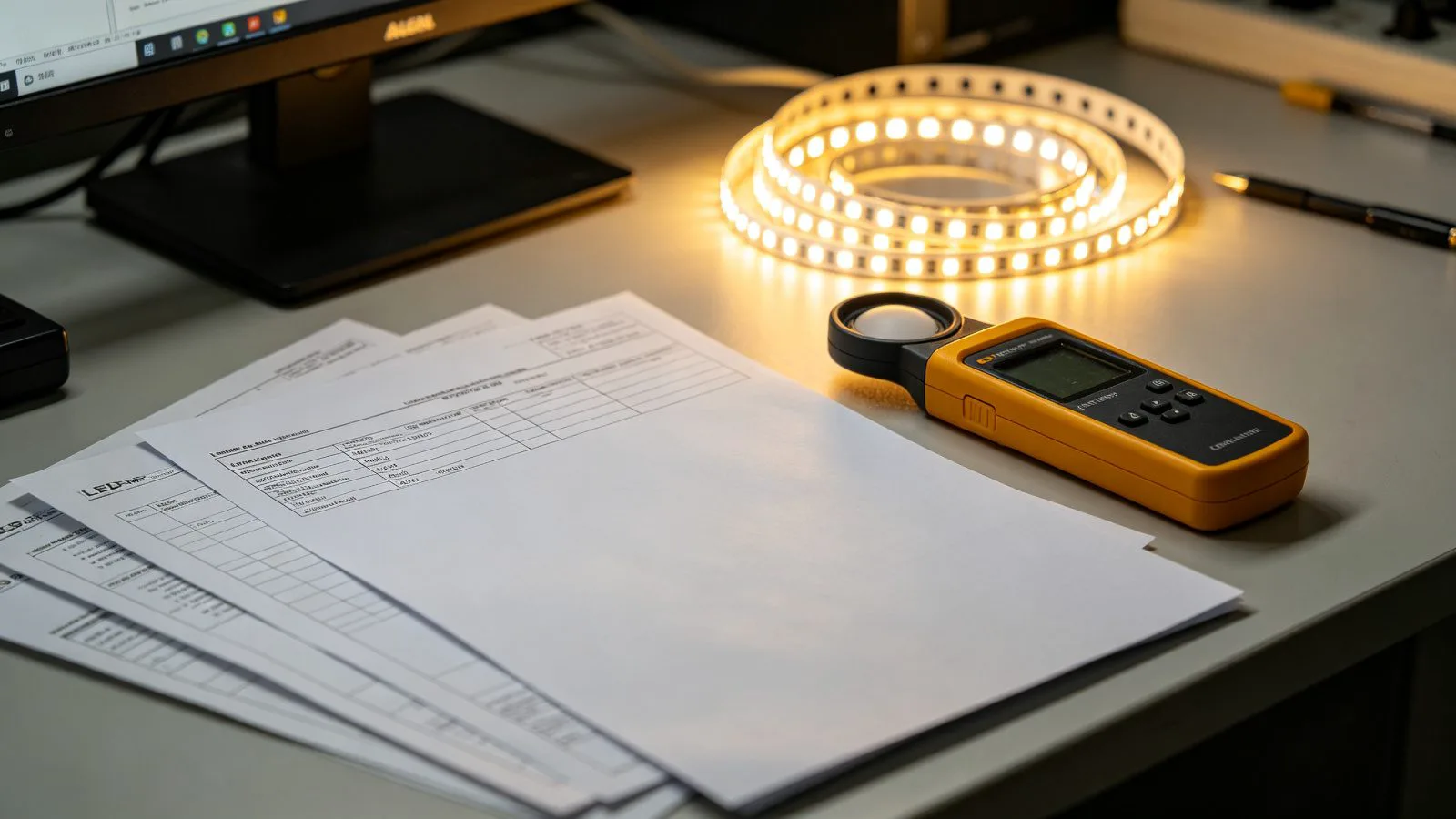
LED strip datasheets mix measurements taken at very different points: the LED manufacturer's chip/package datasheet (best-case component lumens at 25 °C junction temperature), theoretical strip calculations, and measurements on the actual finished reel at operating temperature. Because LEDs lose efficacy as they heat up and strip performance depends on PCB, drive current and optics, component numbers overstate the finished product. Two sheets that both say ‘high brightness’ can describe very different products. The skill is reading which conditions each number represents and demanding the finished-strip, thermal-equilibrium figures that predict real performance.
- Per-LED vs per-metre vs per-reel figures are not comparable.
- 25 °C component lumens overstate hot, installed strip output.
- Nominal vs actual wattage and tolerance (±%) matter for driver sizing.
- Colour without bin tolerance hides visible variance.
- Lifetime without Tc and L-level/B-level is not a meaningful rating.
Key Parameters and What They Should State
Critical datasheet fields and how to read them
| Parameter | Look for |
|---|---|
| LED count / type | LEDs/m, package (2835/COB), genuine chip brand/bin |
| Wattage | W/m actual at rated voltage ± tolerance |
| Lumens | lm/m measured on strip at operating temp |
| Efficacy | lm/W finished strip (higher = efficient/cooler) |
| CCT | Nominal K ± tolerance / SDCM bin |
| CRI | Ra (and R9/TM-30 if colour-critical) |
| Voltage / current | 12/24/48 V, A/m, max run before drop |
| PCB | Width, copper weight, material (for drop/heat) |
| IP / jacket | IP rating, material (epoxy/silicone/TPU) |
| Beam / CRI / dim | Beam angle, dimming type, flicker |
| Lifetime | L70/L80 hours at stated Tc, B-value |
| Dimensions / cut | Width/height, cut length, bend radius |
Spotting Red Flags and Gaps
- Lumens quoted from the LED package datasheet rather than the assembled strip — ask for finished-strip lm/m.
- No test temperature or Tc point, no wattage tolerance, no measurement standard.
- CRI stated as a bare number with no R9 for warm/high-colour products, or CCT with no bin/SDCM.
- Implausibly high efficacy or lifetime versus established class, or L70 with no Tc/B-value.
- No maximum run length / voltage-drop guidance, copper weight or thermal recommendation.
- IP rating with no jacket material or sealing detail; vague ‘waterproof’ claims.
- Missing genuine chip source, certifications, dimensions and dimming compatibility.
Weak vs credible datasheet language
| Weak / risky | Credible |
|---|---|
| ‘Super bright 1200 lm’ (per what?) | lm/m measured at Tc, with W/m and lm/W |
| ‘CRI 90+’ only | Ra with R9 and test report |
| ‘50,000 h life’ alone | L80 B50 at stated Tc per TM-21 |
| ‘Waterproof’ generic | IP67 solid silicone, sealed ends specified |
| No voltage-drop data | Max run length, copper weight, feed points |
| Chip brand unspecified | Genuine brand + bin + traceability |
How to Verify Before Bulk Order
- Request test reports and IES/photometric files for the exact SKU, not generic marketing sheets.
- Order samples and measure: W/m with a meter, lm/m in an integrating sphere or lab, CCT/CRI/SDCM, heat on the intended profile.
- Run a thermal/voltage-drop test at your real run length and profile (see our sample-testing guide).
- Compare apples to apples: same voltage, LEDs/m, CCT, CRI, IP and test temperature.
- Lock the agreed specification in the contract with tolerances and bin consistency across reels.
- Verify certifications and chip authenticity for premium projects.
Quick comparison template
| Column | Value to normalise |
|---|---|
| Output | lm/m finished strip at Tc |
| Power | Actual W/m ±% |
| Efficacy | lm/W |
| Colour | CCT ±K, SDCM, Ra/R9 |
| Run limit | Metres before defined drop % |
| Life | L80/B-value at Tc (hours) |
Our datasheets state finished-strip W/m, measured lm/m and lm/W at defined conditions, CCT/CRI with bin tolerance, copper/PCB details, voltage-drop run guidance, IP/jacket construction and L70/L80 at stated Tc, backed by test reports. Send us a competitor sheet and your application and we will help you compare like for like rather than marketing numbers.
Recommended Products
Frequently Asked Questions
Are the lumens on a strip datasheet per LED or per metre?
They can be either, which is why sheets mislead. LED-package lumens are best-case component values at 25 C; the number that predicts real performance is measured lumens per metre on the finished strip at operating temperature, alongside W/m and lm/W. Always confirm the basis and test temperature before comparing products.
What is a good efficacy for LED strip?
Compare finished-strip lm/W within the same CCT, CRI and IP class; higher efficacy means more light per watt, less heat and longer life. Very high CRI and waterproofing reduce efficacy somewhat, so compare like for like and distrust numbers far above the established class with no test report.
How do I check colour consistency from a datasheet?
Look for CCT with a tolerance (e.g. ±K) and an SDCM/MacAdam bin rating (tighter steps, e.g. 2–3 SDCM, are better for seamless runs), plus CRI Ra and R9. A sheet stating only a nominal CCT (e.g. 3000 K) with no bin control allows visibly mixed reels. Request bin consistency across the order.
What lifetime rating should I believe?
Believe an L-rating at a stated case temperature with a B-value, e.g. L80 B50 at a specified Tc, projected per TM-21 from LM-80 data. A bare '50,000 hours' with no L-level, Tc or B-value is not meaningful; hotter operation shortens real life, so the thermal condition is the key.
How do I know how long a strip run I can wire?
The sheet should give PCB width, copper weight, current per metre and either a maximum run length or enough data to calculate voltage drop; brighter/higher-current strip drops more, while 48 V and thicker copper allow longer runs. Verify with a real run test on the intended aluminum profile and add feed points per the guidance.
Comparing LED strip datasheets?
Our sheets give measured finished-strip lm/m, W/m and lm/W, bin tolerance, copper and voltage-drop guidance, IP construction and L70/L80 at stated Tc with test reports. Send a competitor sheet and your application for a like-for-like comparison.
Email: info@arraystarled.com | Phone: +86-0755-2103-6746 | WhatsApp: 0086 1581 8514 077
Need to size your power supply? Use our LED Strip Power Calculator to find the right driver in seconds.