LED Driver Power Factor & THD: What Commercial Projects Must Check
- 2026-09-19 12:27
- /
- Arraystar
For any project above roughly 300 W, specify LED strip drivers with PF ≥ 0.9 and THD ≤ 15% at 50–100% load, and verify it on a batch test sheet rather than the datasheet cover. Low-PF drivers inflate circuit current, overload neutrals and trip harmonic limits in commercial buildings — even though the strip itself looks identical.
What Power Factor and THD Actually Measure
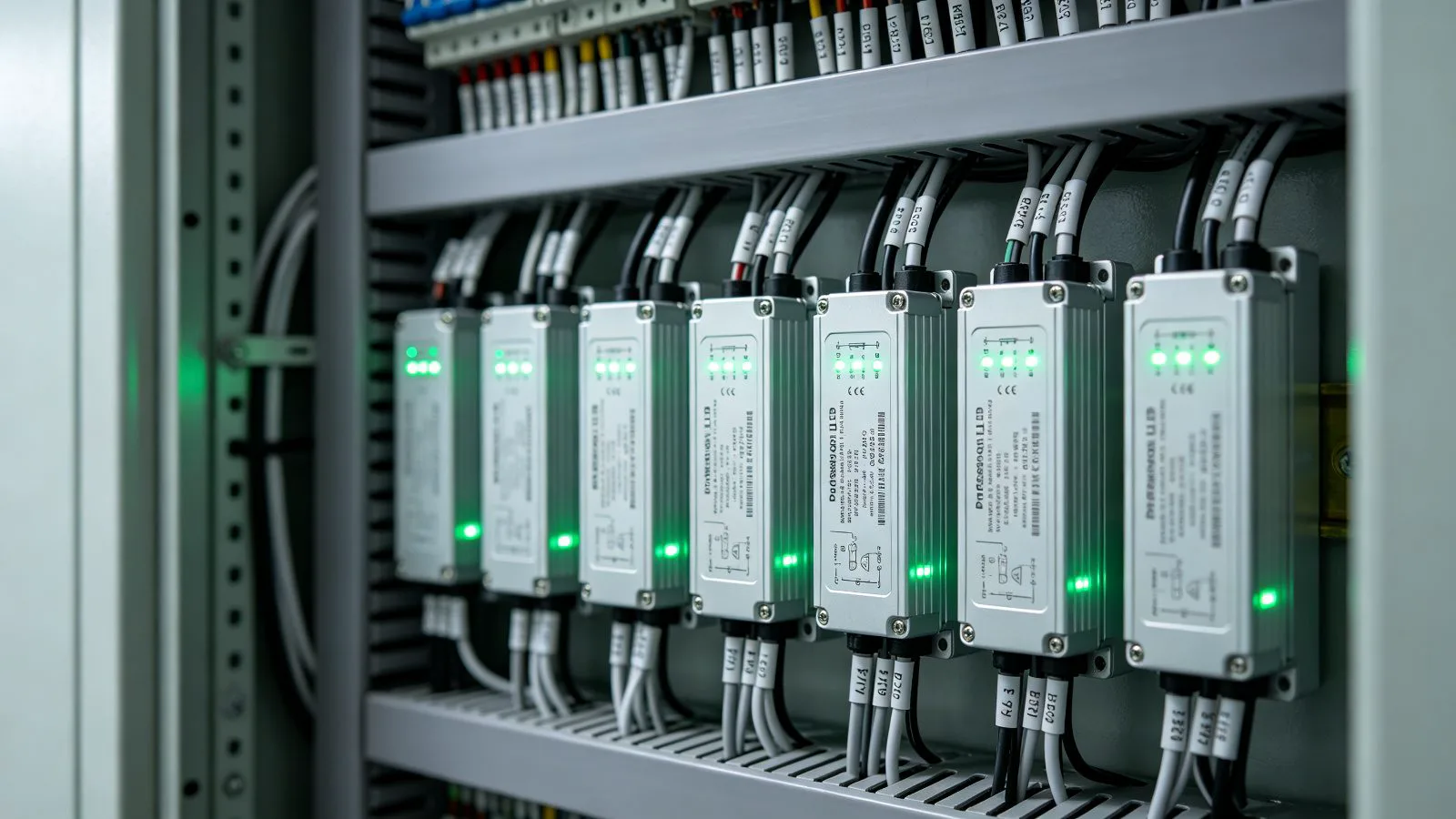
Power factor (PF) and total harmonic distortion (THD) describe the quality of the current a driver draws from the mains, not the brightness or efficiency of the LEDs. A strip can be beautifully bright while its driver pulls a distorted, out-of-phase current that the building's electrical system still has to carry.
Power factor is the ratio of real power (watts that do work) to apparent power (volts × amps). A purely resistive load has PF = 1.0. A simple capacitive or uncorrected LED driver can sit at PF 0.5–0.6, meaning it draws almost twice the current for the same useful wattage.
THD measures how much the current waveform deviates from a clean sine wave, expressed as a percentage. Cheap drivers using a simple capacitor dropper or a basic flyback without active correction can produce THD of 60–150%. That harmonic current flows mainly through the neutral conductor and overheats transformers, breakers and shared neutrals in three-phase installations.
Why the two numbers move together
An active power-factor-corrected (PFC) stage shapes the input current to follow the voltage sine wave, which simultaneously raises PF and lowers THD. That is why reputable drivers tend to show both good numbers at once — and why a driver that quotes high PF but stays silent on THD is usually hiding something.
Why Cheap Drivers Hide Poor Power Quality
The driver is the most common place factories cut cost, because it is the one component a customer cannot see once the strip is installed. A 150 W constant-voltage PSU from an anonymous maker can use a passive or no-PFC topology, under-rated electrolytic capacitors and minimal EMI filtering — then be relabelled with optimistic specifications.
Power-quality tiers commonly found on constant-voltage LED drivers
| Driver tier | Typical PF | Typical THD | Best for |
|---|---|---|---|
| Unbranded / budget | 0.50–0.70 | 40–150% | Short domestic runs, single small reels |
| Mid-range passive PFC | 0.80–0.90 | 20–40% | Small retail and residential projects |
| Active PFC (entry) | 0.90–0.95 | 10–20% | Most commercial installations |
| Active PFC (premium) | 0.95–0.99 | <10% | Hotels, offices, studios, MEP-specified jobs |
The trap is that PF and THD are quoted at full load and 25 °C. Run the same driver at 20% load — extremely common when installers over-size power supplies — and PF can collapse to 0.6 while THD climbs past 40%. The number on the label is a best case, not an operating guarantee.
How PF and THD Affect a Real Installation
In a single 5 m living-room cove the difference is invisible to the homeowner and irrelevant to the grid. It becomes expensive at scale. A hotel floor with 4 kW of low-PF strip can draw 60–80% more current than the lighting schedule assumes, forcing larger cable, breakers and transformers — or causing nuisance tripping and overheated neutrals after handover.
- Neutral overloading: triplen harmonics (3rd, 9th…) add algebraically in the neutral of a three-phase board, so the neutral can carry more current than any phase even when phases are balanced.
- Generator and UPS problems: high-THD loads confuse the voltage regulation and power-threshold logic on backup generators, causing waveform distortion or transfer failures.
- EMC and interference: a driver with no EMI filter can couple noise into audio, AV and network equipment nearby — a serious issue in bars, studios and conference rooms.
- Compliance failure: commercial MEP designs and many public tenders impose harmonic limits (for example IEC 61000-3-2 for equipment, or EN 50160 grid limits) that low-PF drivers cannot meet.
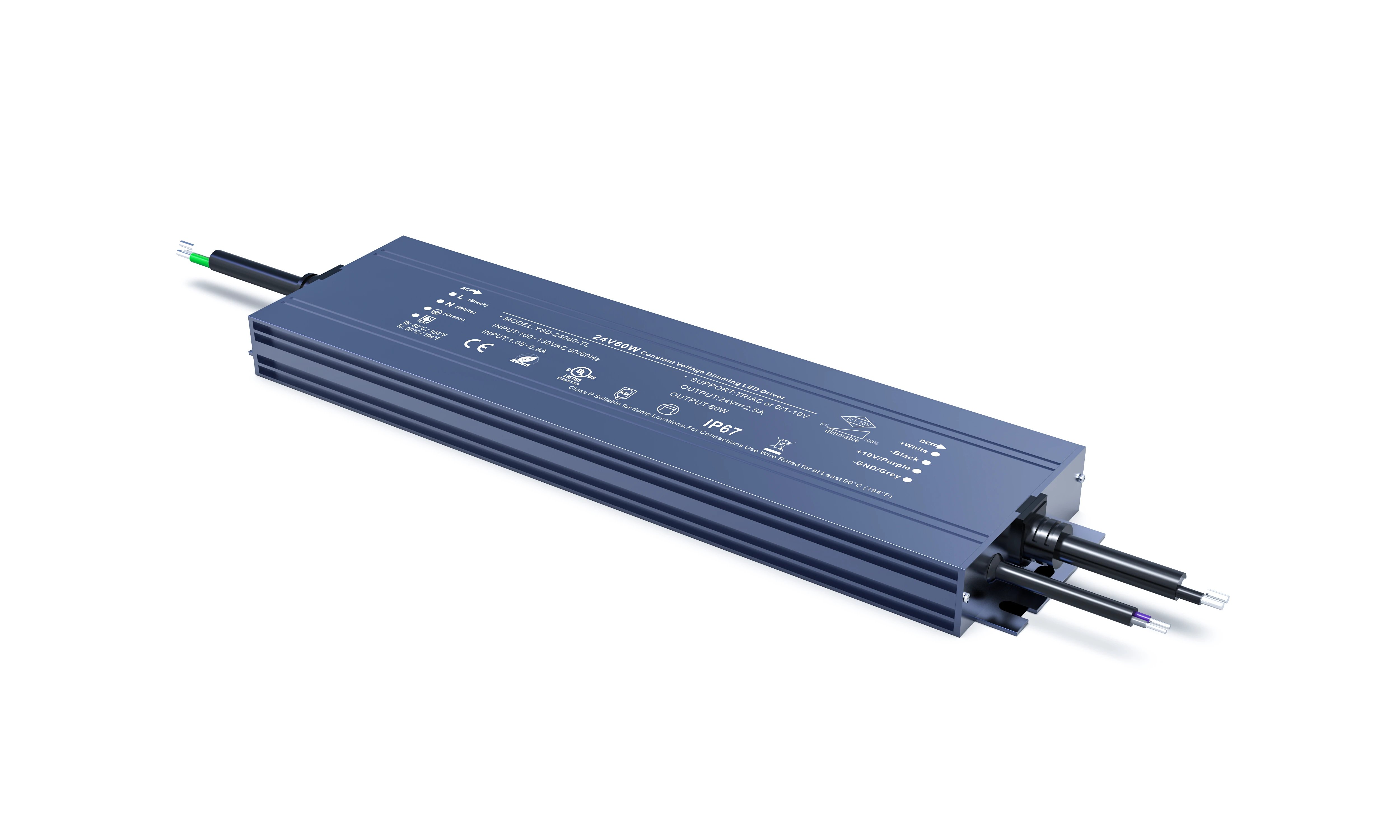
Load discipline matters as much as driver quality. The standard guidance is to load constant-voltage drivers between 50% and 90% — enough to keep the PFC stage in its efficient window, with 10–20% headroom for voltage drop and inrush. Running twenty metres of strip on a grossly oversized 600 W PSU wastes both money and power quality.
How to Specify and Verify PF and THD
A defensible specification ties the requirement to a load point and asks for evidence, not just a catalogue figure. The wording below is typical for commercial projects:
- Constant-voltage drivers shall have active PFC with PF ≥ 0.9 and THD ≤ 15% measured at 50%, 75% and 100% of rated load.
- Drivers shall carry CE/EMC and safety marks (EN 61347) and, where the tender requires, an independent test report to IEC 61000-3-2.
- Supplier shall provide a batch power-quality test sheet or allow a random witness test with a power-quality analyser.
- Do not exceed 80–85% of driver wattage in the lighting schedule to retain headroom.
What to require by project type
| Project | Minimum PF | Maximum THD | Verification |
|---|---|---|---|
| Home / small retail | 0.85 | <25% | Datasheet |
| Shop, restaurant, office | 0.90 | <15% | Batch test sheet |
| Hotel, studio, MEP-specified | 0.95 | <10% | Witness test + report |
| Generator / UPS-backed | 0.90 | <12% | Test on the actual generator |
A handheld power-quality meter or a bench analyser on one driver per carton takes seconds and separates compliant stock from relabelled budget units. As a factory, we run every driver batch at multiple load points and supply the readings on request — if a supplier cannot or will not do the same, treat their PF claim as marketing rather than engineering.
Recommended Products
Frequently Asked Questions
Does a higher power factor make the strip brighter?
No. PF affects the current drawn from the wall and the stress on the building's wiring, not the light output. Two strips can deliver identical lumens while one has PF 0.6 and the other PF 0.95; the difference is entirely in driver quality and circuit load.
What is a good THD value for LED strip drivers?
For commercial work, target THD ≤ 15% with active PFC; premium and MEP-specified projects often require under 10%. Values above 30–40% indicate a basic driver that can overload neutrals and fail harmonic limits in large installations.
Why does PF get worse when I dim or under-load the driver?
PFC stages are tuned for the driver's normal operating band. At very low load — typically below 20–30% — the control loop has little current to shape, so PF falls and THD rises. This is why drivers should be sized to run mostly above 50% load rather than grossly oversized.
Can I mix high-PF and low-PF drivers on the same circuit?
They will operate, but the low-PF units set the circuit's worst-case current and harmonics, so you lose most of the benefit. For commercial circuits, standardise on active-PFC drivers across the whole run and keep total continuous load under 80% of the circuit and driver rating.
Do I need a power-quality analyser on site?
Not for every job. For small projects a datasheet plus a reputable driver is enough; for tenders with harmonic limits or generator backup, request a batch test sheet and, if the value justifies it, witness-test one driver per batch at several load points with a power-quality analyser.
Need drivers that meet MEP harmonic limits?
Tell us your total wattage, input voltage and dimming protocol. We supply active-PFC constant-voltage drivers (PF ≥ 0.95, THD <10%) with batch power-quality test sheets and matched COB or SMD strip.
Email: info@arraystarled.com | Phone: +86-0755-2103-6746 | WhatsApp: 0086 1581 8514 077
Need to size your power supply? Use our LED Strip Power Calculator to find the right driver in seconds.