LED Strip BOM Cost Breakdown: Why Quotes Vary by 30% or More
- 2026-09-19 13:17
- /
- Arraystar
Two ‘identical’ strip quotes rarely describe the same product. Price is driven by a clear bill of materials: LED chip grade and bin, PCB copper and material, resistors and current design, solder and build quality, encapsulation/IP rating, adhesive, drivers and accessories, testing/aging, packaging and certification — plus service. Understanding the BOM lets you compare like for like, spot where a cheap quote cut corners, and decide which trade-offs are safe for your application rather than paying for specs you do not need.
What Makes Up the Cost of LED Strip
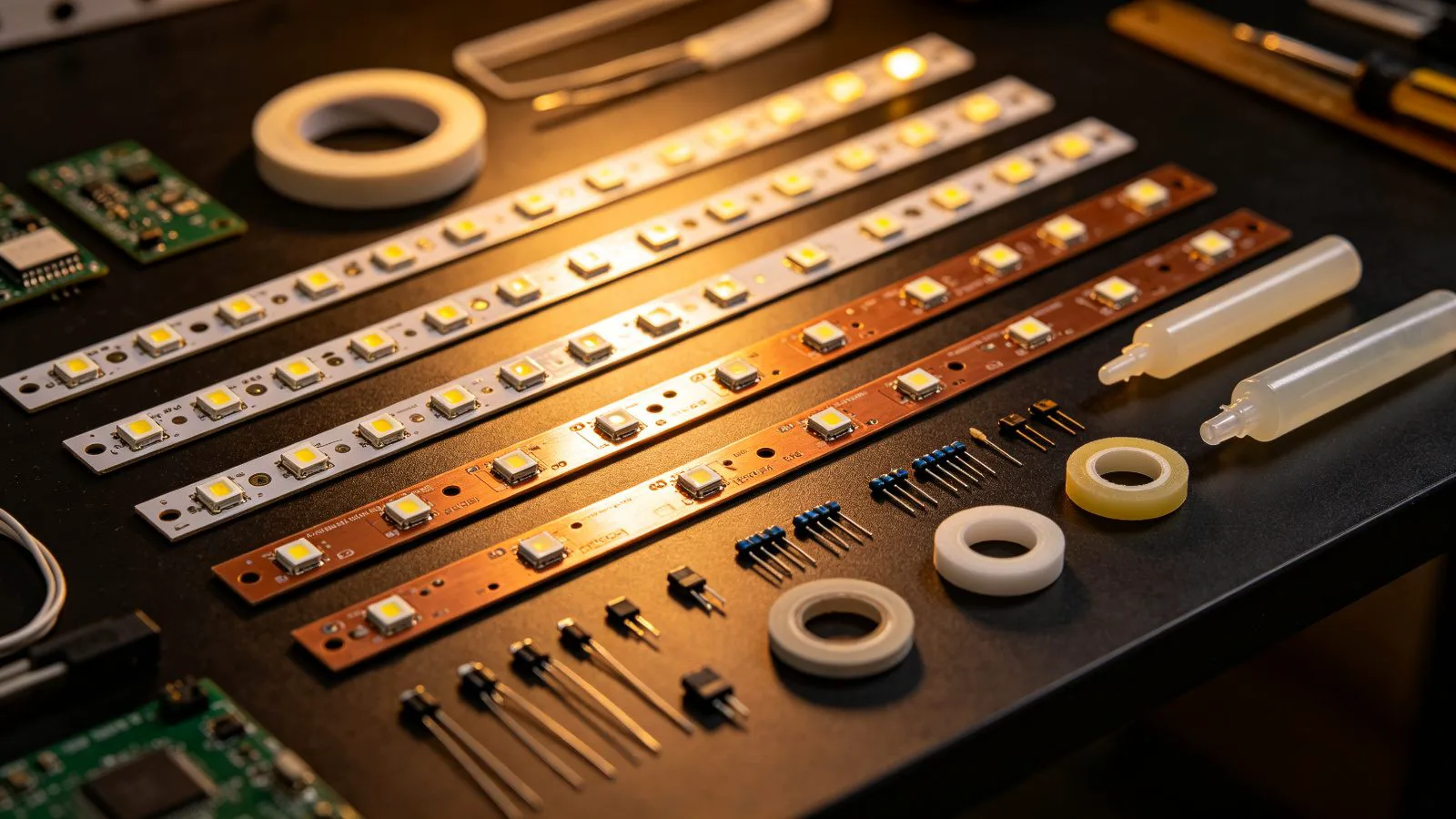
A metre of LED strip is a small assembled electronic product, and its cost stacks up from components that vary enormously in grade. The LED packages themselves are the single largest variable and set the ceiling for efficacy, colour and life; the printed circuit board carries current and dissipates heat; current-limiting resistors or constant-current design set stability; encapsulation determines IP rating and UV/chemical resistance; adhesive and backing determine whether the strip stays up; and drivers, connectors, testing, packaging and compliance documentation complete the landed product. Factories compete on choices at every line, which is why a 12 W/m 24 V strip can be offered at several price points that look the same on a one-line quote.
- LED packages: brand, efficacy bin, CRI bin — the biggest quality lever.
- PCB: copper weight (1 vs 2/3 oz), width, aluminium vs FPC, solder mask.
- Current design: resistor quality, constant-current ICs, drive current (life vs brightness).
- Encapsulation/IP: bare, epoxy, silicone extrusion, TPU/IP68 — material and labour.
- Adhesive/backing: cheap foam tape vs branded high-tack VHB-type tape.
- Overheads: drivers/accessories, aging/test, QC, packaging, certification, service.
Component-by-Component Cost Levers
Where cheap vs premium strip differs
| BOM item | Low-cost choice | Premium choice / benefit |
|---|---|---|
| LED chip | Generic/re-binned die | Branded binned die: efficacy, CRI, LM-80, life |
| PCB copper | Thin (e.g. 1 oz), narrow | 2/3 oz, wider: less drop, cooler, longer life |
| Drive design | Max current for brightness | Conservative current: cooler, longer L80 |
| Resistors/ICs | Cheap tolerances | Quality/tight tolerance, constant-current |
| Encapsulation | Thin epoxy/yellowing | Solid silicone/TPU, UV-resistant, true IP |
| Adhesive | Generic foam tape | Branded high-tack tape, primer-ready |
| Solder/build | Minimal QC, cold joints | Controlled reflow, AOI, aging, clean joints |
| Testing/docs | Little/no data | LM-80, photometric, RoHS, batch records |
Why the Same Spec Shows Different Prices
- LED bin selection: within a brand, high-efficacy/high-CRI/tight-SDCM bins cost more; cheap quotes use lower bins or generic dies.
- Drive current: pushing cheap LEDs hard gives high nominal lumens at low cost but short life and colour shift — brightness bought by sacrificing longevity.
- Copper and PCB: thinner copper is cheaper per metre but causes voltage drop and heat, the root of many field failures.
- IP/encapsulation material: genuine solid-silicone extrusion or IP68 TPU costs far more than a thin epoxy coat that yellows or peels.
- Adhesive and accessories: branded tape, proper connectors and quality drivers are often quietly downgraded.
- Testing, certification and service: LM-80/photometric data, RoHS/energy files, aging lines, warranties and technical support all carry cost that rock-bottom quotes omit.
- Scale and relationship: volume, repeat orders and Incoterms legitimately move price too.
Questions that expose an unrealistically low quote
| Ask | Reveals |
|---|---|
| Exact LED brand/part/bin? | Chip grade substitution |
| Copper weight and PCB width? | Voltage-drop/heat corner-cut |
| Measured W/m and lm/W? | Over-driving for brightness |
| IP construction/material? | Real vs claimed waterproofing |
| Adhesive brand/type? | Likely field de-lamination |
| LM-80/test data & warranty? | Whether life claims are backed |
Buying Smart: Matching BOM to the Job
- Do not over-spec: short-life, dry, indoor, accessible installs can use mid-grade strip safely; don't pay for IP68 and premium bins in a bedroom cove.
- Do not under-spec: long-run, commercial, outdoor, high-temperature or hard-to-access projects cannot afford thin copper, cheap chips or weak adhesive.
- Compare quotes on a written common specification (chip, bin, copper, W/m, lm/W, CRI/SDCM, IP material, adhesive, driver) so prices are comparable.
- Price the system: strip plus correct drivers, profiles, connectors and controls, not just the reel.
- Validate with samples and batch data (see our sample-testing and spec-sheet guides) before bulk.
- Treat a credible factory's transparency and consistency as part of the value.
We quote against an explicit BOM — chip brand/bin, copper weight, measured W/m and lm/W, encapsulation material, adhesive and included accessories — so you can see what you are paying for and compare fairly. Send us competing specifications and we will explain the differences line by line and recommend the grade that matches the application's real demands.
Recommended Products
Frequently Asked Questions
Why are LED strip prices so different for the same wattage?
Because wattage alone omits the cost drivers: LED chip brand and bin, PCB copper weight, drive current, encapsulation/IP material, adhesive, build quality, testing and certification. A cheap strip can match nominal watts while using generic over-driven chips, thin copper, poor waterproofing and weak tape, producing more heat, shorter life and colour shift. Compare a written BOM, not a one-line spec.
What is the most expensive component in LED strip?
The LED packages are usually the largest single variable cost and the main determinant of efficacy, colour quality and life, which is why chip substitution is the most common corner-cut. The PCB, encapsulation (especially high IP) and adhesive are the next meaningful variables, along with drivers and testing in the complete system.
Is it worth paying more for thicker copper PCB?
For long runs, high-density/high-wattage strip, commercial and hard-to-access installs, yes: 2 oz (or 3 oz) copper reduces voltage drop and thermal resistance, keeping brightness even and the strip cool, which directly extends life. For short, low-power, accessible indoor runs, standard copper may be perfectly adequate — match it to run length and wattage (see our PCB copper guide).
Do cheaper LED strips really fail earlier?
Often, because they use lower-bin or generic chips driven hard, thin PCBs that run hot, and weaker encapsulation/adhesive — the combination accelerates lumen depreciation and colour shift and raises failure risk. Some fail in warranty, more degrade noticeably within a year or two in demanding use. The failure is usually gradual and appears after installation, when replacement is expensive.
How do I compare LED strip quotes fairly?
Issue a common written specification covering exact LED brand/part/bin, copper weight and PCB width, measured W/m and lm/W, CCT/CRI/SDCM, IP construction and material, adhesive brand, driver/accessories included, test data (LM-80/photometric) and warranty terms — then compare price against that identical BOM and validate the chosen option with samples and batch data.
Comparing LED strip quotations?
We quote against an explicit BOM with chip brand/bin, copper weight, measured W/m and lm/W, encapsulation and adhesive details, plus test data. Send competing specs and we will explain the differences and match the grade to your application.
Email: info@arraystarled.com | Phone: +86-0755-2103-6746 | WhatsApp: 0086 1581 8514 077
Need to size your power supply? Use our LED Strip Power Calculator to find the right driver in seconds.