1616 Long-Run Neon: 16×16mm, 12W/m, Bend-Limit Guide
- 2026-11-06 16:15
- /
- Arraystar LED
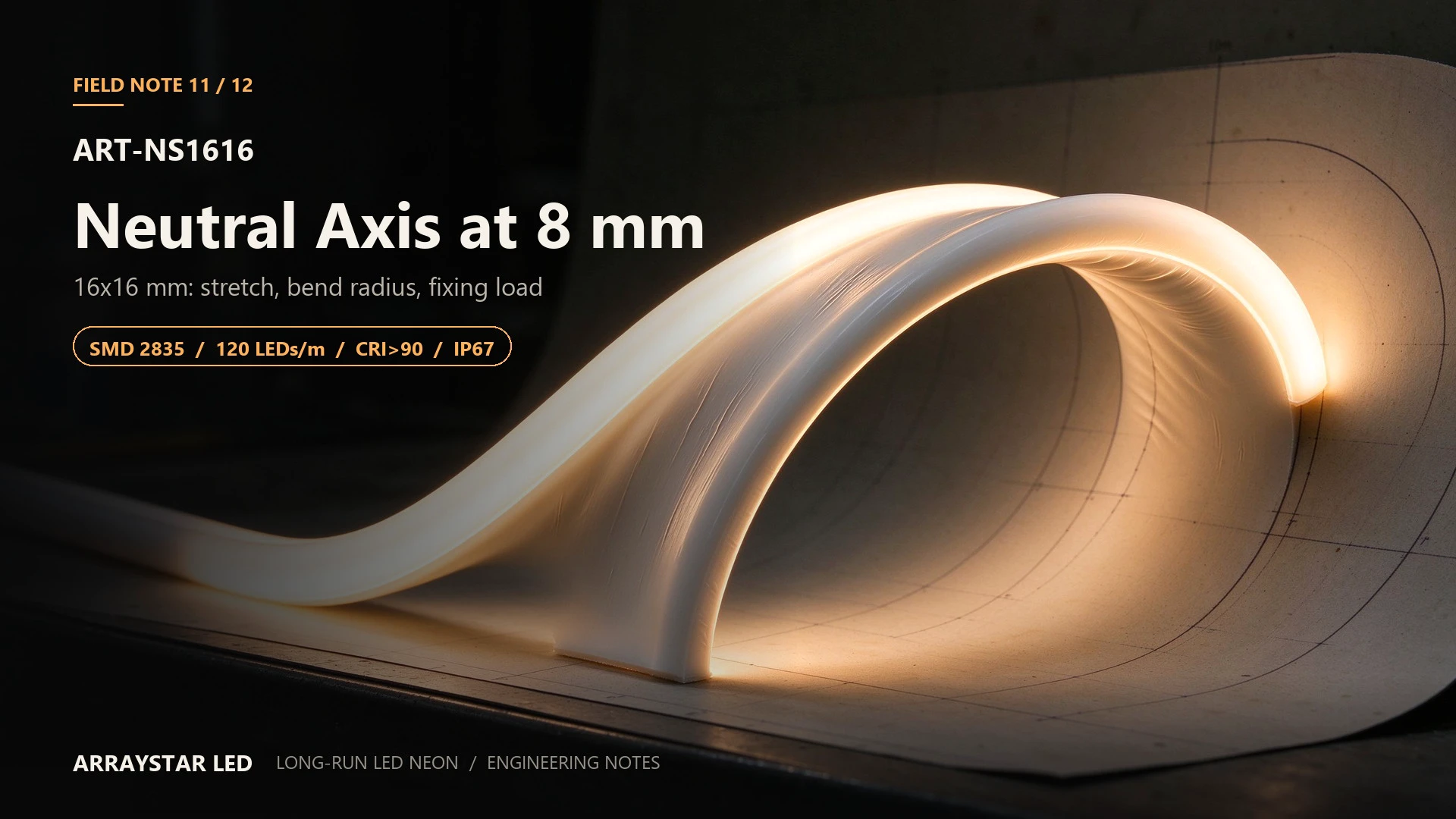
The outer wall goes pale first. A 16 × 16 mm body is pulled around a 300 mm arc, the silicone on the outside of the bend thins, and the surface that was smooth at handover develops a chalky band that later becomes a crack. The inner wall looks compressed but intact. The failure is on the side taking the stretch.
A 16 × 16 mm profile is the large square body in the Long Run range. It is chosen for scale: a bigger section reads at distance, holds more thermal mass, and tolerates rougher site handling. The same wall thickness that makes it robust in a straight run makes it less tolerant of a tight bend.
1. Bend geometry: why a large square section is less forgiving
At a bend, the material on the outside of the neutral axis is stretched and the material inside is compressed. The amount of stretch is proportional to the distance from the neutral axis divided by the bend radius. For a square section, the outer wall sits at half the section depth from the neutral axis.
- A 12 × 12 body has 6 mm from neutral axis to outer wall.
- A 16 × 16 body has 8 mm — one third more.
For the same bend radius, the 16 mm body stretches its outer wall about one third more than the 12 mm body. That is why a radius that works on a 1212 detail will fail on a 1616 detail, even though both are "silicone neon."
Field rule: size the bend radius from the 16 mm section, not from the project's standard detail. Confirm the batch minimum before templating.
2. What the large section buys
| Property | 12 × 12 | 16 × 16 | Site effect |
|---|---|---|---|
| Emitting face | 12 mm | 16 mm | Wider, softer line |
| Perimeter | 48 mm | 64 mm | Better heat path |
| Wall thickness | Thinner | Thicker | More clamp tolerance |
| Neutral-axis offset | 6 mm | 8 mm | Larger minimum radius |
| Weight per metre | Lower | Higher | More fixing load |
The optical result is a line that reads wider and softer than a 12 mm body at the same 12 W/m. If the design wants a substantial neon element rather than a fine architectural edge, this is the correct body. If it wants a crisp 12 mm line, the extra 4 mm is a liability.
3. Optical: 16 mm face over an 8.33 mm pitch
120 × SMD 2835 per metre at 8.33 mm pitch behind a 16 mm diffused face. The face is almost twice the pitch, which is why this body is the most forgiving in the range for dot-free output.
- Viewing distance: continuous from about 120 mm outward — close enough for interior details.
- Line width: reads at roughly 16–18 mm at close range, widening with distance.
- Colour: 1800 / 2700 / 3000 / 4000 / 6000 K, CRI >90. The wide face blends a bin step better than any narrower body, but keep adjacent rolls in the same lot.
4. Electrical: 12 W/m, 24 V and 36 V
| Supply | Current per metre | 5 m segment | 10 m load |
|---|---|---|---|
| 24 V | 0.500 A/m | 2.50 A / 60 W | 120 W / 5.0 A |
| 36 V | 0.333 A/m | 1.67 A / 60 W | 120 W / 3.3 A |
The larger section does not change the electrical limit: 5 m per feed at 24 V, 0.75 mm² conductor minimum, driver at total wattage plus 20–25 % headroom. The 36 V variant reduces current by one third and extends the practical interval.
Cut at marked points: 50 mm, six LEDs.
Feed drop at the segment current (5 m out + 5 m back):
| Conductor | Loop resistance | Drop at the segment | % of supply |
|---|---|---|---|
| 0.50 mm² | 0.37 Ω | 0.93 V | 3.9 % |
| 0.75 mm² | 0.25 Ω | 0.63 V | 2.6 % |
| 1.00 mm² | 0.18 Ω | 0.45 V | 1.9 % |
Use 0.75 mm² as the floor; step up to 1.00 mm² where the driver sits more than 5 m from the first tap.
5. Thermal: the large body runs cooler
A 16 × 16 section has 64 mm of perimeter at 12 W/m. Expect roughly 10–14 K rise above ambient in free air, lower against a metal channel. The thicker wall also spreads a local hot spot before it reaches the diffuser, so clip banding is less visible than on a 12 mm body.
The thermal advantage disappears if the body is buried. A 16 mm section in a sealed 20 mm slot has enough room for an air gap — use it, and vent the ends.
6. Fixing a heavier body
A 16 × 16 body weighs more per metre than a 12 × 12, and a long vertical run puts that weight on the clips.
- Clips: 200 mm on straights, 150 mm on vertical runs, 100 mm through bends.
- Channel: continuous, fixed to the substrate at 300–400 mm; the channel carries the body, the clips locate it.
- Vertical runs: add a mechanical retainer at the base and every third clip.
- Expansion: leave an allowance at the ends of a long aluminium channel; do not pin the body at both ends.
7. Commissioning checks
| Check | Method | Pass criterion |
|---|---|---|
| Outer wall at bends | Visual at grazing angle, 24 h after forming | No chalky band, no crack |
| Line at distance | View from design distance | No bow, no clip shadow |
| Feed drop | Head and tail under load | ≤ 3 % of supply |
| Surface temperature | IR probe after 60 min | ≤ 45 °C in still air |
| End seal | Visual + continuity | Potted, off the water plane |
8. Engineering FAQ
Can a 16 × 16 body make a 300 mm radius corner?
Only if the published minimum for the batch is at or below 300 mm. The 16 mm section stretches its outer wall about one third more than a 12 mm body at the same radius, so a detail that works on 1212 is not automatically valid here. Confirm the datasheet before forming.
What is the difference between the 1616 and the 1220?
Both are 12 W/m and read as substantial lines. The 1616 is a square 16 mm section with a 16 mm face; the 1220 is 12 mm face with 20 mm depth. The 1616 gives a wider, softer line; the 1220 gives a deeper, more structural body with a narrower lit face.
Is 36 V worth it on a 20 m run of 1616?
Yes, where the driver is remote or the run would need more than two 24 V taps. The lower current reduces feed drop. Confirm the 36 V model and driver before designing the segment map.
9. Specification summary
| Parameter | Value |
|---|---|
| Model | ART-NS1616 |
| Cross-section | 16 × 16 mm |
| LED | SMD 2835, 120 LEDs/m |
| Input | 24 V DC / 36 V DC |
| Power | 12 W/m |
| CRI | >90 |
| Colour | 1800 / 2700 / 3000 / 4000 / 6000 K |
| Cut unit | 50 mm (6 LEDs) |
| Warranty | 3 years |
Bending a large section? Send the radius, the run length, and the mounting height. We will confirm whether the section can take the curve, or whether the detail needs a different body.