1225 Long-Run Neon: 12×25mm, 12W/m, Deep-Body Fixing
- 2026-11-06 16:15
- /
- Arraystar LED
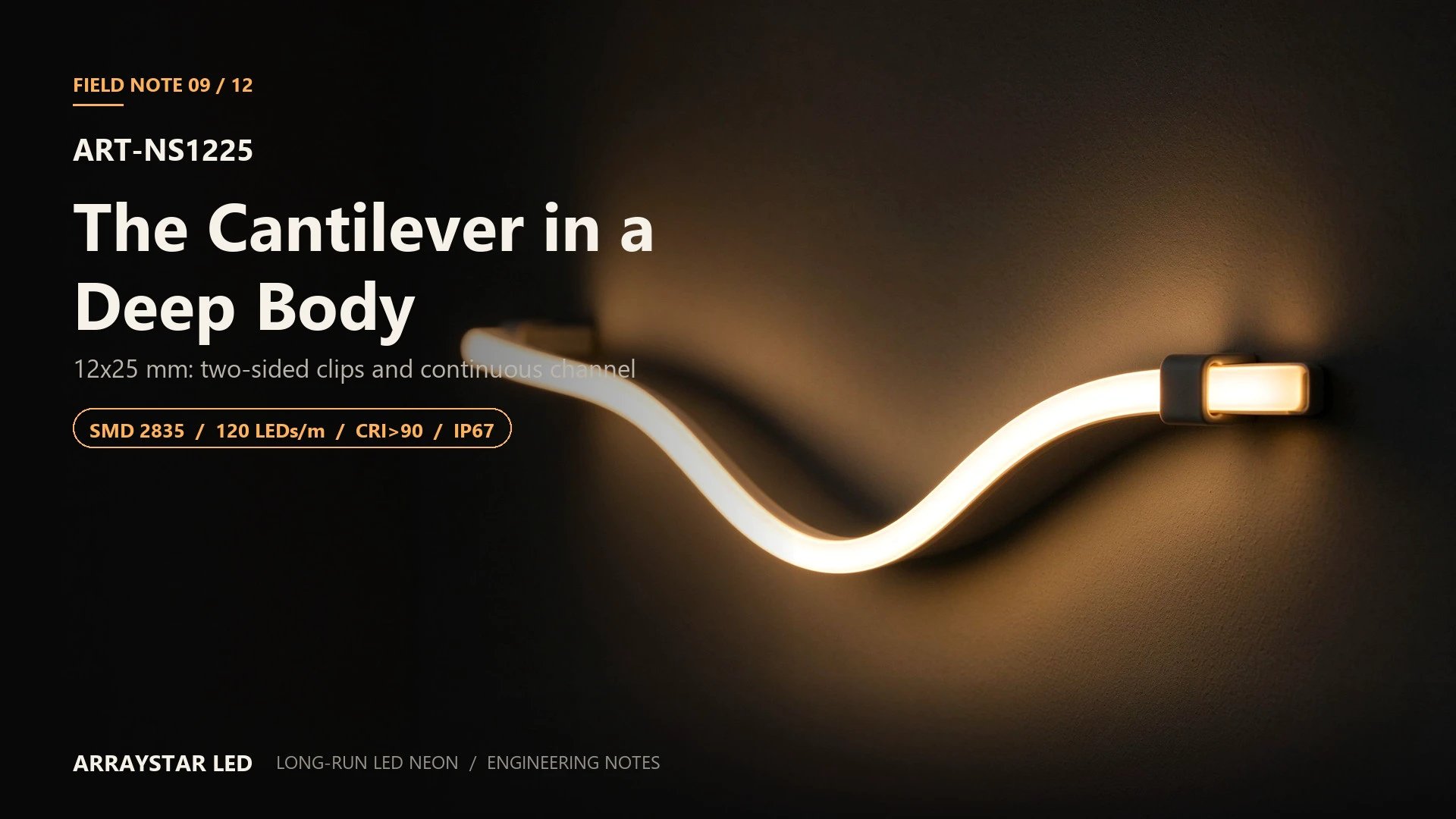
The body twists in the slot before it ever fails electrically. A 12 × 25 mm section is 25 mm deep and only 12 mm wide, so a clip that bears on one face holds it like a cantilever. Under thermal cycling the free side walks, the diffuser turns a few degrees off the wall, and the line that was straight at handover reads as a wave from the other side of the street.
A 12 × 25 mm profile is the deepest body in the Long Run range. It is built for large-scale outlines — bridge parapets, tower edges, long façade bands — where the body must hold a straight line over tens of metres and survive weather. The depth is a structural advantage only if the fixing engages the full section.
1. Where a deep, narrow body goes wrong
| Failure | Root cause | What you see |
|---|---|---|
| Line waves along the run | Single-sided clip on a 25 mm cantilever | Lateral bow, visible at distance |
| Diffuser rotates off-axis | Clip bears on one face only | One edge of the line brighter |
| Crease at a bend | Bend radius sized for a 12 × 12 body | Inner wall fold |
| Water at a joint | Joint on a horizontal run, cap under load | Condensation at the tail |
All four are fixing problems. The body is not too deep; the detail was designed for a shallower profile.
2. Optical: a 12 mm face with 25 mm of depth behind it
120 × SMD 2835 per metre at 8.33 mm pitch behind a 12 mm diffused face gives a continuous line from about 150 mm outward — the same optical behaviour as the 12 × 12 and 12 × 20 bodies.
What changes is the aperture. With 25 mm of depth, the emitting face sits further back from the opening. In a reveal:
- Flush or near-flush: the line reads normally, with a soft edge.
- Set back more than 15 mm: the side walls begin to cut the beam; the line narrows and the surface beside it falls into shadow.
- Seen at an angle: the deep body shows a visible side wall, which reads as a dark band beside the lit face.
That side wall is the reason this body belongs on a large-scale outline, not in a 15 mm interior reveal. At 30 m, the side wall is invisible. At 300 mm, it is the detail.
Colour range 1800 / 2700 / 3000 / 4000 / 6000 K, CRI >90.
3. The fixing detail that holds a 25 mm section
The clip must engage both side walls of the body, not one. Three rules:
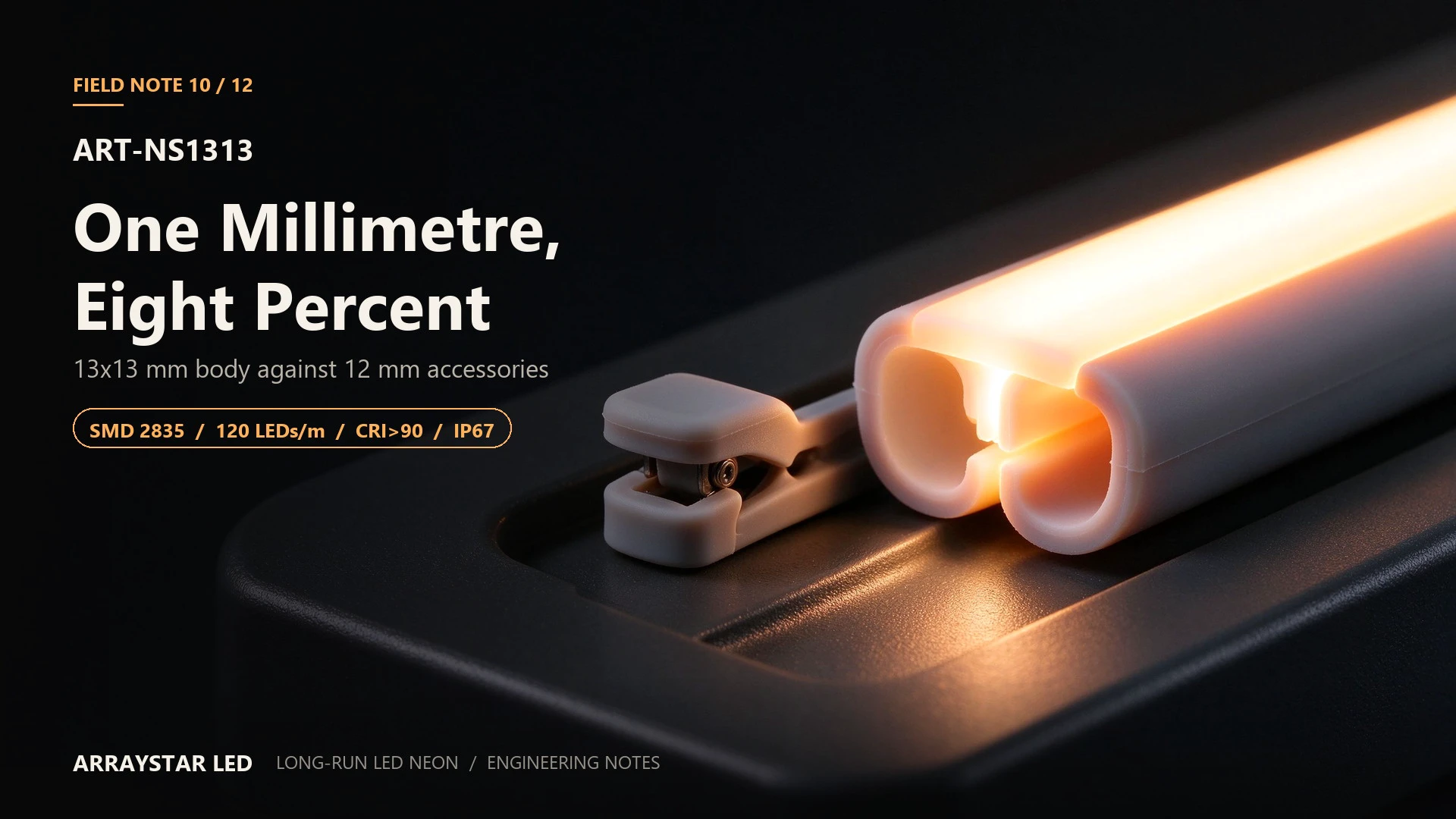
1. Two-sided clips, sized to the 12 × 25 section. A 12 × 12 clip will close on the face and leave the depth unsupported.
2. Clip spacing 200 mm on straights, 150 mm on exposed elevations, plus a clip at every tangent. The cantilever length between clips is what allows the wave.
3. Continuous channel, not intermittent blocks. The channel takes the straight line; the clips hold the body in the channel.
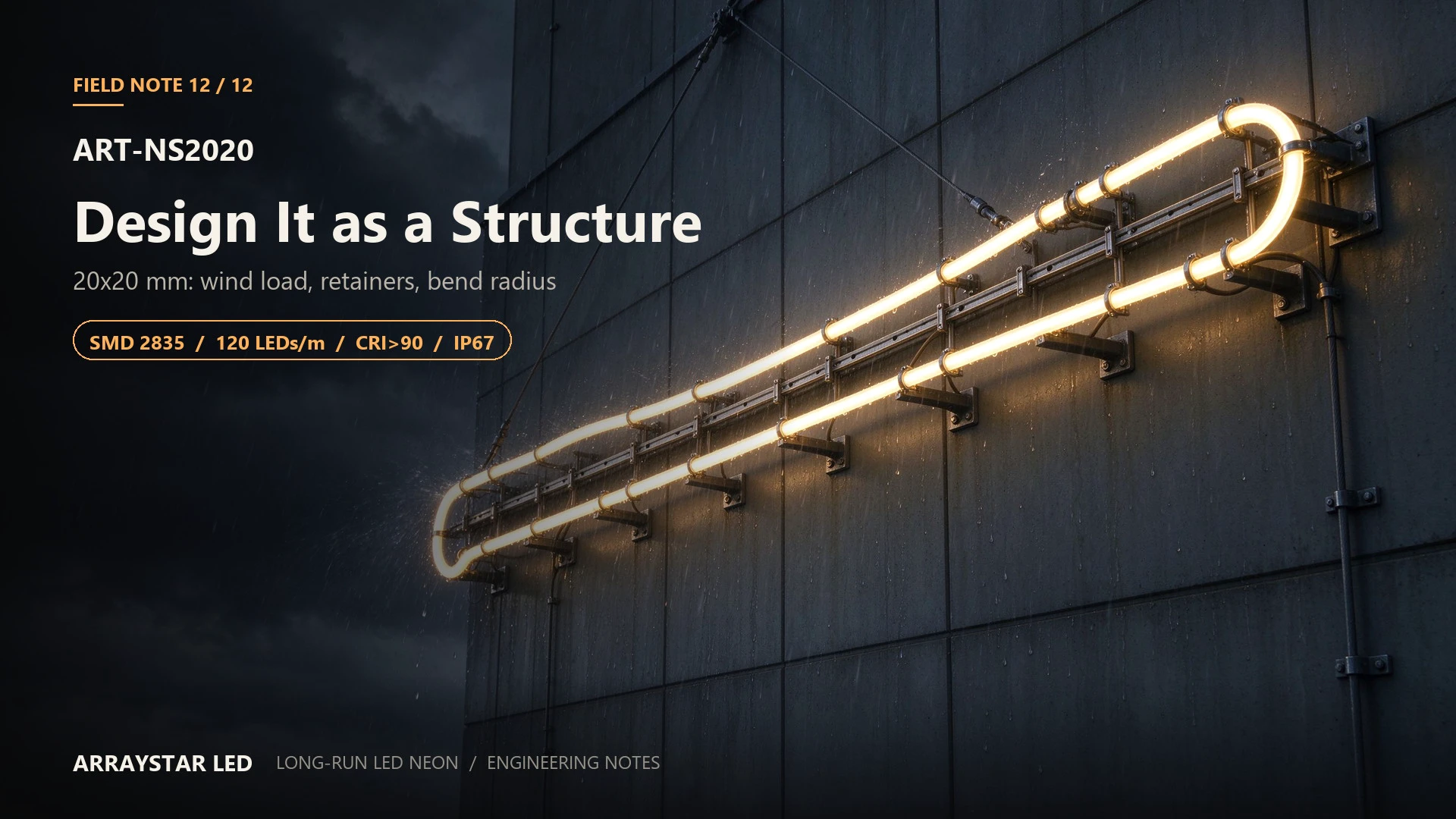
Where the body runs vertically on a façade, add a retainer at the base and at every third clip. A 25 mm body carries more wind moment than a 12 mm body, and the clips see it as a peel load.
4. Electrical: 12 W/m, 24 V and 36 V
| Supply | Current per metre | 5 m segment | 10 m load |
|---|---|---|---|
| 24 V | 0.500 A/m | 2.50 A / 60 W | 120 W / 5.0 A |
| 36 V | 0.333 A/m | 1.67 A / 60 W | 120 W / 3.3 A |
The electrical rules are the same as any 24 V long run: 5 m per feed as the default, 0.75 mm² conductor as the floor, driver at total wattage plus 20–25 % headroom. The 36 V option reduces current by one third and extends the practical interval; confirm the exact model before designing around it.
Cut at marked points: 50 mm, six LEDs.
Feed drop at the segment current (5 m out + 5 m back):
| Conductor | Loop resistance | Drop at the segment | % of supply |
|---|---|---|---|
| 0.50 mm² | 0.37 Ω | 0.93 V | 3.9 % |
| 0.75 mm² | 0.25 Ω | 0.63 V | 2.6 % |
| 1.00 mm² | 0.18 Ω | 0.45 V | 1.9 % |
Use 0.75 mm² as the floor; step up to 1.00 mm² where the driver sits more than 5 m from the first tap.
5. Thermal: the best perimeter in the range
A 12 × 25 section has 74 mm of perimeter, the highest in the Long Run range at 12 W/m. Expect roughly 9–13 K rise above ambient in free air, lower against a metal channel.
The deep body is also the easiest to ventilate: there is room behind it for an air gap, and room at the ends for convection. Use that. A deep body packed into a sealed slot gives away its thermal advantage.
6. Bending and sealing a deep section
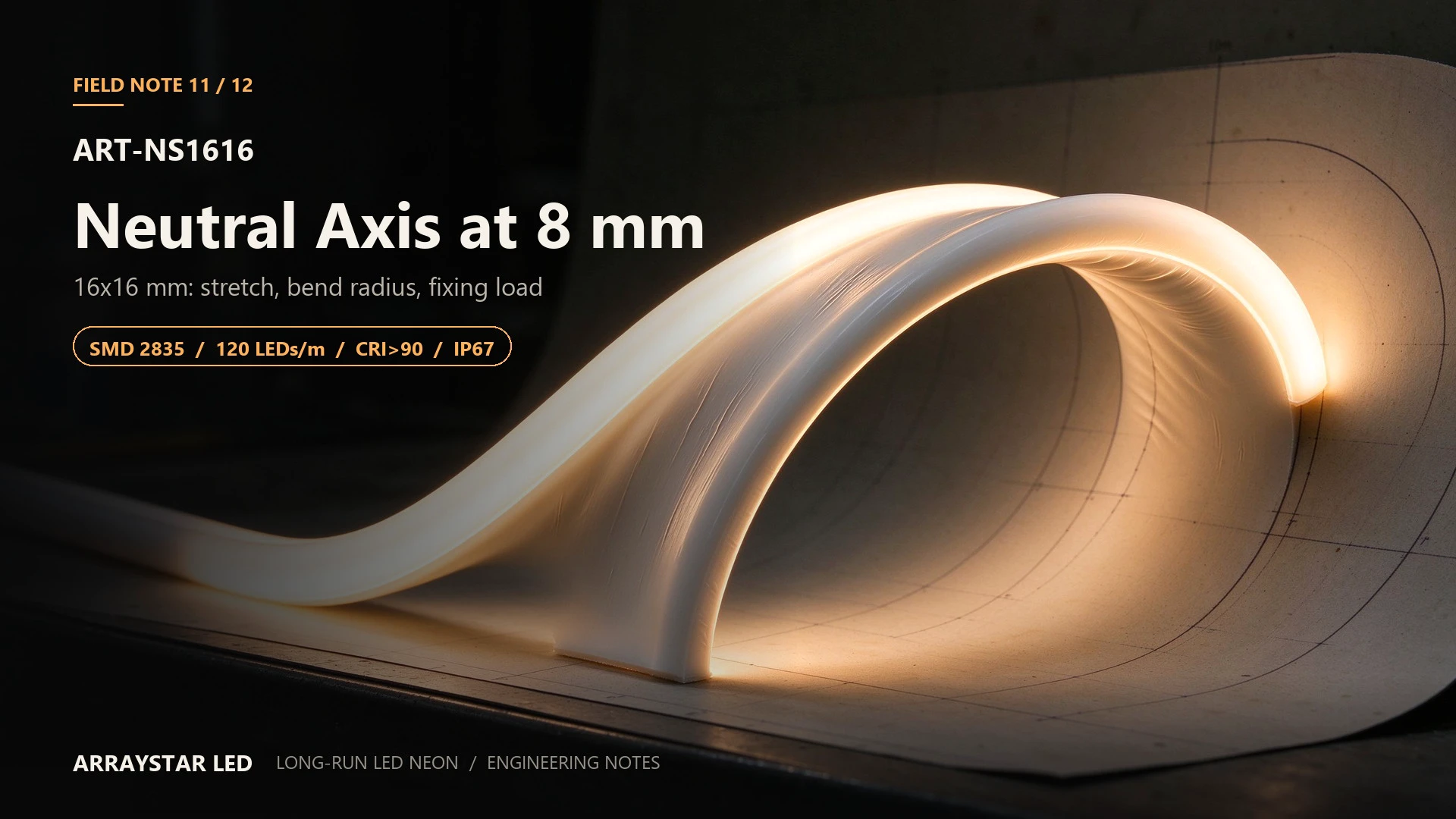
- Bend radius: the neutral axis of a 25 mm deep section sits further from the emitting face than a 12 mm body. The minimum radius is correspondingly larger. Do not template a 1225 corner from a 1212 detail.
- Bend plane: form in the designed plane on a jig; the depth makes a twist failure much more likely.
- Sealing: moulded cap sized for the section, potted joint, joint on a vertical face and at the high end of the run.
- Movement: leave an expansion allowance at both ends of a long channel run; do not pin the body at both ends.
7. Commissioning checks
| Check | Method | Pass criterion |
|---|---|---|
| Straightness | Sight along the run from 10 m | No visible wave or bow |
| Diffuser alignment | View perpendicular at 2 m | Face square to the wall, no dark side band |
| Feed drop | Head and tail under load | ≤ 3 % of supply |
| Surface temperature | IR probe after 60 min | ≤ 45 °C in still air |
| End seal | Visual + continuity | Potted, off the water plane |
8. Engineering FAQ
What is the difference between the 1220 and the 1225?
Both are 12 mm face, 12 W/m deep bodies. The 1225 is 25 mm deep against 20 mm, with more perimeter and a larger minimum bend radius. Choose the 1225 where the body must hold a straight line over a long span or carry more wind; choose the 1220 where the reveal is tighter.
Can I use a 12 × 12 clip on this body?
No. A clip sized for 12 × 12 closes on the face and leaves the 25 mm depth unsupported, which is exactly how a cantilever wave starts. Use a two-sided clip sized for the section.
Is a deep body suitable for a tight architectural reveal?
No. At 25 mm depth, the body needs an opening that lets the face sit near the surface. In a 15 mm reveal it reads as a recessed slot with a dark side wall. Use the 1212 or 1220 for tighter details.
9. Specification summary
| Parameter | Value |
|---|---|
| Model | ART-NS1225 |
| Cross-section | 12 × 25 mm |
| LED | SMD 2835, 120 LEDs/m |
| Input | 24 V DC / 36 V DC |
| Power | 12 W/m |
| CRI | >90 |
| Colour | 1800 / 2700 / 3000 / 4000 / 6000 K |
| Cut unit | 50 mm (6 LEDs) |
| Warranty | 3 years |
Running a large-scale outline? Send the span, the exposure, and the reveal section. We will return a two-sided clip schedule and a bend radius that suits the depth.