2020 Long-Run Neon: 20×20mm, 12W/m, Structural Fixing
- 2026-11-06 16:15
- /
- Arraystar LED
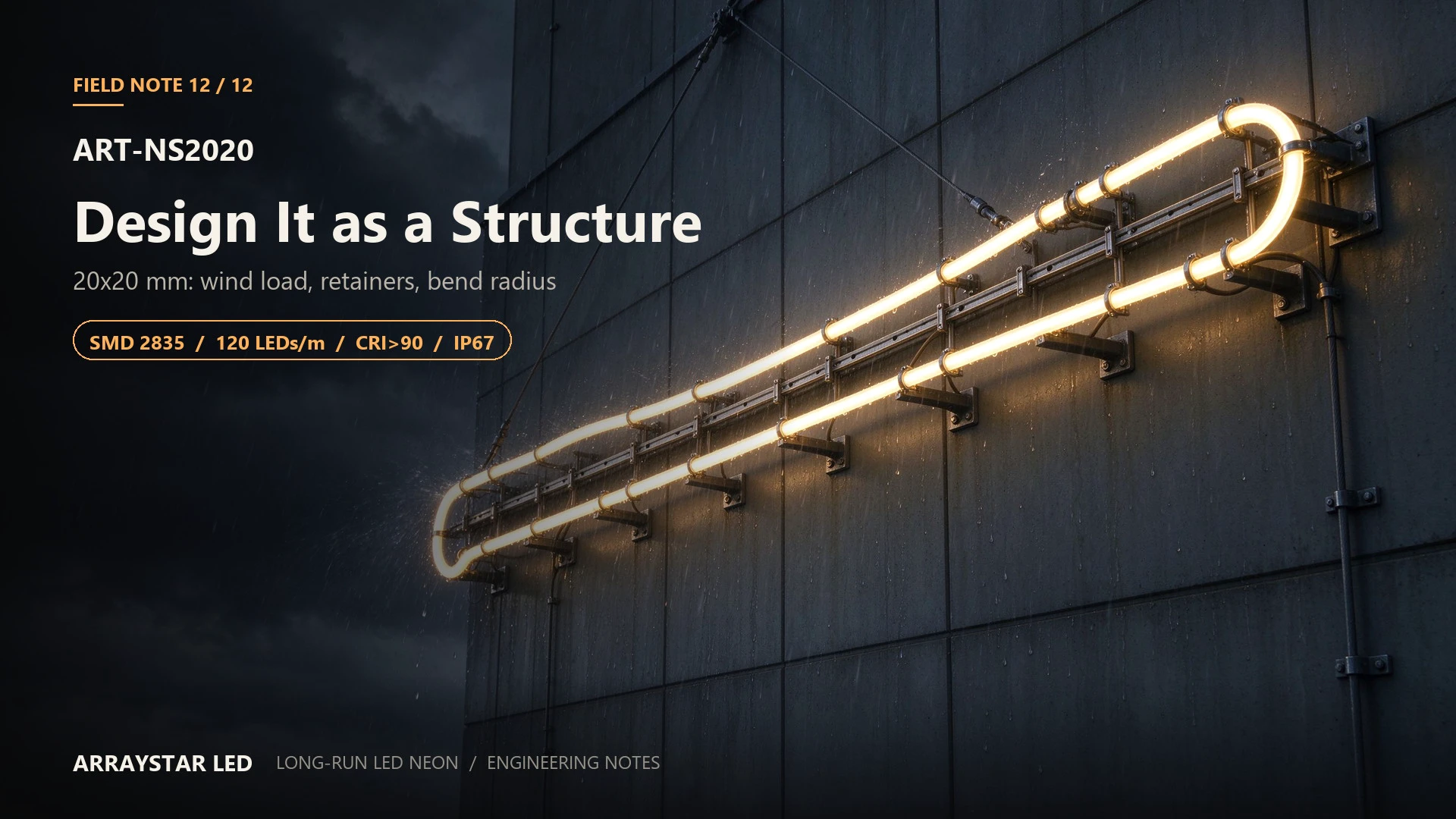
The run moves in the wind before it fails. A 20 × 20 mm body on a six-metre column is fixed with the same 250 mm clip spacing used on an interior cove, a gust hits the elevation, and the whole line oscillates a few millimetres. The clips are not loose; they were specified for a strip, and this body is a structural element.
A 20 × 20 mm profile is the largest section in the Long Run range. At that size the body stops behaving like a flexible strip and starts behaving like a small extruded profile: it has weight, stiffness, sail area, and a minimum bend radius that rules out tight architectural corners. Specify it as structure and it performs. Specify it as strip and the fixing becomes the weak point.
1. What changes at 20 × 20
| Property | 12 × 12 | 20 × 20 | Consequence |
|---|---|---|---|
| Emitting face | 12 mm | 20 mm | Wide, soft line |
| Perimeter | 48 mm | 80 mm | Best heat path in the range |
| Section area | 144 mm² | 400 mm² | Significant weight and stiffness |
| Neutral-axis offset | 6 mm | 10 mm | Largest minimum bend radius |
| Wind sail | Low | High | Fixing must be engineered |
The output is still 12 W/m. The difference is that everything mechanical scales up: weight, stiffness, wind load, and the radius the body will accept.
2. Optical: the widest face in the range
120 × SMD 2835 per metre at 8.33 mm pitch behind a 20 mm diffused face. The face is more than twice the pitch, so the line is completely blended at any normal viewing distance.
- Viewing distance: continuous from about 100 mm outward.
- Line width: reads at roughly 20–24 mm at close range — a band, not a hairline.
- At distance: on a tower or bridge, the body reads as a continuous architectural band; the fixing points disappear beyond about 30 m.
- Colour: 1800 / 2700 / 3000 / 4000 / 6000 K, CRI >90. The wide face is the most tolerant of bin variation, which matters on a large elevation where several rolls meet.
If the design needs a fine line, this body is the wrong scale. If it needs a visible neon band on a large surface, the width is the point.
3. Electrical: 12 W/m, 24 V and 36 V
| Supply | Current per metre | 5 m segment | 10 m load |
|---|---|---|---|
| 24 V | 0.500 A/m | 2.50 A / 60 W | 120 W / 5.0 A |
| 36 V | 0.333 A/m | 1.67 A / 60 W | 120 W / 3.3 A |
The electrical limit is unchanged by the section size: 5 m per feed at 24 V, 0.75 mm² conductor minimum, driver at total wattage plus 20–25 % headroom. On a large elevation the 36 V option is often the better choice because it reduces current and lets the taps sit further apart; confirm the exact 36 V model before designing the segment map.
Cut at marked points: 50 mm, six LEDs.
Feed drop at the segment current (5 m out + 5 m back):
| Conductor | Loop resistance | Drop at the segment | % of supply |
|---|---|---|---|
| 0.50 mm² | 0.37 Ω | 0.93 V | 3.9 % |
| 0.75 mm² | 0.25 Ω | 0.63 V | 2.6 % |
| 1.00 mm² | 0.18 Ω | 0.45 V | 1.9 % |
Use 0.75 mm² as the floor; step up to 1.00 mm² where the driver sits more than 5 m from the first tap.
4. Thermal: the easiest body to keep cool
A 20 × 20 section has 80 mm of perimeter, the highest in the range. At 12 W/m expect roughly 8–12 K rise above ambient in free air, lower against a metal channel.
That is a real advantage on a large façade where maintenance access is difficult. It is not a licence to bury the body: a 20 mm section in a sealed slot still needs a substrate or ventilation. But compared with a 12 mm body at the same wattage, this section has the most margin.
5. Fixing: design for load, not for appearance
A 20 × 20 body needs a fixing schedule that assumes wind and weight:
- Continuous aluminium channel, fixed to the substrate at 300–400 mm centres. The channel is the structural spine.
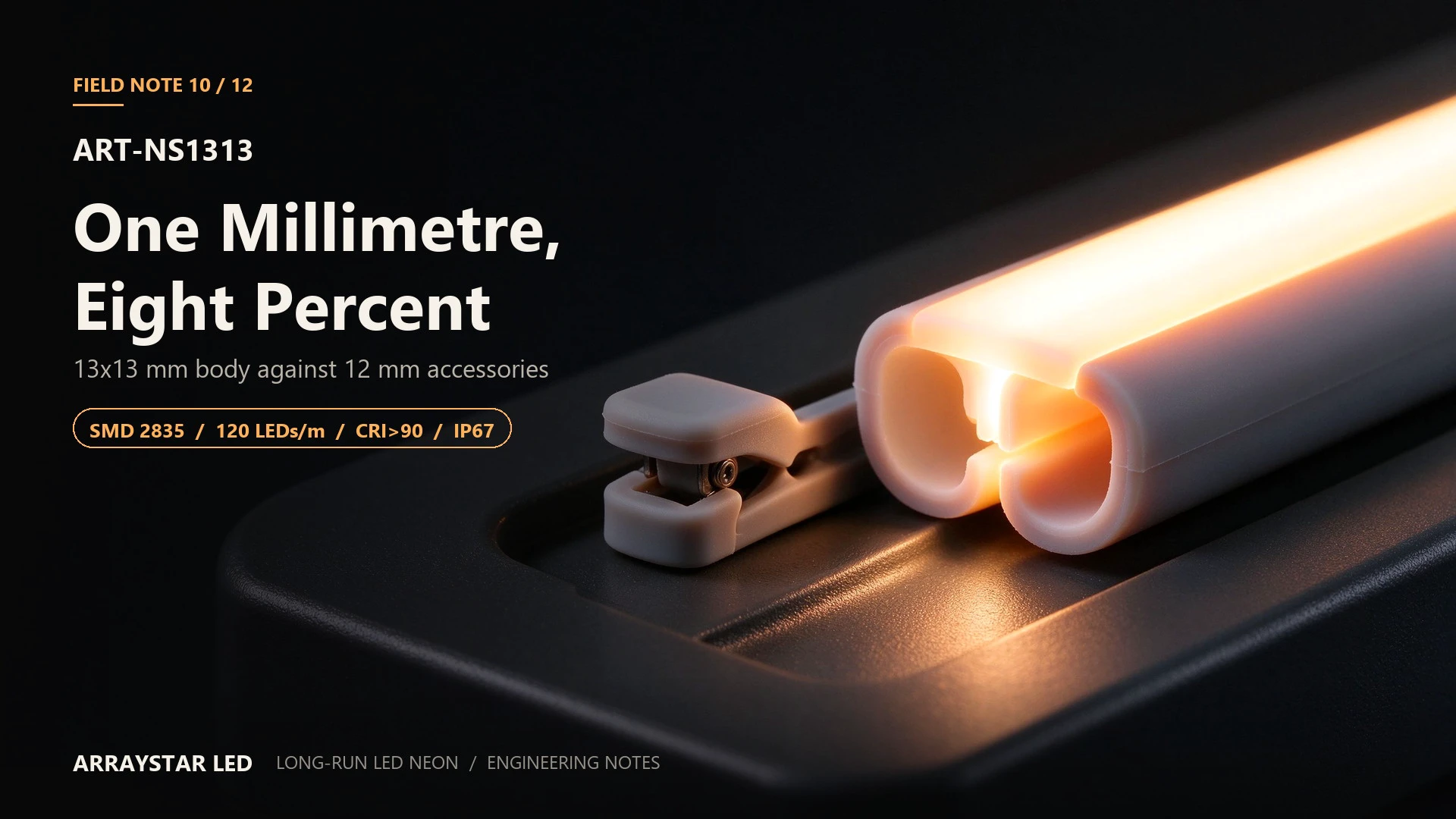
- Clips at 150–200 mm, two-sided, sized to the 20 mm section.
- Mechanical retainers at the base of every vertical run and at every third clip on exposed elevations.
- Expansion allowance at both ends of a long channel; do not pin the body at both ends.
- Joints on vertical faces, never on horizontal runs or at the low point.
On a high-rise or bridge, have the fixing checked against the project wind load. A clip schedule copied from an interior detail is not a façade schedule.
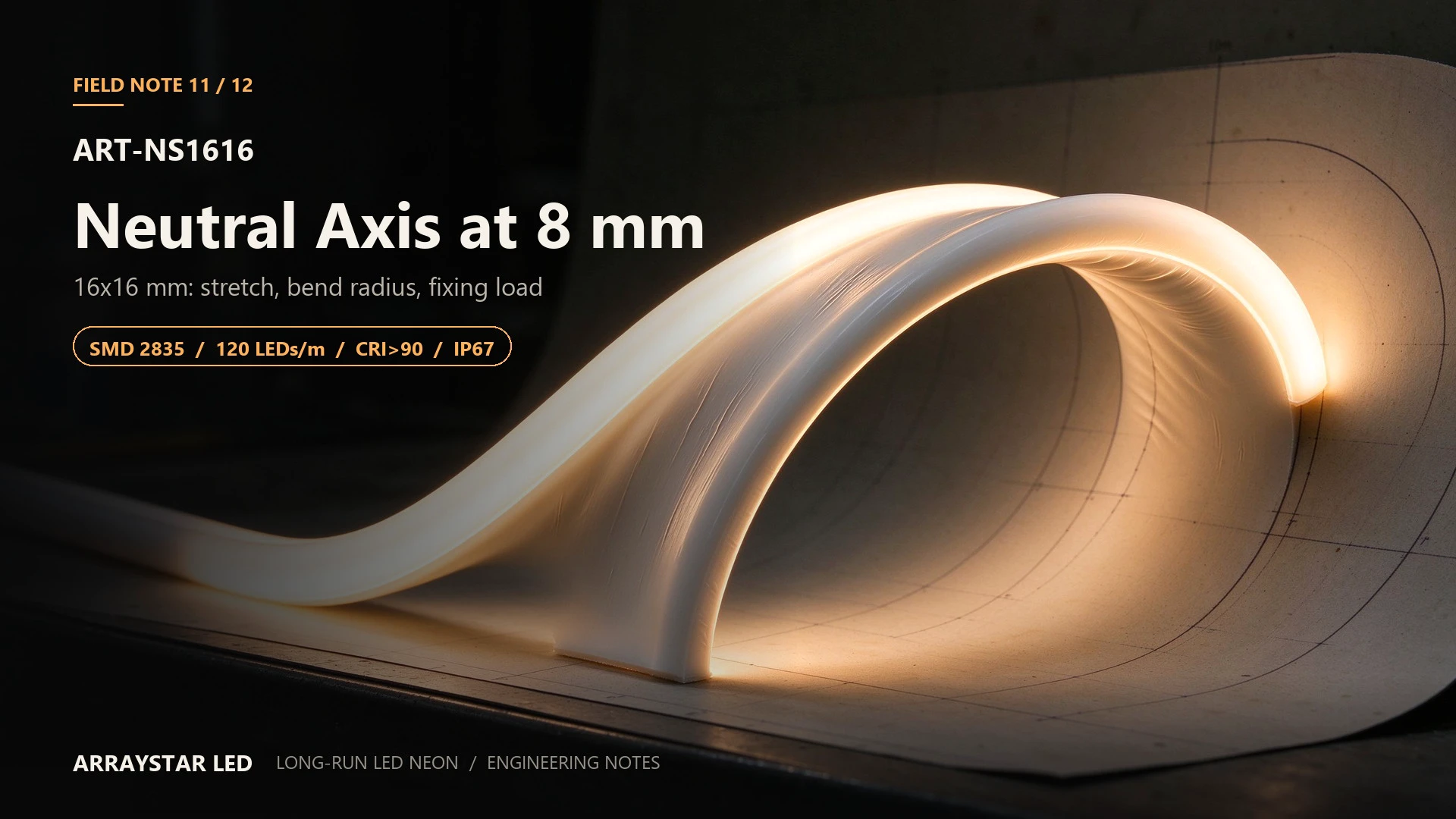
6. Bending: the largest radius in the range
The neutral axis of a 20 × 20 section sits 10 mm from the outer wall. At the same radius, the outer wall stretches about two thirds more than a 12 mm body. Practically:
- Do not template a 2020 corner from a 1212 or 1616 detail.
- Form on a jig, in the designed plane, and leave it to relax before fixing.
- Where the design needs a tight corner, use a corner connector or switch to a smaller section — do not force the body.
7. Commissioning checks
| Check | Method | Pass criterion |
|---|---|---|
| Fixing integrity | Pull test at sample clips and retainers | No movement, no silicone compression |
| Straightness | Sight along the run from 10 m | No visible bow or oscillation |
| Outer wall at bends | Visual at grazing angle | No chalky band, no crack |
| Feed drop | Head and tail under load | ≤ 3 % of supply |
| Surface temperature | IR probe after 60 min | ≤ 45 °C in still air |
8. Engineering FAQ
What is the difference between the 1616 and the 2020?
Both are 12 W/m square bodies. The 2020 is 20 mm against 16 mm: wider face, more weight, more wind sail, larger minimum radius, better perimeter. Choose the 2020 for large-scale bands seen from distance; choose the 1616 where the fixing load or the radius is tighter.
Can a 20 × 20 body be used on a high-rise façade?
Yes, with a continuous channel, two-sided clips at 150–200 mm, mechanical retainers, and a fixing design checked against the project wind load. The body is capable; the clip schedule must be engineered.
Is 36 V necessary on a long 2020 run?
Not necessary, but often better: one third less current extends the feed interval and reduces cable size. Confirm the 36 V model and driver before committing, and never mix 24 V and 36 V on one circuit.
9. Specification summary
| Parameter | Value |
|---|---|
| Model | ART-NS2020 |
| Cross-section | 20 × 20 mm |
| LED | SMD 2835, 120 LEDs/m |
| Input | 24 V DC / 36 V DC |
| Power | 12 W/m |
| CRI | >90 |
| Colour | 1800 / 2700 / 3000 / 4000 / 6000 K |
| Cut unit | 50 mm (6 LEDs) |
| Warranty | 3 years |
Specifying a large-scale band? Send the elevation, the wind zone, and the mounting height. We will return a fixing schedule sized for the load, not for the look.
- Pre: 1616 Long-Run Neon: 16×16mm, 12W/m, Bend-Limit Guide
- Next: Sorry!