
High-Wattage Hexagon Lights for Large Detailing Bays
- 2026-10-09 18:41
- /
- Arraystar LED
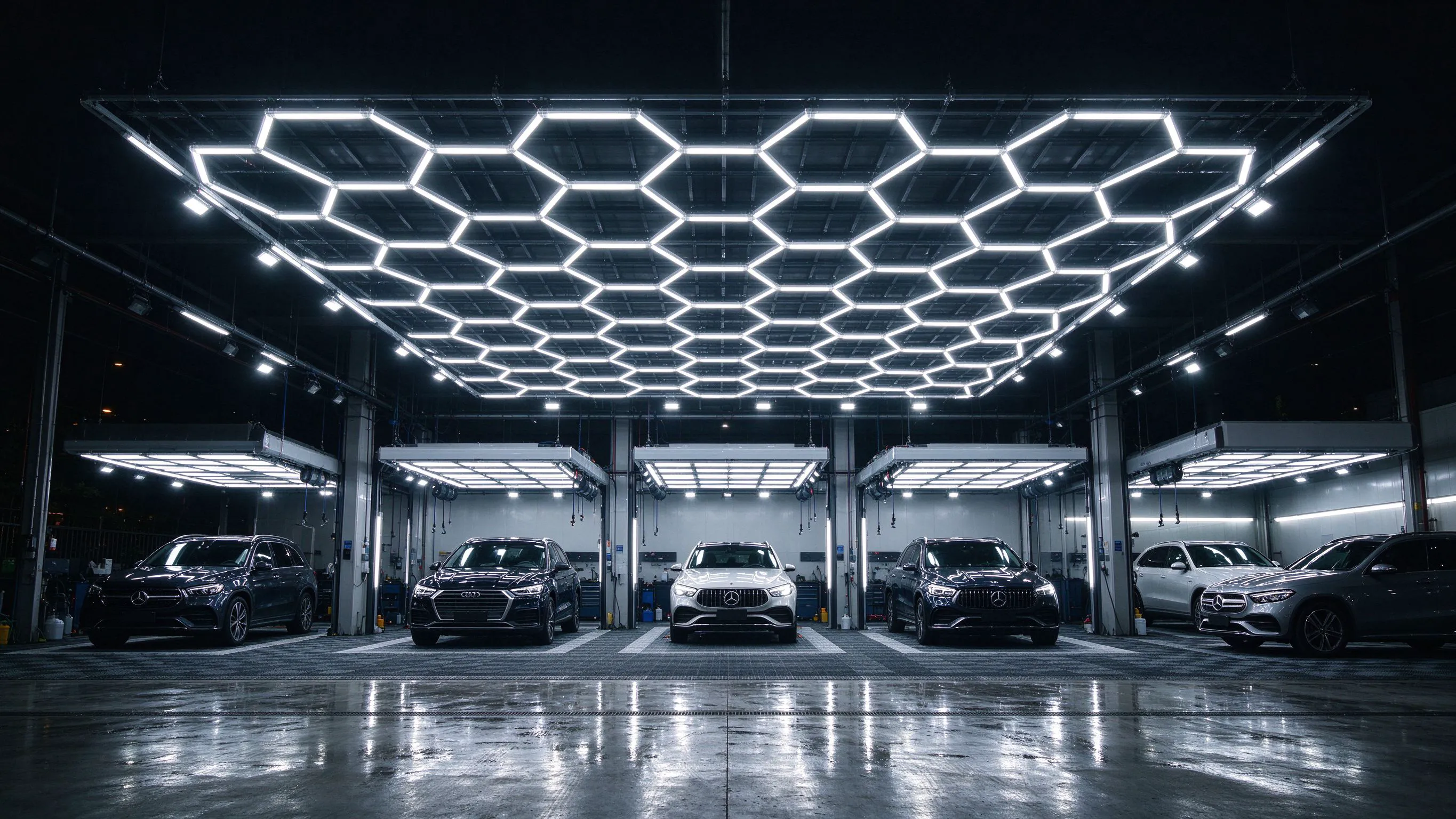
Large commercial detailing and workshop bays, especially those tiled for showroom impact, need far more light than a single small hex kit provides. An 825W high-wattage hexagon honeycomb system delivers the elevated, shadow-free lux levels and the signature ceiling aesthetic that a big commercial bay or multi-vehicle detailing space demands across the whole working area.
When a Small Hex Kit Is Not Enough
Compact hexagon kits suit a home garage or a single small bay, but a commercial detailing workshop with a large footprint, multiple vehicles or high-end paint correction needs proportionally more light. Under-lit hex grids look the part in photos yet leave the edges of a big bay below the lux needed to inspect paint, and the worker still casts shadows across large panels.
Large commercial spaces call for a high-wattage honeycomb system such as the 825W hexagon layout, which tiles enough illuminated cells to hold a high, even lux level across the entire bay while delivering the premium ceiling look.
What the 825W Hexagon System Provides
- 825W across a large honeycomb ceiling grid.
- High lux levels over a full commercial bay.
- Multi-directional, shadow-free illumination.
- Seamless tessellation across a wide area.
- The signature showroom honeycomb aesthetic.
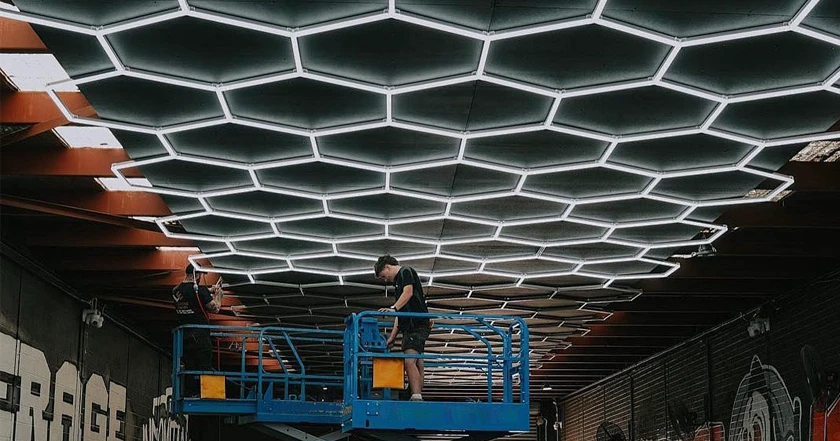
For large commercial bays I specify the 825W hexagon system. It combines inspection-grade light across the whole area with the honeycomb ceiling that signals a premium detailing business.
Small Hex Kit vs High-Wattage Commercial Grid
Big commercial bays need the wattage and cell count to match.
| Factor | Small hex kit | 825W commercial hex grid |
|---|---|---|
| Coverage | Single small bay | Large/multi-vehicle bay |
| Lux at panel | Moderate | High, inspection-grade |
| Edge brightness | Falls off | Even across full area |
| Scale | Home garage | Commercial workshop |
| Investment | Low | Higher, business asset |
Where High-Wattage Hex Systems Are Specified
- High-end car detailing and paint correction studios.
- PPF, wrapping and ceramic coating workshops.
- Multi-vehicle and large-footprint commercial bays.
- Premium showrooms wanting the honeycomb ceiling feature.
- Inspection and quality-control bays needing high lux.
Planning the Grid for Coverage, Not Just Looks
The temptation is to buy a hex grid for its appearance and stop there, but I plan the cell layout against a lux target at working height across the whole bay, including the edges and corners where grids commonly fall dim. I size the 825W system to cover the actual working footprint, extend cells over the vehicle's full length and width rather than just the centre, and verify lux at panel height on a real vehicle so the photography-friendly ceiling is also genuinely functional.
- Set a lux target at working height, not ceiling level.
- Tile cells to cover edges and corners, not just the centre.
- Extend the grid over the full vehicle footprint.
- Verify on a vehicle before finalising the layout.
Electrical Load, Mounting and Installation
An 825W system is real electrical load, so I confirm the circuit capacity and driver layout rather than treating it as a decorative kit, distribute the drivers across the grid to avoid voltage drop and dim outer cells, and plan robust ceiling fixing for the weight of a large assembled honeycomb. I also phase the installation so the grid can be energised in sections during fit-out and serviced cell by cell later, which matters in a busy commercial bay that cannot easily close for maintenance.
Balancing the Showroom Look With Working Light
The hex ceiling is a marketing asset as well as a working light, so I match colour temperature and CRI to paint work, neutral high-CRI daylight, while using the geometry for visual impact in customer-facing bays. Where a workshop mixes customer-facing and purely functional zones, I may specify the full hex system at the front and simpler rectangular frames in rear bays, concentrating the aesthetic investment where clients see it and the wattage where the detailers work.
Specifying a Large Detailing Bay
Send the bay dimensions and ceiling height, number of vehicles worked simultaneously, target lux at panel height, electrical capacity and whether the ceiling is customer-facing. I will confirm the 825W hex grid footprint, driver and circuit layout, mounting and whether rear bays can use simpler frames. We supply the high-wattage hex system and recommend a lux verification across the full bay including edges after installation.
Fitting Out a Six-Bay Detailing Flagship
A premium detailing franchise was building a six-bay flagship with a customer lounge overlooking the workshop and wanted the ceiling to be both a genuinely high-performance inspection light across every bay and a signature visual feature clients would photograph. A single small hex kit or scattered rectangular frames would neither hold the required lux over six vehicles nor deliver the seamless branded ceiling the concept demanded, so this was a clear case for a high-wattage honeycomb at scale.
- Tile the 825W-class hex grid continuously over the full six-bay footprint.
- Plan cells to a panel-height lux target, extending over edges and corners.
- Confirm three-phase circuit capacity and distribute drivers to prevent dim outer cells.
- Engineer ceiling fixing for the weight of the assembled honeycomb.
- Section the grid so it energises and services in zones without closing the shop.
We planned the honeycomb against a lux target measured at panel working height rather than by the ceiling's appearance, which is the discipline that separates a functional flagship grid from a decorative one. The cells were tiled to cover the complete working footprint including the bay edges and corners where grids most often fall dim, and extended over the full length and width each vehicle occupied so no car sat half in bright centre light and half in a dim perimeter. Because the total load was substantial, we worked through the three-phase circuit capacity up front and distributed the drivers across the grid to avoid voltage drop that would have dimmed the outer cells and ruined the uniformity the brand was paying for, and we specified robust fixing for the weight of the large assembled honeycomb. The system was divided into zones that could be energised during fit-out and serviced cell by cell later, essential for a busy commercial floor that could not shut entirely for maintenance. We kept the colour temperature a neutral high-CRI daylight throughout for accurate paint work while exploiting the geometry for visual impact in the customer-facing front bays, and used simpler rectangular frames in the rear prep bays where the aesthetic was invisible, concentrating the honeycomb investment where clients looked and the detailers worked at the highest level. After install we verified lux across every bay including edges with vehicles in place. The flagship opened with a ceiling that performs as inspection lighting and photographs as a brand asset, and the zoned design has kept maintenance non-disruptive. It is the benchmark for when high-wattage hexagons are genuinely justified: large footprint, high lux requirement and a customer-facing ceiling all aligned.
Recommended Products
Frequently Asked Questions
What is an 825W hexagon garage-light system?
It is a large honeycomb LED ceiling grid totalling 825W that tiles many hexagonal cells over a full commercial detailing or workshop bay, delivering high, even, multi-directional inspection-grade light across the whole area together with the premium showroom honeycomb aesthetic. It is the commercial-scale step up from a small single-bay hex kit.
Why isn't a small hex kit enough for a commercial bay?
Small kits suit a home garage or one small bay; on a large multi-vehicle commercial footprint they cannot hold the lux needed for paint inspection, and brightness falls off at the edges while workers still cast shadows on large panels. A high-wattage grid tiles enough cells to keep high even light across the entire working area.
How do I plan a hex grid for even coverage?
Work to a lux target measured at panel working height rather than ceiling appearance, tile cells to cover the edges and corners that usually fall dim, and extend the grid over the full vehicle footprint rather than just the centre. Verify the lux on a real vehicle across the whole bay before finalising the layout, because a photogenic ceiling can still under-light the work.
What electrical work does an 825W hex grid need?
Treat it as genuine load: confirm circuit capacity, distribute drivers across the grid to prevent voltage drop and dim outer cells, and plan robust ceiling fixing for the weight of the assembled honeycomb. Arrange the system to energise in sections during fit-out and to be serviced cell by cell later, minimising downtime in a busy commercial bay.
Should the whole workshop use high-wattage hexagons?
Not necessarily. Use the full hex system in customer-facing and primary detailing bays where both the high lux and the showroom look pay off, and consider simpler rectangular frames for rear or purely functional bays. Match the colour temperature and high CRI to paint work throughout, concentrating aesthetic investment where clients see it and wattage where detailers actually work.
Need help with your LED project?
Get factory-direct pricing, free samples and engineering support within 24 hours.
Email: info@arraystarled.com | Phone: +86-0755-2103-6746 | WhatsApp: 0086 1581 8514 077
Need to size your power supply? Use our LED Strip Power Calculator to find the right driver in seconds.







