
36W Small Hexagon Lights for the Home Garage DIY
- 2026-10-09 18:41
- /
- Arraystar LED
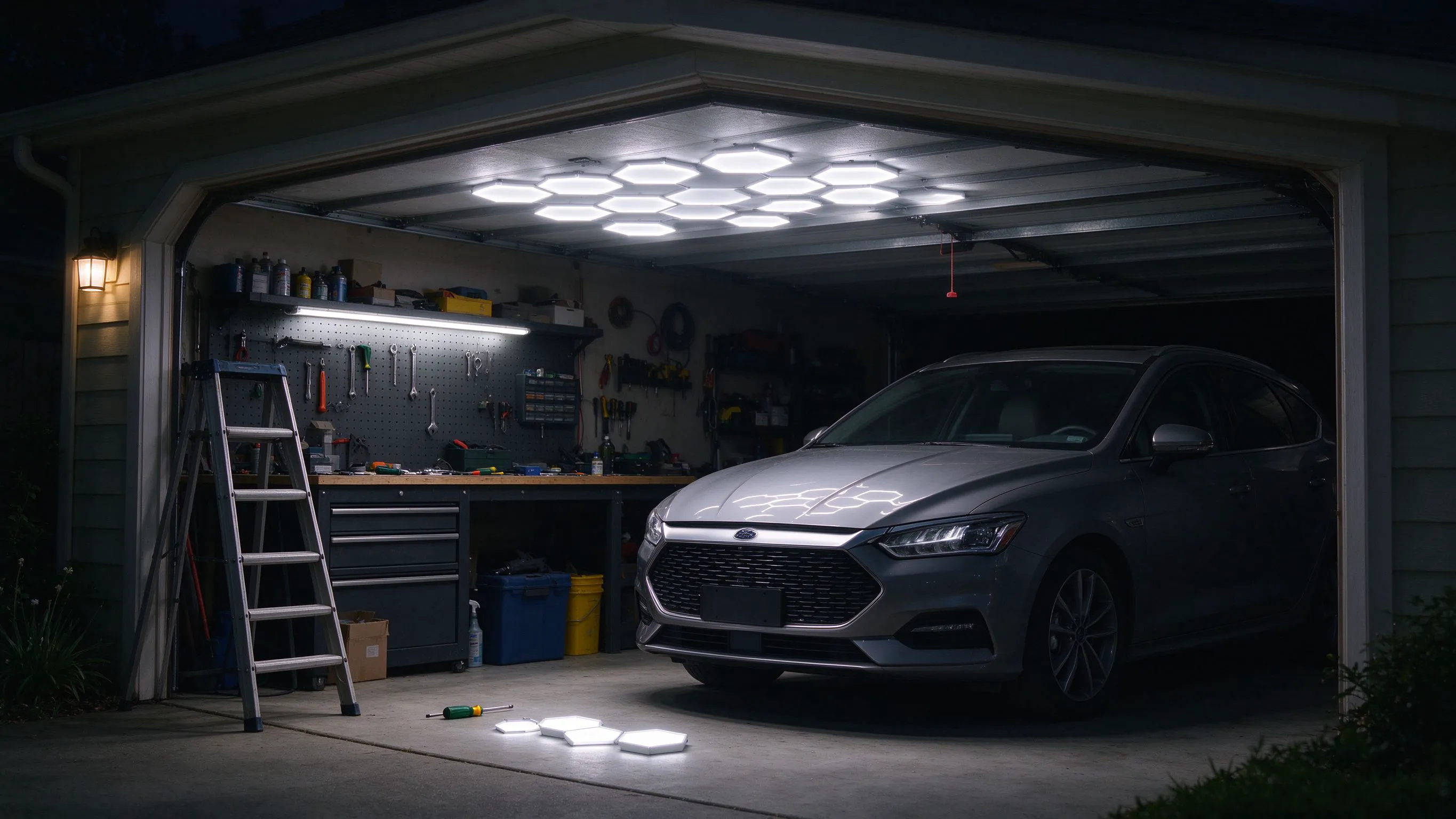
The honeycomb garage-light look does not require a full commercial grid to begin with. A 36W small hexagon module gives a home garage or hobby workshop the signature multi-directional light at an affordable entry point, links together into a larger grid as needs grow, and installs as a manageable DIY ceiling project rather than a commercial fit-out.
Why Home Garages Have Adopted Hex Lighting
Home garages and hobby workshops increasingly serve as detailing bays, workshops and gyms, and a single bare bulb or one flat panel leaves the bench and vehicle sides in shadow. The hexagon ceiling, popularised by professional detailing studios, distributes light from many directions, which is exactly what a home user wants for seeing tools, paintwork and equipment clearly.
Most homeowners do not need, and do not want to pay for, an 800W commercial grid on day one. A small 36W hexagon module provides the same multi-directional honeycomb light at a modest scale and cost, with the option to grow.
What the 36W Small Hex Module Offers
- 36W entry-level honeycomb module for home garages.
- Multi-directional light that cuts bench and vehicle shadows.
- Links into a larger grid as the workshop grows.
- Manageable DIY installation for a single bay.
- The signature hexagon look at an affordable price.
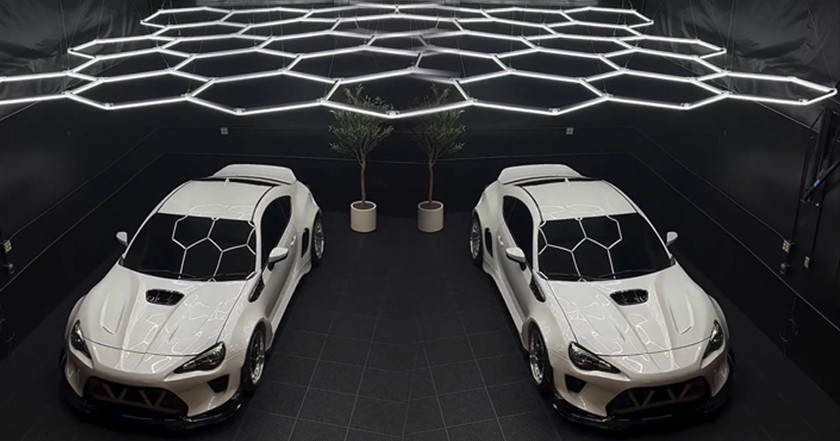
For a home garage starter setup I use the 36W small hex module. It delivers the honeycomb light quality without committing to a full commercial grid.
Small Module vs Full Commercial Grid
Start small at home and expand the grid as needs and budget grow.
| Factor | 36W small module | Commercial hex grid |
|---|---|---|
| Scale | Single bay / hobby | Large multi-bay shops |
| Cost | Low entry point | Major fit-out budget |
| Install | DIY-friendly | Professional/electrical work |
| Growth | Adds modules over time | Designed as a full system |
| Best for | Home garages | Commercial detailing |
Where Small Hex Modules Fit Best
- Single-car home garages used for detailing or hobbies.
- Workbench and tool-wall zones needing shadow-free light.
- Home gyms and workshop corners.
- DIY enthusiasts wanting the hex look on a budget.
- Renters or owners planning to expand the grid later.
Planning a DIY Hex Layout
I plan even a small grid around where the work happens, positioning the first module over the bench or the centre of the parking bay rather than simply centring it on the ceiling for symmetry. I check ceiling height and joist positions for fixing, confirm the driver and a nearby circuit can handle the module, and I lay the cells out so they can extend in a logical direction when more modules are added, which avoids having to relocate the starter grid later.
- Centre the first module over the bench or vehicle work zone.
- Check joists and fixing points before mounting.
- Confirm the circuit and driver for the starter load.
- Orient cells so the grid can extend logically later.
Expanding the Grid Over Time
The main advantage of a modular starter is expandability. I confirm the connector system and module compatibility up front so additional cells purchased later join the original grid cleanly, and I plan power so added modules do not overload the first driver; growing beyond the starter driver's capacity means adding a driver rather than overloading it. Treating the first purchase as the corner of a future grid means the home workshop can scale its light in step with the hobby.
Brightness Expectations for a Home Bay
A 36W module transforms a dim single-bulb garage and suits hobby detailing and bench work, but it is not commercial paint-correction lux across a whole large bay. I set expectations honestly: it is a genuine upgrade and a perfect start, and users who later need inspection-grade light over an entire vehicle simply add modules to raise coverage, rather than discarding the original purchase.
Specifying a Home Garage Starter
Send the garage dimensions, ceiling height and construction, primary use (bench work, detailing, gym) and whether you plan to expand. I will confirm the 36W module count for a starter, mounting, driver and how the grid can grow. We supply the small hex module and recommend positioning the first cell over the main work zone and verifying the light on a vehicle or bench before adding more.
A Two-Phase Home Garage Build
A hobbyist wanted the hexagon ceiling he had seen in professional detailing studios for his two-car garage, where he detailed his own cars on weekends and maintained two project vehicles, but his budget only allowed a modest first purchase and his ceiling had a mix of finished drywall and open joists. Rather than either abandoning the idea or overspending on a full grid he did not yet need, we planned the lighting as a two-phase modular build around the 36W small hex module.
Phase one covered the zone that delivered the most value immediately, the workbench and tool wall where he spent most of his maintenance time, with a starter cluster of 36W modules positioned directly over the bench rather than centred symmetrically on the ceiling. We checked the joist layout so fixing was solid across the mixed ceiling, confirmed a nearby circuit and the starter driver handled the load, and oriented the open ends of the cluster toward the centre of the garage so the future extension would grow in a clean direction without relocating anything. The effect on the bench was immediate and genuinely transformative after years of a single bulb; multi-directional light removed his shadow over the engine bay and tool work, and the honeycomb looked sharp enough that the garage became a room he wanted to spend time in. Crucially, before buying we confirmed the connector system and module compatibility so the cells added in phase two would join the originals seamlessly, and we sized the plan so a second driver would be added when the grid crossed the first driver's capacity rather than overloading it. Six months later, once he had budgeted for it, phase two extended the honeycomb out over the parking and detailing bays using identical modules, and the finished ceiling looked like one originally designed grid rather than two purchases bolted together. He now has near-commercial coverage over his detailing zone for a fraction of the upfront cost of a full system, paid in two affordable stages. The build is the clearest illustration I give home users that the small hex module is not a compromised product but a deliberately modular one: start over the highest-value work zone, orient for growth, confirm compatibility and power before the first purchase, and let the ceiling scale with the hobby instead of forcing a single large, intimidating spend.
Recommended Products
Frequently Asked Questions
What is a 36W small hexagon garage light?
It is an entry-level honeycomb LED ceiling module rated at 36W that gives a home garage or hobby workshop multi-directional, shadow-reducing light in the signature hexagon style, at an affordable price. It installs as a manageable DIY starter and links with additional compatible modules to build a larger grid over time.
Is a small hex module enough for a home garage?
A 36W module is a major upgrade over a single bulb and suits hobby detailing, bench work and a home gym in a single-car garage, but it is not full commercial paint-correction lux over an entire large bay. It is designed as a starter that you expand by adding compatible modules when you need more coverage.
Can I add more hexagons to a starter grid later?
Yes, that is the point of starting modular. Confirm the connector system and module compatibility before buying so later cells join cleanly, orient the starter so the grid can extend logically, and plan power so that added modules do not overload the first driver; beyond its capacity you add another driver rather than overloading it.
How do I lay out a DIY hexagon light?
Position the first module over the workbench or the centre of the parking bay where the work happens rather than centring it purely for symmetry, check ceiling joists and fixing points, confirm the nearby circuit and driver can handle the load, and orient the cells so the grid can extend in a logical direction later.
How does a small hex module differ from a commercial grid?
The 36W module is a low-cost, DIY-friendly starter for a single home bay that grows by adding cells, whereas a commercial grid is a high-wattage, professionally installed system designed for even inspection-grade lux across large multi-bay workshops. The home module shares the honeycomb light quality and look but at hobby scale and budget.
Need help with your LED project?
Get factory-direct pricing, free samples and engineering support within 24 hours.
Email: info@arraystarled.com | Phone: +86-0755-2103-6746 | WhatsApp: 0086 1581 8514 077
Need to size your power supply? Use our LED Strip Power Calculator to find the right driver in seconds.







