Arc-Shaped Hollow SCOB Strips That Bend Around Curves
- 2026-10-09 18:40
- /
- Arraystar LED
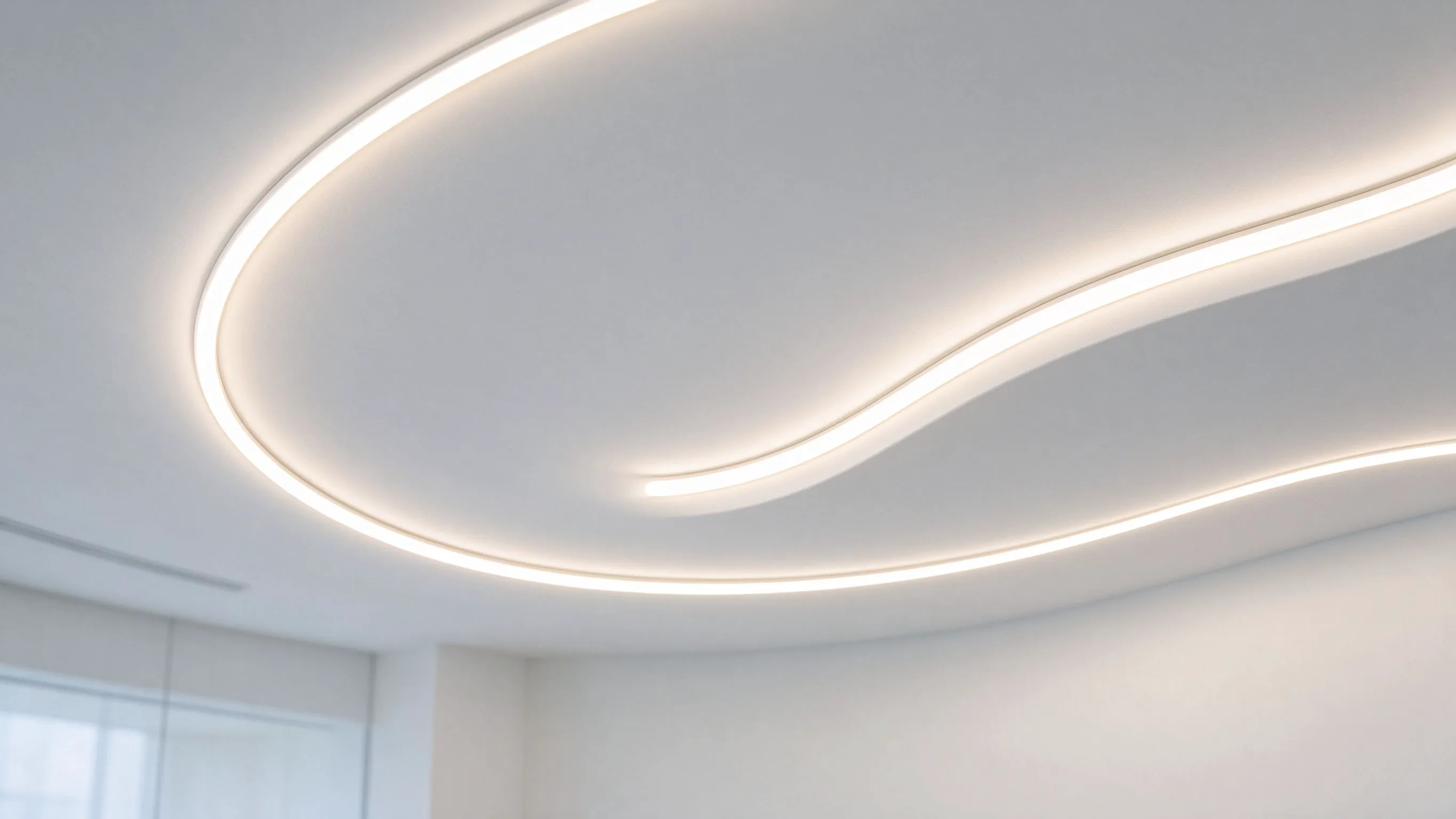
Solid silicone-extruded strip is robust but stiff, which makes tight curves and arcs a struggle. An arc-shaped hollow SCOB strip uses a fully encapsulated hollow silicone body that flexes around curves more easily while still delivering a smooth dot-free line and full encapsulation. It is the bend-friendly middle ground between rigid solid extrusion and unprotected bare strip for curved architectural details.
The Stiffness Problem with Solid Extrusion
Solid silicone-extruded strip is a favourite for wet and outdoor work because the continuous body is so robust, but that same solid construction makes it comparatively stiff. Bending it around a tight arc or a flowing curve requires real force, it can kink at the inner edge, and on small radii the solid body resists the shape rather than following it.
Designers building curved coves, arches, columns and free-form details kept asking for the encapsulation of solid extrusion with the flexibility of a softer body, which is what hollow SCOB construction addresses.
What an Arc-Shaped Hollow SCOB Is
- Fully encapsulated hollow silicone body protecting the LED board.
- Arc-shaped profile engineered to flex around curves and bends.
- Easier tight-radius bending than solid extrusions of similar size.
- Smooth dot-free SCOB emission along the curve.
- Continuous encapsulation for protected, often damp-rated use.

For curved details that still need encapsulation I use the arc-shaped fully encapsulated hollow SCOB. The hollow body gives the strip room to flex without giving up the protective silicone envelope.
Hollow SCOB vs Solid Extrusion vs Bare Strip
Hollow SCOB trades a little rigidity for curve-friendliness.
| Factor | Bare strip | Solid extrusion | Arc hollow SCOB |
|---|---|---|---|
| Protection | None | Highest, rigid | High, encapsulated |
| Flexibility / curves | High | Limited, stiff | High, bend-friendly |
| Tight-arc behaviour | Follows but exposed | Can kink | Follows smoothly |
| Light quality | Depends on strip | Smooth diffused | Smooth dot-free |
| Best use | Dry interior channels | Straight wet/outdoor runs | Curved protected details |
Where the Bend-Friendly Body Wins
- Curved and circular coves in reception and retail spaces.
- Arches, barrel-vault details and rounded soffits.
- Column-wrapping and curved feature walls.
- Free-form furniture and organic-shaped joinery.
- Outdoor curved edges where some encapsulation is required.
Understanding the Hollow Body Trade-offs
The hollow construction is what allows the easy flex, but I am clear that it positions the product slightly differently from a fully solid extrusion. The body is still fully encapsulated for protection, yet the hollow profile means sealing discipline at connectors and ends matters just as much, and the exact IP rating should be confirmed for the specific product and environment rather than assumed equal to every solid extrusion. I treat hollow SCOB as excellent for curved protected and damp-sheltered details, and I reach for solid extrusion or dedicated IP68 product for the harshest permanent immersion.
- Seal connectors and ends with matched accessories.
- Confirm the IP rating against the actual exposure.
- Do not assume hollow equals the same immersion rating as solid IP68.
- Use solid or IP68 product for permanent underwater duty.
Bending and Fixing on a Curve
Even a flexible hollow body should be bent onto a defined curve rather than forced freehand. I prepare the curved track or former first, seat the strip progressively into the profile, and avoid concentrating the bend at one point by spreading it along the arc. The arc-shaped body helps the strip sit cleanly in curved channels without the rippling or lifting that stiff solid extrusion shows when forced. I power-test the curved section before final closing, checking for any kink that would create a bright or dark spot along the glow.
Curved install sequence
- Fix the curved profile or former to the true radius first.
- Feed the strip in progressively, letting the hollow body flex naturally.
- Avoid localised sharp bends; distribute the curve evenly.
- Secure with clips that hold but do not pinch the hollow body.
- Power up along the arc to confirm an even unbroken line.
Light Quality Along Curves
Curves are exactly where dotted strip looks worst, because the eye follows the bending line and any scalloping or uneven spacing is magnified. The SCOB dot-free emission keeps the glow continuous as it wraps the arc, so a circular cove or column reads as one clean ring of light rather than a chain of points. I match the diffuser or use the integral encapsulation to keep the line soft on both the straight and curved sections so there is no visible change where the run bends.
Specifying Curved Encapsulated Lighting
Send the curve radius, total arc length, the environment (dry interior, damp or sheltered outdoor), channel details and required protection. I will confirm whether the arc-shaped hollow SCOB handles the radius or whether a solid extrusion can manage a gentler curve, along with sealing and mounting. We supply the arc-shaped hollow SCOB and recommend bending and powering a sample offcut to the tightest radius before fitting, so the flex behaviour and light continuity are proven on the actual curve.
Wrapping a Circular Column: A Practical Case
A hotel lobby featured four large cylindrical columns that the designer wanted ringed with continuous light at the ceiling junction and again at the base. We initially priced the detail with a solid extruded product because the columns were in an air-conditioned interior but close to the entrance where rain occasionally blew in, so some encapsulation was prudent. The solid strip fought the radius: wrapping it around the roughly 600mm columns required heating, force and frequent fixing, and at the tightest point it kinked twice during the mock-up, producing visible bright spots.
Switching to the arc-shaped hollow SCOB transformed the fitting. The hollow body followed the column circumference by hand, seated into a curved aluminium ring former that the joiner had prepared, and produced an uninterrupted dot-free halo with no kinks. We fixed the rings first, fed each strip around progressively, and brought the connection to the rear of each column where it was invisible and protected from the entrance weather. The eight rings, two per column, were fitted in a fraction of the time the solid mock-up had taken for a single ring, and the encapsulated body gave the specifier enough protection for the location. The project is my reference whenever a curved detail sits in a semi-protected environment: the lesson is to match the body construction to the geometry rather than forcing the most rigid, most sealed product onto a radius it was never designed to follow, and to prove the tightest curve on a mock ring before committing the full set of columns.
Recommended Products
Frequently Asked Questions
What is an arc-shaped hollow SCOB strip?
It is LED strip enclosed in a fully encapsulated, arc-shaped hollow silicone body that flexes around curves and tight radii more easily than a stiff solid extrusion, while still giving a smooth dot-free line and protective encapsulation. It is used for curved coves, arches, columns and organic-shaped details.
Why not just use solid silicone extrusion on a curve?
Solid extrusion is robust but comparatively stiff; on tight arcs it requires force, can kink at the inner edge and resists the shape. The hollow SCOB body has room to flex, so it follows small radii and flowing curves smoothly while keeping encapsulation and dot-free light.
Is hollow SCOB as waterproof as solid IP68 extrusion?
Not automatically. It is fully encapsulated and suited to protected and damp-sheltered curved details, but its exact IP rating must be confirmed for the product and environment, and connectors and ends still need matched seals. Use solid extrusion or dedicated IP68 product for permanent immersion and the harshest outdoor exposure.
How do you bend hollow SCOB around a tight curve without kinking?
Prepare the curved track or former to the true radius first, feed the strip in progressively so the hollow body flexes naturally, spread the bend along the arc rather than concentrating it at one point, use clips that hold without pinching, and power-test the section to catch any kink that would cause a bright or dark spot.
Does dot-free light matter more on curves?
Yes. The eye follows a bending line, so any dotted scalloping or uneven spacing on a curve is magnified. SCOB's continuous emission keeps the glow seamless as it wraps an arc or column, and matching the diffuser across straight and curved sections prevents a visible change where the run bends.
Need help with your LED project?
Get factory-direct pricing, free samples and engineering support within 24 hours.
Email: info@arraystarled.com | Phone: +86-0755-2103-6746 | WhatsApp: 0086 1581 8514 077
Need to size your power supply? Use our LED Strip Power Calculator to find the right driver in seconds.