
Hexagon & Diamond LED Garage Lights for Car Detailing Shops: Layout, Watts and CRI
- 2026-09-30 17:37
- /
- Arraystar LED
Detailing work lives or dies on reflection. If you can't see a hologram or a faint swirl under your ceiling light, you'll hand the car back with defects you never caught. Hexagon and diamond grid lights win in detailing bays because they throw a wide, even, 5000K daylight field whose honeycomb pattern reflects clearly on glossy clear coat, so paint correction, ceramic coating and PPF all become visible. Size roughly 80-120W per single bay, mount 2.4-3m high, and stop using scattered tube lights that leave dark corners.
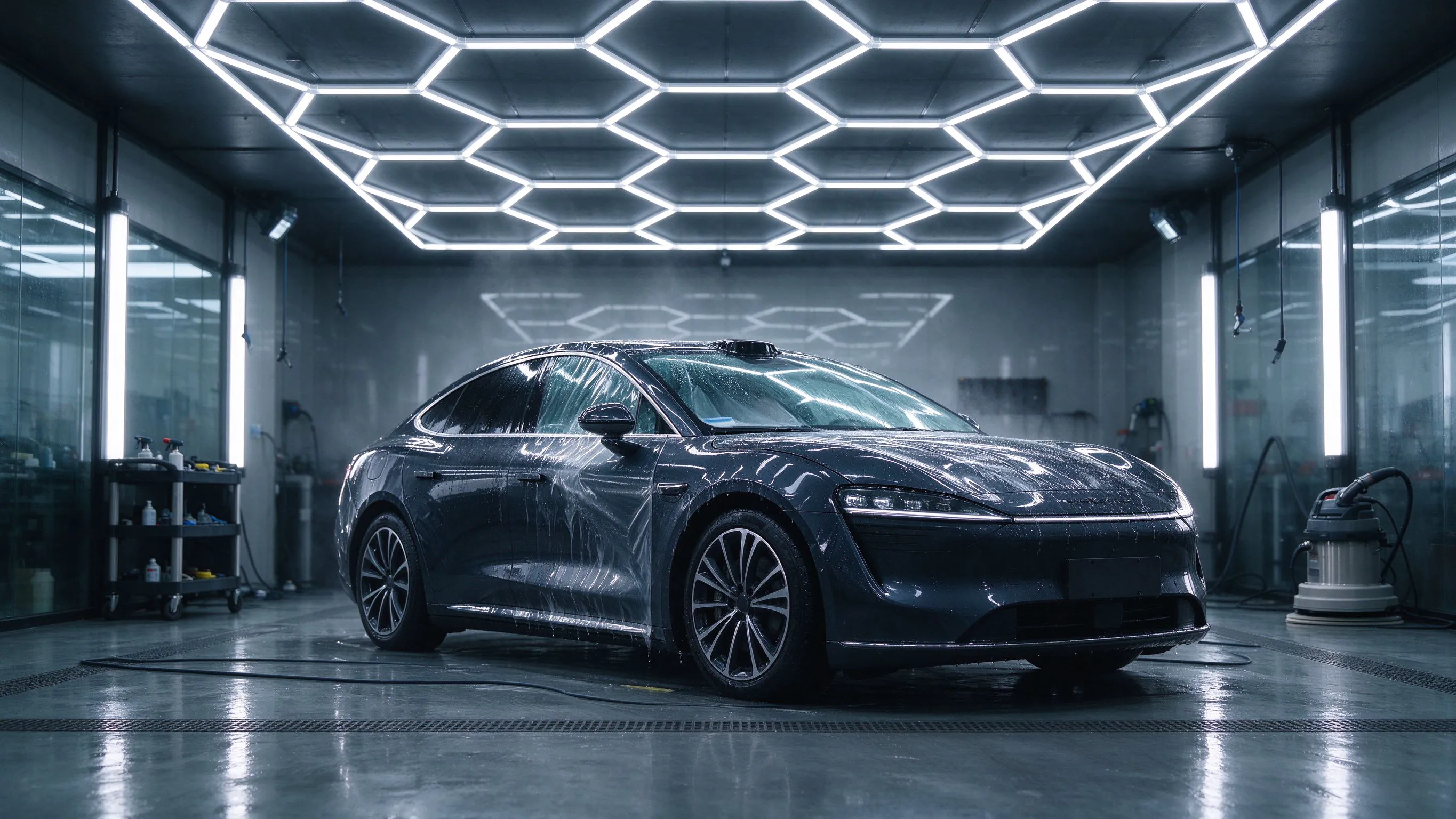
Why Ordinary Garage Lights Fail a Detailing Bay
I've stood in too many 'professional' detail bays where the owner had bolted up a handful of cheap LED battens and wondered why his paint correction looked perfect indoors and terrible in the sun. The problem isn't brightness in watts, it's the quality and the shape of the light.
Glossy paint is a mirror. When you compound or polish, you're reading the reflection of your ceiling on the hood. Scattered tube lights give you broken bright stripes separated by dark gaps, and swirl marks hide in those gaps. A single bright panel overhead creates one hot spot and glare, forcing you to move the car or your head constantly to inspect a panel.
What a detailer actually needs is a continuous field of daylight-balanced light directly over the work zone, wide enough to cover a full vehicle and even enough that the reflection stays uniform as you walk around. That's exactly what connected hexagon and diamond grids are built for.
Why the Hexagon (Honeycomb) Pattern Works on Glossy Paint
Hexagon modules tile together into one large luminous ceiling with no rectangular dark seams. On a wet, freshly polished or ceramic-coated panel, the honeycomb reflection shows up as a crisp repeating grid. Any swirl, hologram, buffer trail or high spot distorts that grid, which makes defects jump out the way a flat light never will.
- Continuous coverage - interlocking frames leave no dark strips between fixtures.
- Daylight 5000K - matches outdoor sun so the color you correct indoors matches delivery light.
- Diffused, low-glare output - bright enough to inspect without blinding you straight-on.
- Wide beam - lights vertical doors as well as the horizontal hood and roof.
The 552W hexagon grid is the workhorse I spec for a single full-size detailing bay. It covers roughly a 4x5m working footprint at the brightness a paint-correction specialist needs, and the linked frames mean the reflection on the door is the same intensity as the reflection on the roof.
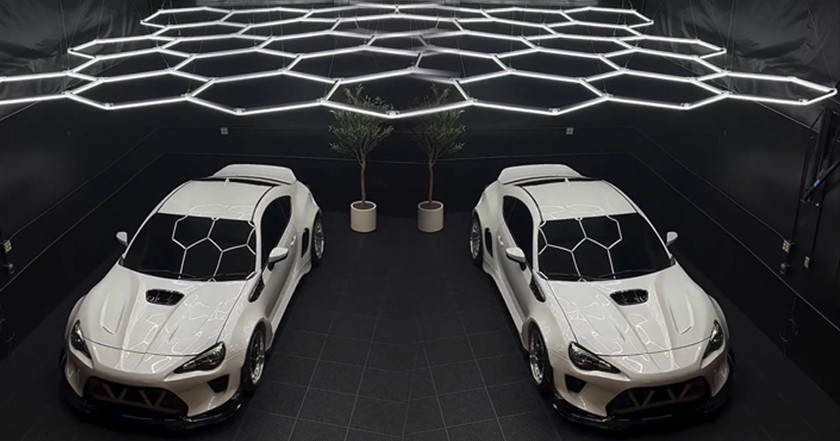
Sizing Watts and Lux per Detailing Bay
Detailers love to over-light, but there's a practical ceiling. Too bright at close range washes out the subtle contrast you need to read a hologram; too dim and you miss it. For a standard 2.4-3m ceiling over one vehicle, I target the figures below.
Starting points for 5000K diffused hexagon grids at 2.4-3m mounting height.
| Bay type | Grid watts | Approx. lux on the paint | What it suits |
|---|---|---|---|
| Single standard bay | 450-600W | 1500-2500 lux | Paint correction, coating, PPF |
| Small / low ceiling bay | 180-250W | 1000-1500 lux | Valeting, interiors, touch-ups |
| Add-on fill row | 30-100W | supplementary | Corners, wash stations |
| Multi-bay workshop | 800-1900W linked | 1500+ lux across floor | High-volume detailing shops |
The 210W hexagon is the right pick when the ceiling is low, the bay is compact, or you're lighting a valeting-only station where you don't need correction-grade intensity. It also works as an extension row bolted onto a larger main grid.
Hexagon vs Diamond: Which Pattern for Which Bay
Both patterns deliver the even daylight field, but they reflect differently. Hexagons produce the tight, detailed honeycomb reflection that correction work relies on for reading fine swirls. Diamond grids throw a slightly softer, broader fill with less aggressive contrast, which many PPF and ceramic installers prefer because they're inspecting for dust and alignment rather than chasing holograms.
In practice I run a main hexagon grid over the correction bay and use diamond frames for the coating/PPF bay or as lower-glare fill in bays where technicians spend long hours looking upward. The 215W diamond grid is a popular single-bay choice for exactly that reason - broad coverage without the intense repeating reflection fatiguing the eye.
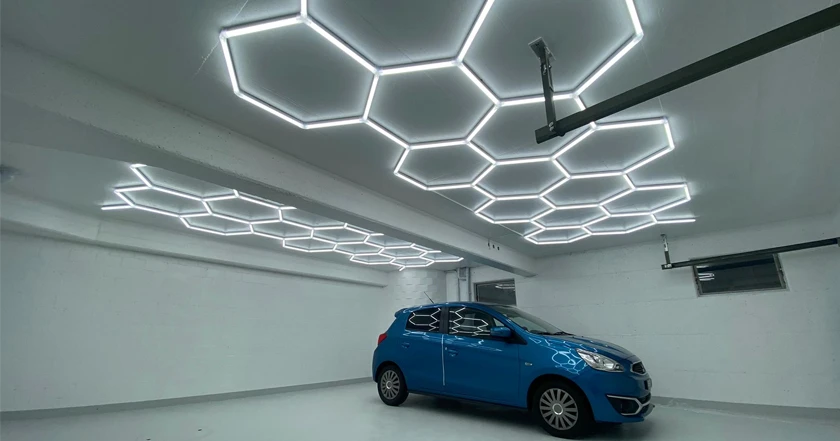
Mixing patterns in one shop
You don't have to standardize on one shape. I've laid out shops with hexagon grids in the correction bays, diamond grids in the coating bays, and small add-on hexagons over wash and prep zones. Keep the color temperature identical (5000K) across all of them so a car moving between bays doesn't appear to change color.
Mounting Height, CRI and the Flicker Test
Mount the grid 2.4-3m above the floor for a normal passenger vehicle. Higher than 3.2m the lux on the paint drops off and you lose defect contrast; lower than 2.3m the frame reflects too small on the hood and creates glare in the technician's eyes. Hang the frames level with the supplied chains or flush-mount on a suitable ceiling.
- Hold 5000K daylight across the whole shop; mixing 4000K and 6500K fixtures makes color matching impossible.
- Look for CRI 80+ at minimum (90+ if you do color-matched touch-up or custom work).
- Demand flicker-free drivers - phone-camera inspection is now part of every detailer's workflow, and cheap grids band on video.
- Keep the grid footprint slightly larger than the vehicle so vertical doors and bumpers get light, not just the roof.
Wiring, Expansion and the Mistakes I See Repeatedly
These grids are modular for a reason: you start with one bay and add frames as the business grows. Plan the power so each connected run stays within the rated load, and keep junction boxes and drivers accessible above the ceiling rather than buried behind paneling.
- Don't light only the center of the bay - doors and the front/rear bumper end up in shadow, which is where defects get missed.
- Don't mix color temperatures between grid batches; buy one 5000K range per shop.
- Leave a dimmer or circuit split if you also do filming/showcase work, where you sometimes want lower ambient.
- Clean the diffusers quarterly - compound dust and ceramic overspray film cut output surprisingly fast.
Recommended Products
Frequently Asked Questions
How many watts of hexagon light do I need for one detailing bay?
For a single full-size bay on a 2.4-3m ceiling, target around 450-600W of 5000K diffused hexagon grid, which gives roughly 1500-2500 lux on the paint - enough to read swirls during correction. A compact or valeting-only bay works fine at 180-250W.
Are hexagon or diamond lights better for car detailing?
Hexagons give the tight honeycomb reflection that exposes fine swirls and holograms during paint correction. Diamond grids give a slightly softer, broader fill that's comfortable for PPF and ceramic coating work and long sessions. Many shops use hexagon in correction bays and diamond in coating bays, all at 5000K.
What color temperature should detailing bay lights be?
5000K daylight. It matches outdoor sunlight so the paint color and correction quality you see indoors match how the car looks when delivered. Keep every fixture in the shop the same 5000K so a vehicle doesn't appear to change color as it moves between bays.
How high should I mount a hexagon detailing grid?
Mount the grid 2.4-3m above the floor. Above 3.2m the lux on the paint drops and you lose defect contrast; below 2.3m the reflection is too small and the light glares in the technician's eyes. Keep the footprint slightly larger than the vehicle to cover vertical panels.
Why can't I just use regular LED tube lights in my detailing shop?
Scattered tubes create broken bright stripes with dark gaps between them, and swirl marks hide in those dark gaps on glossy paint. A connected hexagon or diamond grid produces one continuous, even daylight field whose grid reflection distorts wherever there's a defect, making problems visible that tube lights conceal.
Need help with your LED project?
Get factory-direct pricing, free samples and engineering support within 24 hours.
Email: info@arraystarled.com | Phone: +86-0755-2103-6746 | WhatsApp: 0086 1581 8514 077
Need to size your power supply? Use our LED Strip Power Calculator to find the right driver in seconds.







