The Fuse Blows Over and Over - Hunting the Short Across a Long LED Run
- 2026-11-02 15:55
- /
- Arraystar LED
A fuse that blows the second you flip the switch is not a fuse that is too small. It is a short, and the job is to find where the + and - are touching. I split the run in half, disconnect at the midpoint, and watch which half still trips.
Why a bigger fuse is the wrong answer
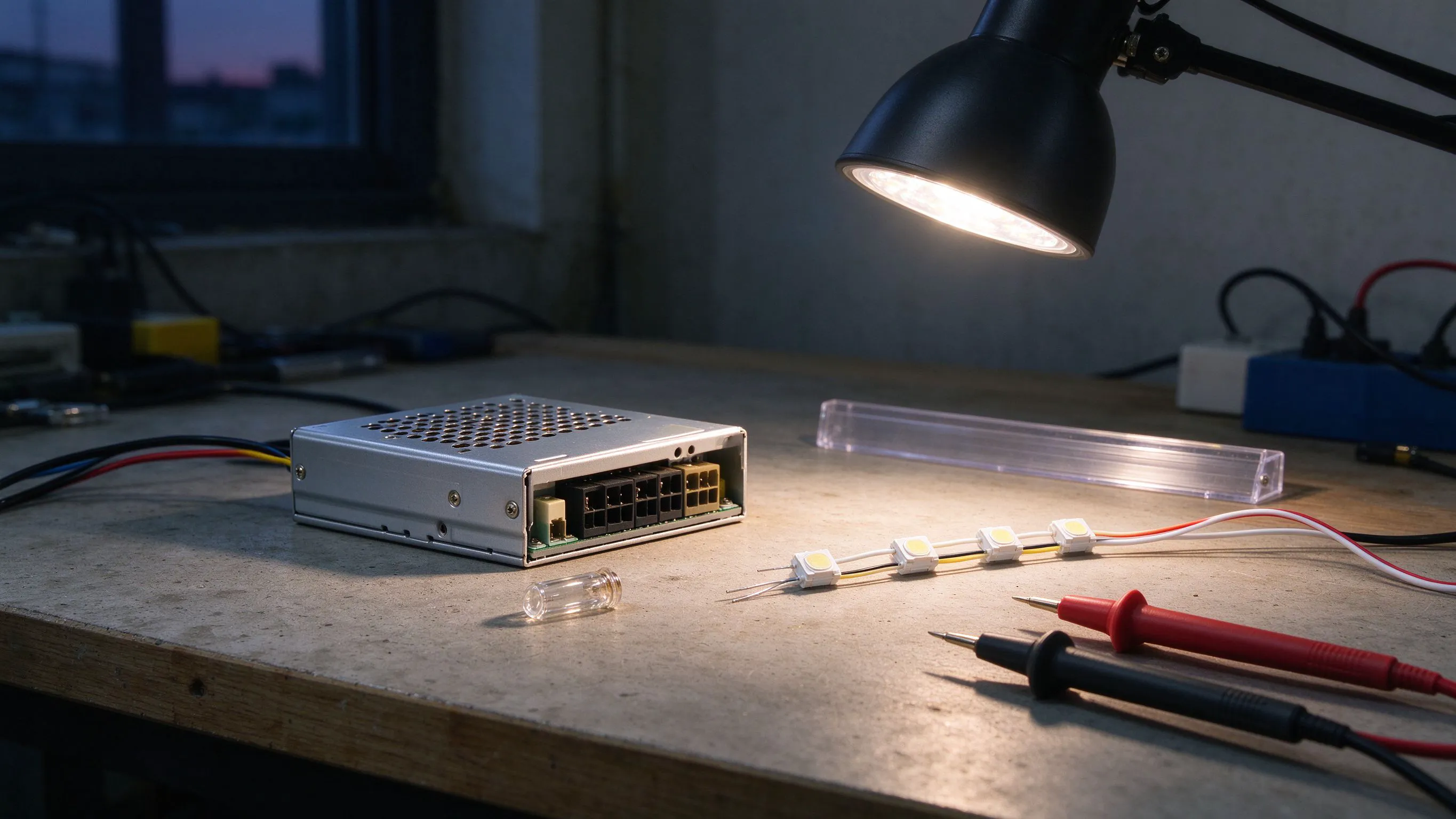
The first instinct when a 5 A fuse blows on a 12 V run is to slap in a 10 A fuse. That is how you turn a dead run into a melted wire. The fuse exists to protect the cable, and if there is a short, the extra current goes straight into heating the wire until the insulation fails. On a long run installed in a wall cavity, that is a fire waiting for a dry day.
Blow behaviour tells you the fault. If the fuse blows instantly on power-up, you have a dead short, + touching - somewhere. If it blows after a minute at full white, it is either an overloaded supply or a joint that heats up and then shorts. I treat those two cases completely differently.
Where shorts actually live on a strip run
The short is almost never inside the LED die itself. It lives where the strip has been mechanically abused: a bend that flattened the PCB and pushed the + and - copper traces together, a staple or screw driven through the run, a solder bridge across two pads, or a connector where the insulation slipped and the two pins touch inside the housing. Silicone waterproof strips also collect a thin film of flux and dust that becomes conductive when humidity climbs.
Feel the connectors before you cut anything; heat leaves a fingerprint.
| Blow pattern | Most likely location | First move |
|---|---|---|
| Instant on power-up | Solder bridge or pinched trace | Disconnect midpoint, isolate half |
| After 30-60 s warm | Connector heating up, arcing | Feel connectors with hand off power |
| Only on one colour | One channel shorted in a pixel | Cut that pixel out, jumper data |
| Only when bent / moved | Cracked trace touching sleeve | Flex the strip, watch the meter |
The half-split hunt, step by step
Isolate before you cut
- Disconnect the strip from the supply and set a multimeter to resistance, 200 ohm range.
- Measure + to - at the feed end. A healthy unpowered 12 V strip reads somewhere above 200 ohm, often several k.
- A reading under 5 ohm means a solid short right at the feed end or in the first metre.
- Cut the strip at the midpoint, measure again on the feed half. If it still reads low, the short is in the first half.
- Repeat on the bad half, splitting again, until the zone is down to 30 cm.
On a 10 m run this is three cuts and ten minutes, and it beats peeling the whole run off the wall. Keep the pieces labelled as you go, because the shorted half is the only half you actually need to open up.
Pinched traces, solder bridges, and water
Once the zone is down to 30 cm, inspect it with your eyes first. Look for a bend flatter than the minimum bend radius, usually about 30 mm for a silicone tube. Look for a staple or a cable clip that dug through the silicone and into the PCB. Look at every solder joint you made: a blob of solder bridging two adjacent pads on a density strip is the classic factory fault, and it is easy to miss because the solder is the same colour as the copper.
For waterproof runs, I wash the suspect zone with isopropyl alcohol, blow it dry, and let it sit for ten minutes. A wet flux film across two pads will short at 12 V even though it looks dry. If the resistance reading climbs after cleaning, the short was contamination, not a broken trace.

When to cut, bridge, or replace
If you find a solder bridge, wick it away with desoldering braid and clean. If you find a pinched trace, cut 50 mm back on either side of the pinch and reconnect with a latch connector. If you find water inside a silicone tube, the whole affected metre comes out; water never dries out of a sealed jacket. If you cannot find the short after three splits, the fault is in a connector or a controller output, not the strip itself.

- Never up-rate the fuse to make the blowing stop; that hides the short.
- Use a slow-blow fuse rated 1.25 times the expected steady current, not 2 times.
- Disconnect all secondary loads, sensors and controllers, before hunting the short.
- Always measure resistance with the supply disconnected, never with power on.
Recommended Products
Frequently Asked Questions
My fuse blows instantly when I turn the strip on. What now?
You have a dead short between + and -. Disconnect the strip from the supply, set a multimeter to resistance, and measure + to -. A reading under 5 ohm confirms it. Cut the run in half at the midpoint and test each half; the half that still reads low is where the short lives. Keep halving until the zone is about 30 cm.
Should I just put a bigger fuse in?
No. A bigger fuse will carry the short current long enough to melt the cable insulation. The fuse protects the wire, not the strip. If your 5 A fuse blows on a 12 V run, the supply may be oversized for the load, but an instant blow always means a short, not an undersized fuse. Find the short first.
What resistance should a healthy LED strip read unpowered?
On a 12 V constant-voltage monochrome strip, between 200 ohm and several kohm depending on length and density. A 5 m, 60 LED per metre white strip at 14.4 W per metre is about 12 ohm across the whole run when lit, but unpowered with LEDs off the reading is higher. Under 5 ohm is a short; infinite is an open.
Can water inside a silicone tube cause a short?
Yes, especially on 24 V and 12 V runs where the copper pads are millimetres apart. Distilled water is a weak conductor, but the flux residue on the PCB makes a conductive film once it is wet. If your fuse blows after rain or high humidity, open the end cap, dry the tube for an hour with compressed air, and reseal it with neutral-cure silicone.
How do I choose the right fuse rating for a strip run?
Add up the steady current of the whole run, then pick a slow-blow fuse rated 1.25 times that number. A 5 m 24 V strip at 14.4 W per metre pulls 3 A, so a 4 A slow-blow fuse is right. A 10 A fuse on a 18 AWG feed cable means the wire can overheat before the fuse reacts. Always size the fuse to the cable, not to the strip.
Need help with your LED project?
Get factory-direct pricing, free samples and engineering support within 24 hours.
Email: info@arraystarled.com | Phone: +86-0755-2103-6746 | WhatsApp: 0086 1581 8514 077
Need to size your power supply? Use our LED Strip Power Calculator to find the right driver in seconds.