
Sizing Large Hexagon LED Grid Systems for Workshops and Detail Shops
- 2026-09-30 17:39
- /
- Arraystar LED
Lighting a large workshop, warehouse bay, production floor or multi-vehicle detailing facility is a photometric sizing problem, not a matter of buying the biggest cool-looking grid. Under-lighting large spaces creates shadowed work zones and safety risks; over-lighting wastes power and creates glare. The discipline is defining the area and required lux, selecting high-wattage hexagon/rectangle grid fixtures with the right total output and mounting height, and distributing them for even coverage with no dark aisles. Size it like a facility, not a garage, and the whole floor becomes safe, shadow-free working space.
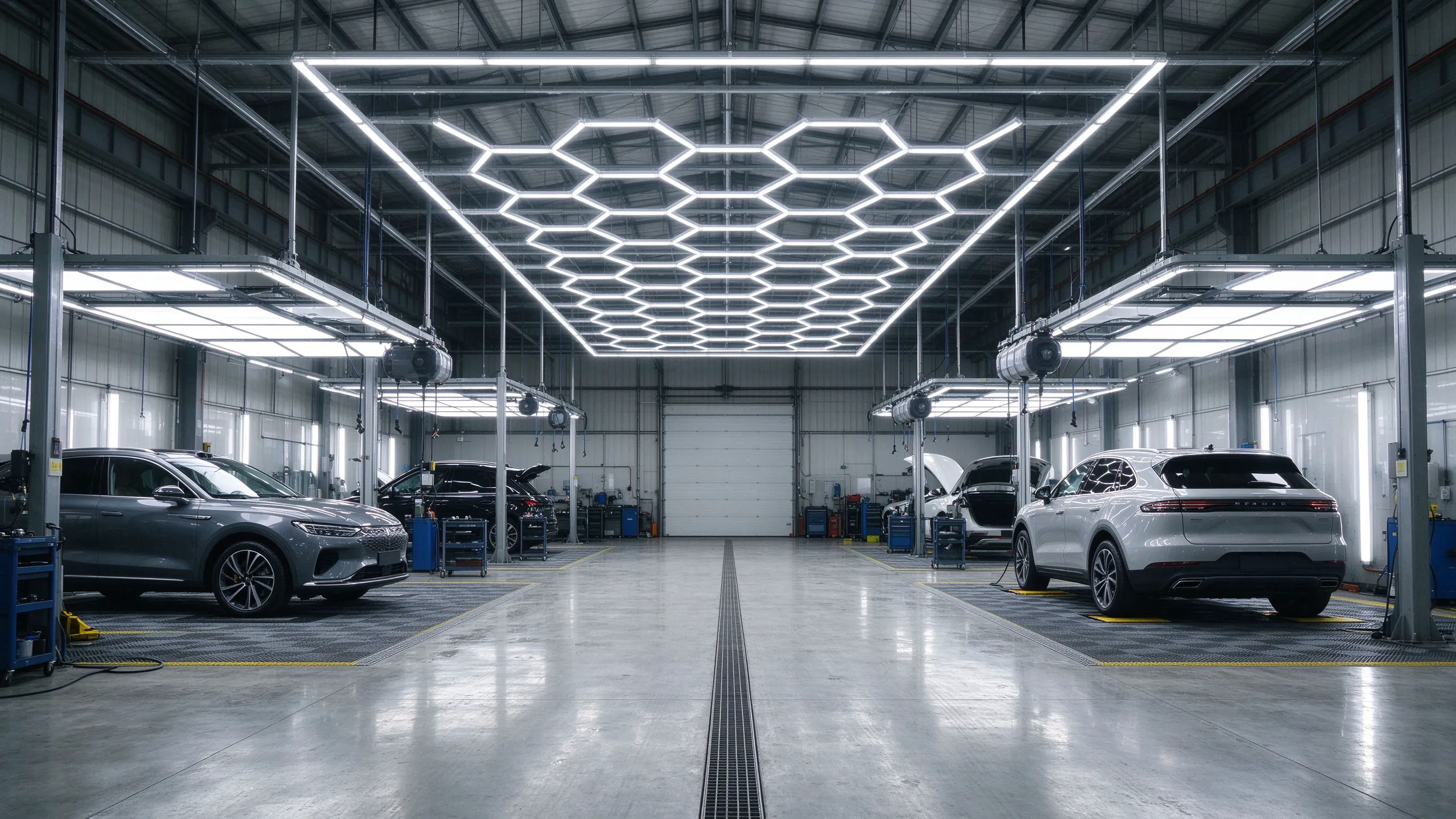
Large Spaces Need a Lighting Calculation, Not a Guess
A single-bay home garage can be lit by eye; a production workshop, warehouse or multi-bay detailing shop cannot. Large-space lighting must be designed from floor area, mounting height, required lux for the task, reflectance of surfaces and the light-loss factors over time. The output is a target total lumen count and a fixture layout that delivers even coverage at working height.
Industrial tasks typically need more light than people assume - detailed assembly, inspection and detailing can require 500-1000 lux at the work plane, while general storage aisles need less. Start from the task standard, convert to total lumens for the area, then choose fixtures and layout. Buying impressive-looking grids without this calculation leaves dark corners and over-lit centers.
High-Wattage Hexagon Grids for Big Coverage
For large workshops and multi-vehicle facilities, high-output hexagon fixtures cover substantial floor area per unit and can be arrayed across the ceiling. The 825W hexagon honeycomb is a heavyweight grid for large detailing facilities and production bays, delivering the dense multi-source coverage that wraps vehicles and workstations in shadow-free light at a scale small garage fixtures can't reach.
At the top end, the 1900W hexagon honeycomb is a facility-scale light for very large open floors, big detailing halls and high-bay production areas where a single massive high-CRI grid (or a small number of them) provides uniform coverage. These high-wattage units require proper mounting structure, adequate 220V power and often dimming/zoning so the whole floor isn't forced to full brightness at once.
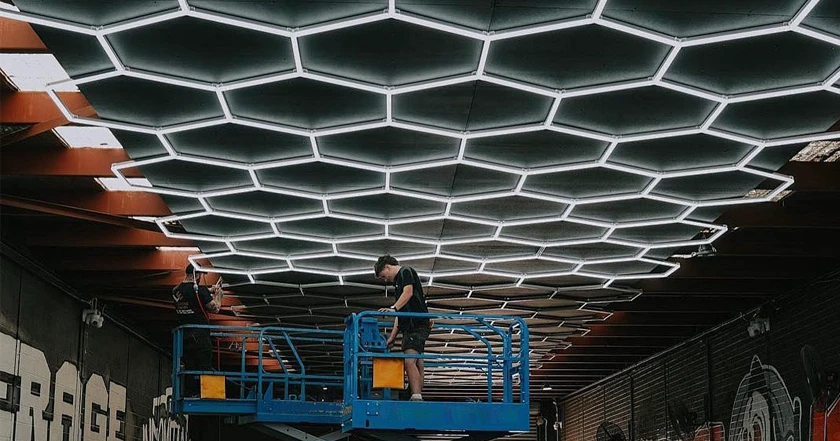
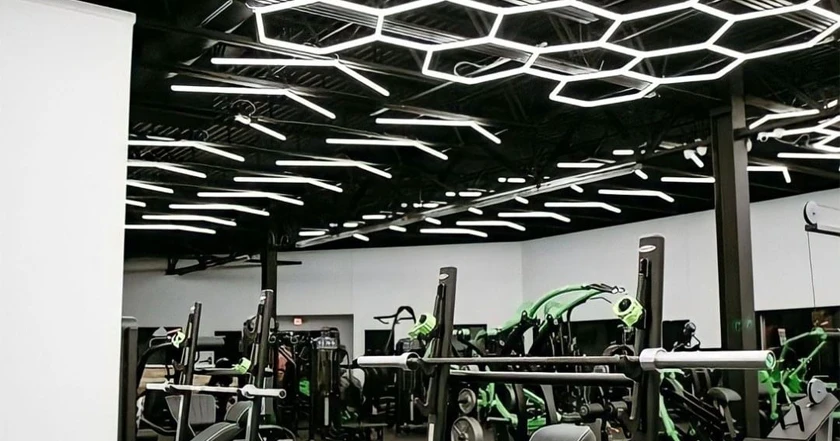
Scaling grid fixtures to facility size.
| Fixture | Scale | Typical space |
|---|---|---|
| 36-160W grids | Single bay / small garage | Home garage, one workstation |
| ~288W rectangle | Mid bay / rectangular zones | Long work areas, aisles |
| 825W hexagon | Large facility grid | Multi-bay detailing, production |
| 1900W hexagon | Facility/high-bay scale | Very large open floors, high ceilings |
| Layout | Array for uniformity | Avoid dark aisles and over-lit centers |
Rectangle Fixtures for Long Work Zones and Aisles
Not every large space suits a square honeycomb. Long production lines, rectangular repair bays, aisles and workbenches are better matched by rectangular grid fixtures that distribute light over an elongated footprint, aligning with the work zone rather than wasting output at the corners of a square grid.
The 288W rectangle garage ceiling light covers a rectangular work area - useful over long benches, paired with hex grids to fill rectangular gaps in a layout, or as the primary fixture in elongated bays. Mixing hex and rectangle modules lets you tune the footprint to the actual floor plan for complete, even coverage rather than forcing everything into honeycombs.
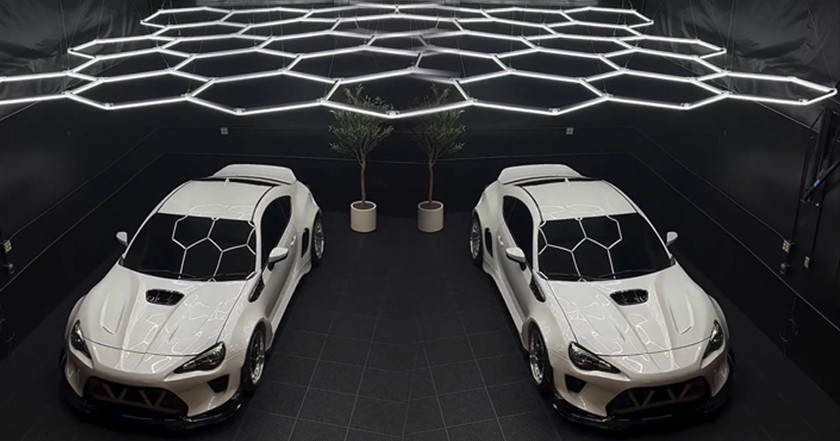
Mounting Height, Spacing and Uniformity
- Define required lux by task (inspection/detail high, storage lower).
- Calculate total lumens for the floor area, then select fixtures.
- Higher ceilings need higher output and wider spacing - verify with photometry.
- Overlap beam coverage between fixtures to eliminate dark aisles.
- Align rectangle fixtures with long work zones; hex for open bays.
- Account for maintenance/dirt light-loss and specify a margin.
At height, fixtures must throw further, so spacing tightens or output rises - a layout that's even at a 2.5m residential ceiling will be patchy at a 6m high bay. Aim for good uniformity ratio (avoid pools of bright light separated by dark aisles, which fatigue workers and create safety issues), and keep diffusers to control glare from high-output sources viewed from below.
Power, Zoning and Safety in Facility Installs
High-wattage grids need three-phase or adequate 220V circuits, structural mounting for their weight, and - increasingly - zoning and dimming so different bays and aisles run at task-appropriate levels (full for active detailing, dimmed for cleaning or empty zones), which also saves substantial energy. Have high-wattage mains work installed by a qualified electrician, and confirm emergency/egress lighting requirements are met separately from the work-lighting grid.
Recommended Products
Frequently Asked Questions
How do I calculate LED lighting for a large workshop?
Start from the required lux for the task (often 500-1000 lux for inspection/detailing, less for storage), multiply by floor area to get total lumens, factor in ceiling height, surface reflectance and light loss, then select and lay out fixtures for even coverage. Don't buy grids by appearance - under-lighting causes shadows and safety risks, over-lighting wastes energy.
What wattage hexagon light does a large detailing facility need?
Scale up from single-bay units: an 825W hexagon covers large multi-bay detailing and production floors, while a 1900W hexagon suits very large open or high-bay halls. These need solid mounting, adequate 220V/three-phase power and zoning/dimming. Verify coverage with the fixture photometry at your actual mounting height.
When should I use rectangle instead of hexagon workshop lights?
For elongated work zones - long production lines, rectangular repair bays, aisles and workbenches - where a rectangular fixture (like the 288W rectangle) matches the footprint better than a square honeycomb and doesn't waste light at the corners. Mix rectangle and hex modules to fill a floor plan completely and evenly.
Does ceiling height change workshop light spacing?
Yes - higher ceilings mean light travels farther, so you need higher-output fixtures and/or tighter spacing, and you must verify coverage with photometry at the real mounting height. A layout that's even at 2.5m will be patchy at 6m. Overlap coverage between fixtures to remove dark aisles and maintain a good uniformity ratio.
What electrical and safety requirements apply to high-wattage grids?
Large 825-1900W fixtures need adequate 220V or three-phase circuits, structural mounting for their weight, and zoning/dimming so bays run at task-appropriate levels. Have the mains work done by a qualified electrician, and provide separate code-compliant emergency/egress lighting independent of the work-light grid.
Need help with your LED project?
Get factory-direct pricing, free samples and engineering support within 24 hours.
Email: info@arraystarled.com | Phone: +86-0755-2103-6746 | WhatsApp: 0086 1581 8514 077
Need to size your power supply? Use our LED Strip Power Calculator to find the right driver in seconds.







