1220 Long-Run Neon: 12×20mm, 12W/m, Façade Fixing Detail
- 2026-11-06 16:15
- /
- Arraystar LED
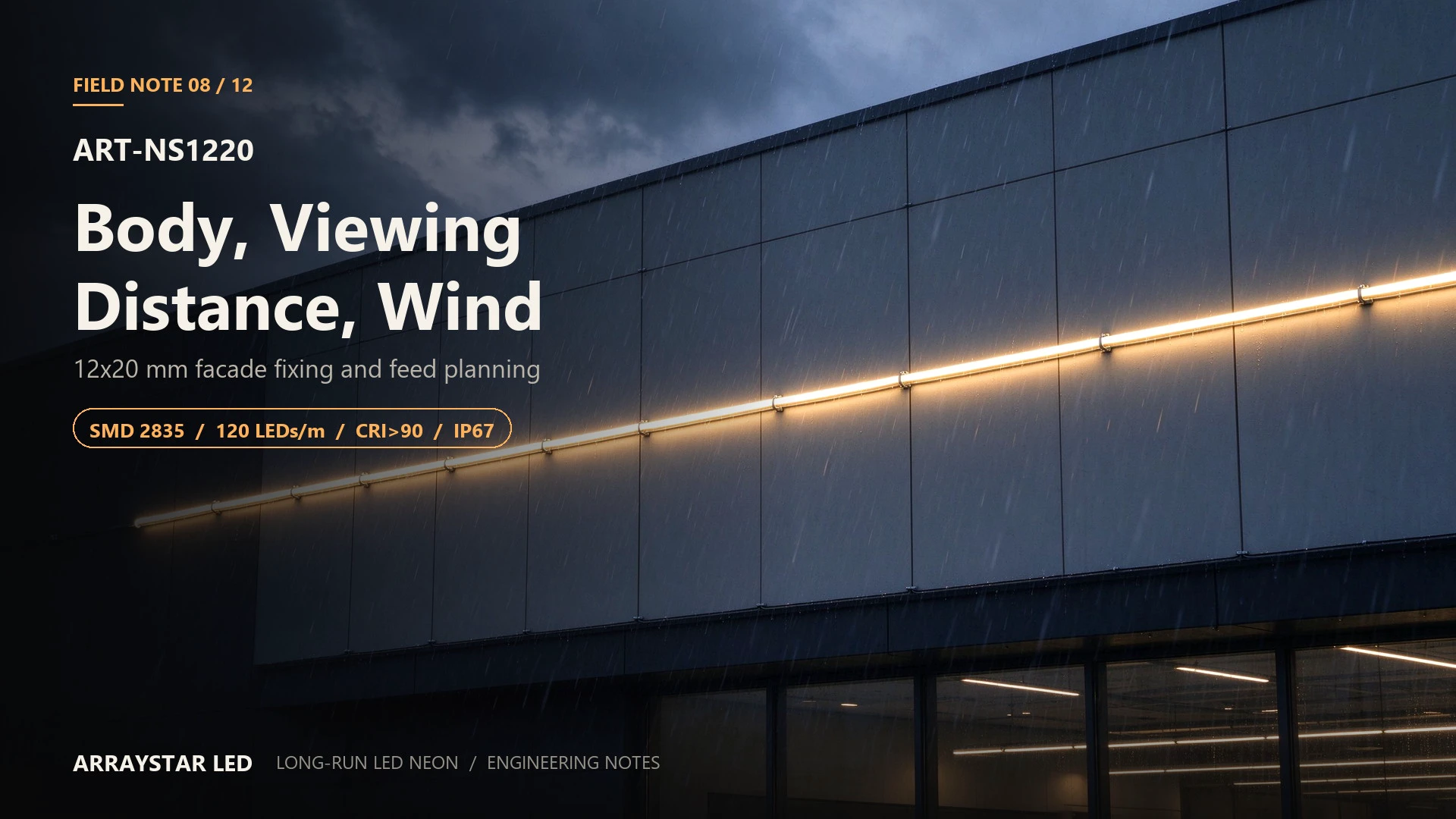
At three metres the line looks right. At thirty metres, the same 12 × 20 mm body reads as a heavy band, and the client asks why the "neon" looks like a plastic tube. Nothing changed except the viewing distance: a 20 mm deep section has visible volume, and volume is what the eye reads before it reads brightness.
A 12 × 20 mm profile is the deep-body option in the Long Run range. It is chosen for façades and bridge lines where the body must be seen from a distance and must survive wind. Both of those requirements are structural, not optical, and both are decided by the fixing detail.
1. What the 20 mm depth actually buys
| Property | 12 × 12 | 12 × 20 | Site effect |
|---|---|---|---|
| Emitting face | 12 mm | 12 mm | Same line width up close |
| Section depth | 12 mm | 20 mm | Visible volume at distance |
| Perimeter | 48 mm | 64 mm | Better heat dissipation |
| Stiffness | Moderate | High | Resists bowing and wind |
| Bend radius | Tighter | Larger | Fewer tight corners |
The output is identical at 12 W/m. The difference is presence and structure. If the design calls for a thin line, this is the wrong body; if it calls for a façade element that holds its shape across a long elevation, the extra depth is the reason to specify it.
2. Viewing distance: when a line becomes a band
The emitting face is 12 mm, but the body is 20 mm deep. At a distance, the eye integrates the whole section, not just the lit face.
- Up to 10 m: reads as a line of about 12–14 mm.
- 10–30 m: the depth becomes visible; the line reads as a 20 mm band with a lit face.
- Beyond 30 m: the body reads as a continuous architectural element, and the individual fixing points disappear.
This is useful on a bridge or a tower where a 12 mm body would vanish at distance. It is wrong on a shopfront where the detail is seen from 2 m and the client wants a fine line.
3. Wind load and the fixing schedule
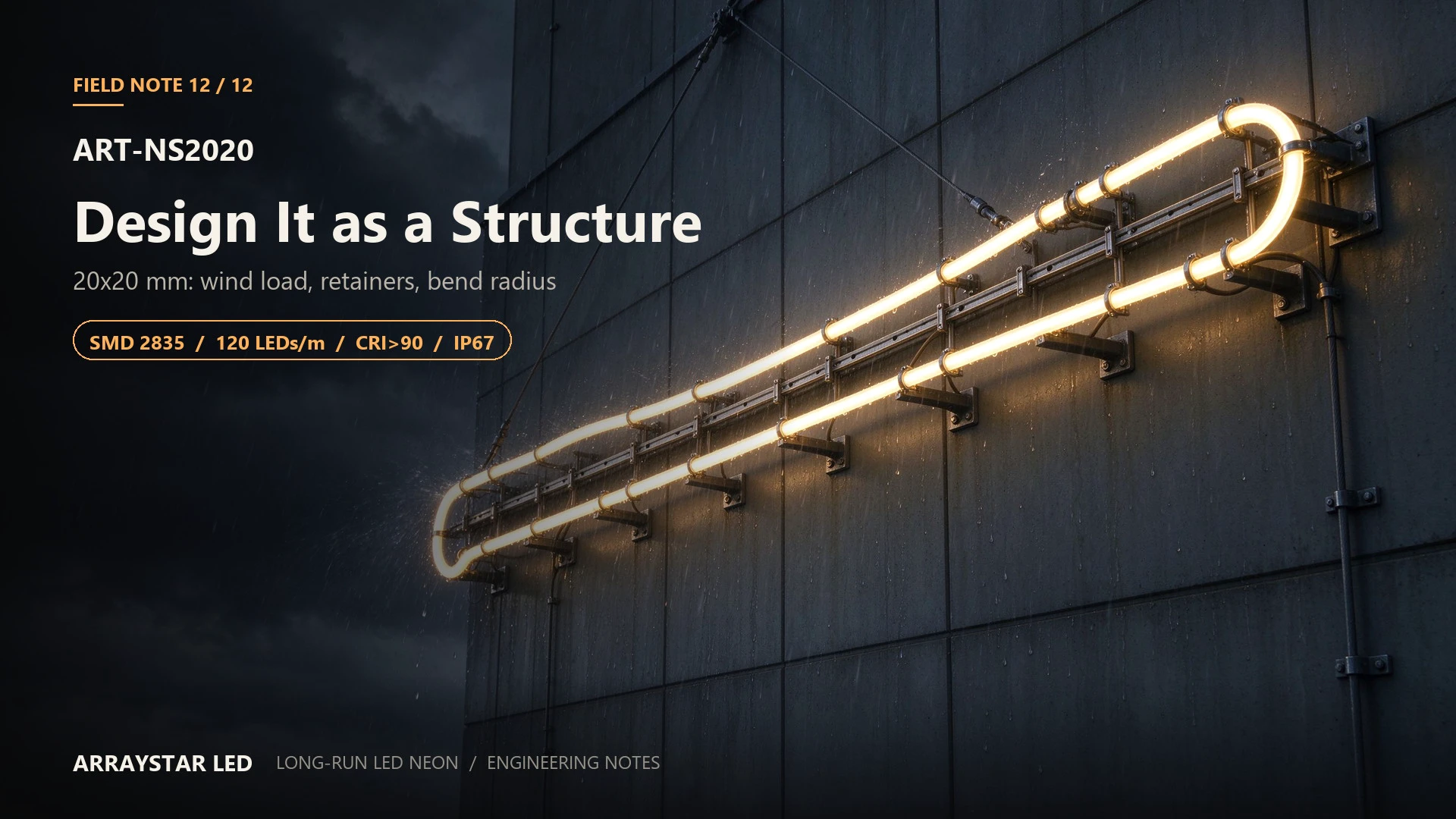
A 20 mm deep body has more sail area than a 12 mm body. On an exposed façade, that load goes straight into the clips.
- Clip spacing: 200 mm on sheltered elevations, 150 mm on exposed façades and anywhere the body runs across the wind.
- Fix at both ends of every straight run, and at every tangent point on a curve.
- Do not rely on the channel alone. The channel locates the body; the clips carry the load. On a high-rise, add a mechanical retainer at every third clip.
- Allow for thermal movement. A long aluminium channel expands; if the body is pinned at both ends with no allowance, the silicone takes the movement as tension.
On a bridge or a tall façade, the body should be detailed with a continuous channel and a clip schedule that assumes gust loading, not just dead weight.
4. Optical and electrical
120 × SMD 2835 per metre at an 8.33 mm pitch behind a 12 mm face: continuous from about 150 mm outward, the most forgiving diffuser in the range. Colour range 1800 / 2700 / 3000 / 4000 / 6000 K, CRI >90.
Electrical is the standard 12 W/m:
| Supply | Current per metre | 5 m segment | 10 m load |
|---|---|---|---|
| 24 V | 0.500 A/m | 2.50 A / 60 W | 120 W / 5.0 A |
| 36 V | 0.333 A/m | 1.67 A / 60 W | 120 W / 3.3 A |
For a façade run of 20 m or more, the 36 V option reduces current and extends the feed interval. Use 5 m feeds on 24 V; confirm the 36 V model and driver before committing to a longer interval.
Cut at marked points: 50 mm, six LEDs.
Feed drop at the segment current (5 m out + 5 m back):
| Conductor | Loop resistance | Drop at the segment | % of supply |
|---|---|---|---|
| 0.50 mm² | 0.37 Ω | 0.93 V | 3.9 % |
| 0.75 mm² | 0.25 Ω | 0.63 V | 2.6 % |
| 1.00 mm² | 0.18 Ω | 0.45 V | 1.9 % |
Use 0.75 mm² as the floor; step up to 1.00 mm² where the driver sits more than 5 m from the first tap.
5. Thermal: the best heat path in the range
A 12 × 20 section has 64 mm of perimeter — the highest in the Long Run range at 12 W/m. Expect roughly 10–14 K rise above ambient in free air, lower again against a metal channel.
That does not mean the body can be buried. It means a 12 W/m 1220 in a ventilated façade cavity will run cooler than a 1212 in the same cavity. The channel and the cavity ventilation still do the work.
6. Installation sequence for a façade
1. Set out the channel runs and confirm the substrate fixing pattern before any body is cut.
2. Fix the channel continuously, not at intervals; the channel is the thermal and mechanical datum.
3. Clip at 150–200 mm, with a clip at every end and tangent.
4. Cut at marked points, seal every outdoor end with a moulded cap and potted joint, and keep joints off horizontal surfaces.
5. Commission at night, from the design viewing distance, not from the access platform.
7. Commissioning checks
| Check | Method | Pass criterion |
|---|---|---|
| Line at design distance | View from the specified distance | No visible bowing, no clip shadows |
| Fixing integrity | Pull test at sample clips | No movement, no silicone compression |
| Feed drop | Head and tail under load | ≤ 3 % of supply |
| Surface temperature | IR probe after 60 min | ≤ 45 °C in still air |
| End seal | Visual + continuity | Potted, off the water plane |
8. Engineering FAQ
Is a 20 mm body brighter than a 12 mm body at the same wattage?
No. Same 12 W/m, same 12 mm face, same flux. It looks more present at distance because of its volume, not because it emits more.
How do I fix a 1220 run on an exposed high-rise façade?
Use a continuous aluminium channel, clips at 150 mm, a mechanical retainer every third clip, and an allowance for thermal movement at the ends. Confirm the wind load with the façade engineer; the clip schedule should be designed, not copied from an interior detail.
Can I use 36 V on a 25 m façade run?
Yes, if the 36 V model is specified and the driver matches. The lower current reduces feed drop and can remove one or two taps. Do not mix 24 V and 36 V on one circuit.
9. Specification summary
| Parameter | Value |
|---|---|
| Model | ART-NS1220 |
| Cross-section | 12 × 20 mm |
| LED | SMD 2835, 120 LEDs/m |
| Input | 24 V DC / 36 V DC |
| Power | 12 W/m |
| CRI | >90 |
| Colour | 1800 / 2700 / 3000 / 4000 / 6000 K |
| Cut unit | 50 mm (6 LEDs) |
| Warranty | 3 years |
Specifying a façade line? Send the elevation, the viewing distance, and the wind zone. We will return a channel and clip schedule sized for the load, not just for the look.