1212 Long-Run Neon: 12×12mm, 12W/m, Heat and Feed Guide
- 2026-11-06 16:15
- /
- Arraystar LED
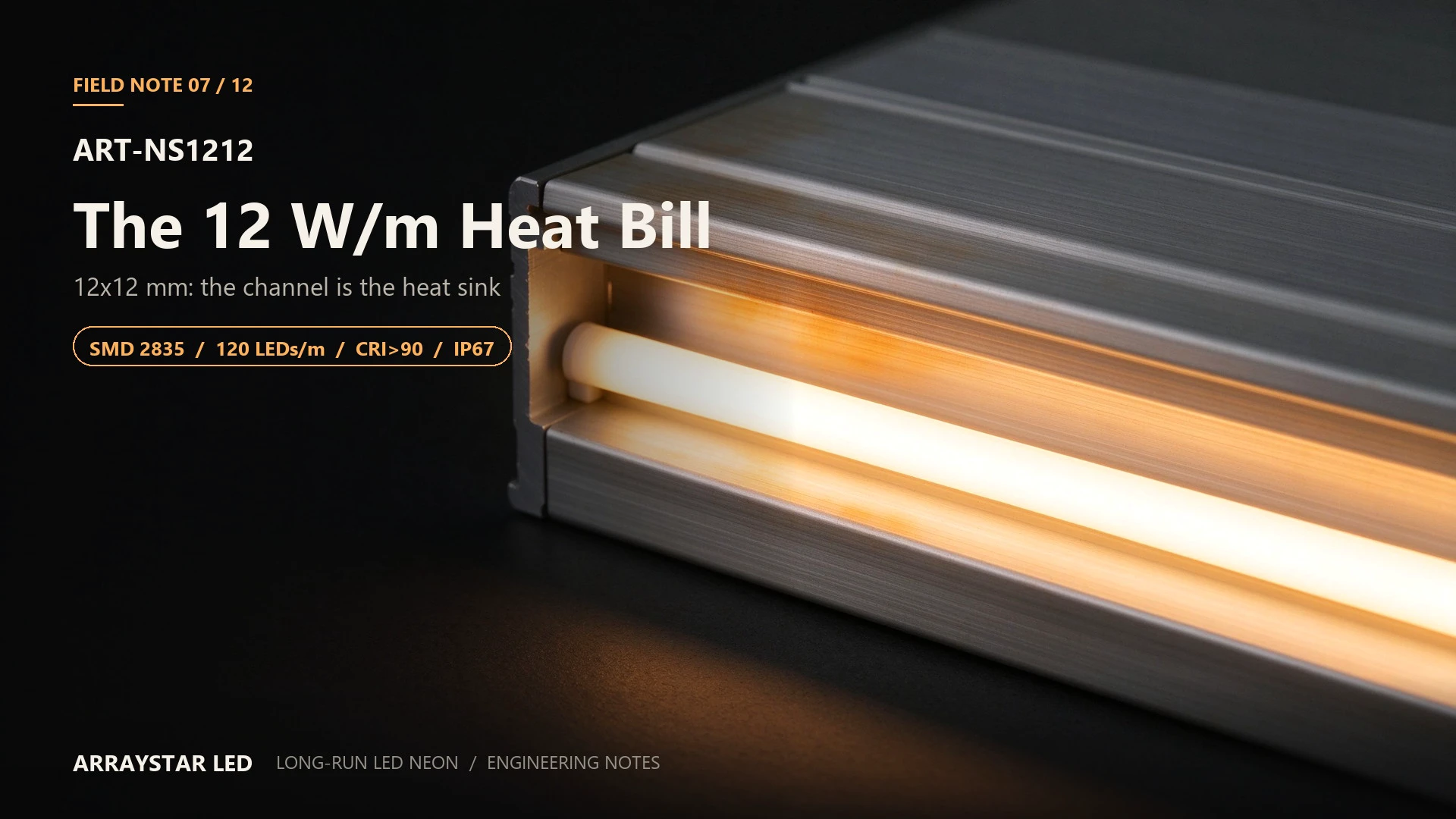
The diffuser turns yellow from the inside, and the meter still says the strip is drawing its rated 12 W/m. There is no fault at the driver and no water in the body. The installation simply ran 12 W/m through a 12 mm section inside a closed aluminium reveal with no thermal path, and the silicone has been sitting above its comfortable surface temperature since the first summer.
A 12 × 12 body is the default architectural neon profile. That does not make every 12 W/m installation in it a default installation. The standard body has a standard thermal limit, and 12 W/m is where that limit starts to matter.
1. The difference between 10 W/m and 12 W/m in the same section
The section does not change. The heat does.
| Load | Surface rise (free air) | Surface rise (closed slot) | Practical consequence |
|---|---|---|---|
| 10 W/m | ≈ 12–16 K | ≈ 18–24 K | Acceptable in most reveals |
| 12 W/m | ≈ 16–20 K | ≈ 24–32 K | Needs a metal substrate or venting |
At 35 °C ambient, a closed-slot 12 W/m run can sit in the 60–67 °C range at the diffuser. Silicone will survive that for a while; it will not survive five summers of it without colour shift. The LED may still be inside its junction-temperature limit — the diffuser fails first, which is why the complaint is always "the light looks yellow," not "the LEDs died."
The rule for this SKU: at 12 W/m, the body must touch a metal channel or the slot must be vented at both ends. A 12 × 12 body in free air is fine. The same body buried in plaster is not.
2. Optical: the 12 mm face is the forgiving one
120 × SMD 2835 per metre gives an 8.33 mm pitch. A 12 mm diffused face is wider than the pitch by a comfortable margin, so this body is the most forgiving in the range for dot-free output.
- Viewing distance: continuous from about 150 mm outward — close enough for handrail and joinery details.
- Line width: reads at roughly 12–14 mm at close range, widening with distance.
- Colour: 1800 / 2700 / 3000 / 4000 / 6000 K, CRI >90. The wider face blends a bin step better than a 6 mm or 8 mm body, but it does not eliminate it; keep adjacent rolls in the same bin lot.
If the detail needs a wider, softer line than a 10 mm body gives, this is the correct step up. If it needs a narrower line, step down to 8 × 12 — not down in wattage.
3. Electrical: 12 W/m, 24 V and 36 V
| Supply | Current per metre | 5 m segment | 10 m load |
|---|---|---|---|
| 24 V | 0.500 A/m | 2.50 A / 60 W | 120 W / 5.0 A |
| 36 V | 0.333 A/m | 1.67 A / 60 W | 120 W / 3.3 A |
At 24 V, a 5 m segment at 2.50 A needs a 0.75 mm² feed as a floor. At 36 V the same segment draws 1.67 A and can use a smaller conductor for the same drop, or the same conductor for a longer interval.
Driver sizing: total wattage plus 20–25 % headroom. For a 10 m run at 24 V that is a 150 W driver, not 120 W.
Cut only at the marked points: 50 mm, six LEDs at 120 LEDs/m.
Feed drop at the segment current (5 m out + 5 m back):
| Conductor | Loop resistance | Drop at the segment | % of supply |
|---|---|---|---|
| 0.50 mm² | 0.37 Ω | 0.93 V | 3.9 % |
| 0.75 mm² | 0.25 Ω | 0.63 V | 2.6 % |
| 1.00 mm² | 0.18 Ω | 0.45 V | 1.9 % |
Use 0.75 mm² as the floor; step up to 1.00 mm² where the driver sits more than 5 m from the first tap.
4. The channel is the heat sink, not an accessory
A 12 × 12 body in a flexible aluminium channel transfers heat through the channel wall to the substrate. The channel does three jobs at once:
1. Conduction. It spreads the 12 W/m along the profile instead of letting it concentrate at the diffuser.
2. Mechanical location. It holds the body on centre and takes the clamp load off the silicone.
3. Bend control. It defines the radius so the body cannot be forced into a crease.
For this profile, use a channel sized to the 12 × 12 body rather than a generic reveal. A channel with a 2 mm air gap on each side is a mechanical holder, not a heat sink.
5. Installation sequence
1. Confirm the load. 12 W/m × the measured run length; do not size the driver from the nominal roll length.
2. Fix the channel to the substrate before the body goes in. The channel-to-substrate contact is the thermal path.
3. Clip at 200–250 mm on straights, 100 mm through bends, offset by half a pitch from any emitter.
4. Cut only at marked points, then seal with a moulded cap and potted joint outdoors.
5. Commission with a meter: head and tail voltage under load, then surface temperature after 60 minutes at full output.
6. Commissioning checks
| Check | Method | Pass criterion |
|---|---|---|
| Surface temperature | IR probe after 60 min at full output | ≤ 45 °C in still air at 25 °C ambient |
| Feed drop | Head and tail under load | ≤ 3 % of supply |
| Diffuser colour | Compare against a retained sample | No visible yellowing after burn-in |
| Bend integrity | Visual at every radius, 24 h after forming | No crease, no lift |
| End seal | Visual + continuity | Potted, off the water plane |
7. Engineering FAQ
Can a 12 W/m 1212 run without an aluminium channel?
In free air, yes. In a closed reveal, no — the surface temperature climbs into the range where the diffuser yellows. If the detail cannot accept a channel, reduce the load or vent the slot at both ends.
Why does the same body exist at 10 W/m and 12 W/m?
The 10 W/m version is for reveals with limited thermal path; the 12 W/m version is for runs with a metal substrate where the extra output is usable. Choosing 12 W/m for a slot that cannot dissipate it is a thermal error, not a brightness upgrade.
Is 36 V better for a 12 W/m run?
For long runs, yes: one third less current for the same wattage means less feed drop and longer practical intervals. For a 5 m run with a local driver, 24 V is simpler and equally effective.
8. Specification summary
| Parameter | Value |
|---|---|
| Model | ART-NS1212 |
| Cross-section | 12 × 12 mm |
| LED | SMD 2835, 120 LEDs/m |
| Input | 24 V DC / 36 V DC |
| Power | 12 W/m |
| CRI | >90 |
| Colour | 1800 / 2700 / 3000 / 4000 / 6000 K |
| Cut unit | 50 mm (6 LEDs) |
| Warranty | 3 years |
Running 12 W/m in a tight reveal? Send the section and the substrate. We will confirm whether the detail can take the load, or whether the 10 W/m version is the correct specification.