Why a Dark Shadow Band Runs Behind My Neon Letter on the Wall
- 2026-11-02 15:54
- /
- Arraystar LED
That dark band running behind your neon letter is the standoff gap, and it is one of two problems: the tube sits too close to the wall and casts a shadow, or the wall behind is lit unevenly. I set the gap at 12 to 20 mm depending on tube size, and the band disappears without turning into a halo.
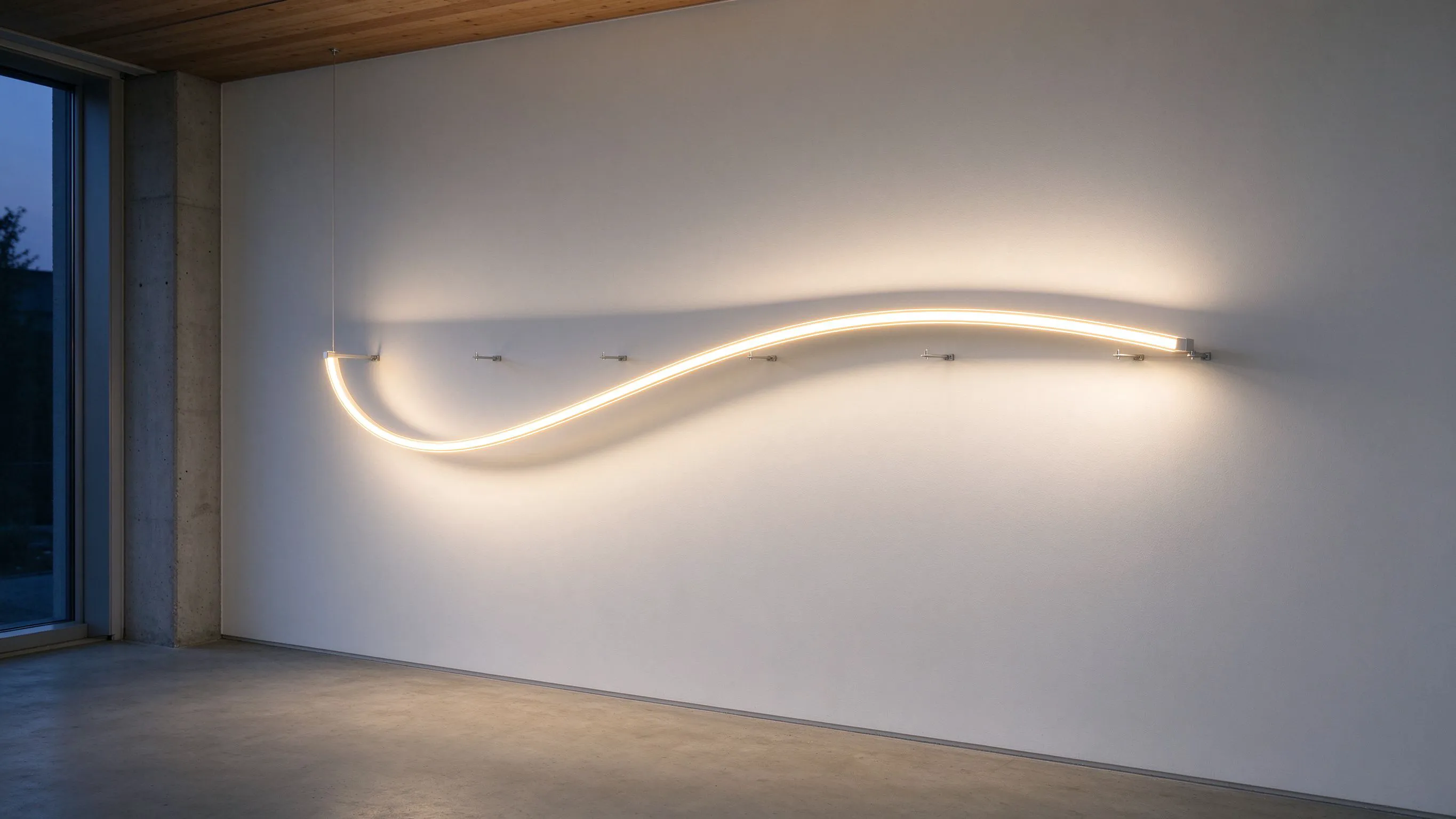
The dark stripe behind every letter
You hang the sign, step back, and there it is: a sharp dark shadow hugging the back edge of each letter, like the tube is sitting on a black ruler. The client loves the glow itself, but that stripe makes the sign look stuck on rather than part of the wall. It happens on white render more than anywhere else, because the contrast is so high.
I used to think it was a problem with the diffuser until I measured a few standoffs. The tube was mounted 8 mm off the wall, and the light from the back of the silicone fell off so quickly that the wall directly behind the letter got almost no spill. The shadow is geometry, not a defect in the tube.

Why the gap decides everything
A neon tube emits light from the front, but a small amount leaks out the back through the silicone jacket. That back spill is what lights the wall around the letter. Sit the tube too close and the back spill is blocked by the tube itself, leaving a dark strip directly behind it. Sit it too far and the spill spreads into a wide fuzzy halo that looks like the sign is floating.
The sweet spot scales with tube cross-section; bigger tubes want a slightly larger gap.
| Standoff gap | What you see | Use it? |
|---|---|---|
| Under 10 mm | Dark shadow band behind the letter | No |
| 12-20 mm | Clean outline, faint even spill | Yes |
| Over 25 mm | Wide halo, standoffs visible | No |
How I set the gap for each tube size
I size the gap off the tube cross-section rather than a fixed number. A 10 mm tube wants about 12 mm off the wall; a 20 mm tube wants 20 mm. The idea is that the back spill has just enough distance to spread into a soft wash that ends about level with the tube edges, rather than pooling into a dark line or exploding into a halo.
- 10-12 mm tube: 12-15 mm off the wall.
- 14-16 mm tube: 15-18 mm off the wall.
- 18-25 mm tube: 20-25 mm off the wall.
I also check the wall colour. On a dark feature wall the shadow band is almost invisible, so I can sit the tube a touch closer. On bright white render I bias toward the larger end of the range, because the eye is far pickier there.
What makes the band worse

Three things make the shadow band worse than it needs to be. First, a flat-back tube with no diffuser on the rear casts a hard shadow because almost no light leaks back. Second, a matte dark wall absorbs the little back spill there is. Third, mounting the tube against a recessed box or channel blocks the spill entirely and guarantees the band.
A channel mounts the tube neatly but kills the back spill.
| Cause | Effect | Fix |
|---|---|---|
| Flat-back tube | Hard shadow behind | Use a rounded diffuser tube |
| Dark matte wall | Spill absorbed | Move to a lighter substrate or add gap |
| Tube in a recessed channel | No back spill at all | Mount proud of the channel |
Checking the band before I leave site
I always look at the sign at night from the normal viewing distance, not up close on the ladder. The shadow band that looks harsh at 30 cm disappears at 3 m, and vice versa. If I can see a dark stripe from across the room, I adjust the standoffs before I pack up.
- Stand 3 m back in a dark room and squint; the band either reads or it does not.
- Photograph the sign at night with a phone; the camera shows the band more honestly than your eye.
- If the band persists, raise the standoffs 3 mm rather than swapping the tube.

Recommended Products
Frequently Asked Questions
Why is there a dark shadow behind my neon letter?
Because the tube is mounted too close to the wall. The light that leaks through the back of the silicone jacket is what lights the wall around the letter; sit the tube under 10 mm off the wall and the tube itself blocks that back spill, leaving a dark stripe directly behind. Raise the standoffs to 12-20 mm and the band goes.
How far off the wall should neon standoffs be?
I keep 12 to 25 mm depending on tube size. A 10-12 mm tube sits 12-15 mm off the wall; a 16-20 mm tube sits 18-25 mm. Closer than 10 mm casts a hard shadow band; further than 25 mm spreads the spill into a wide halo and makes the standoffs themselves visible. Bias toward the larger gap on bright white walls.
Can I stop the neon shadow by painting the wall?
A little. A slightly warmer or mid-tone wall hides the band far better than stark white render, because the contrast between the lit spill and the dark stripe drops. It is not a fix for a tube mounted at 8 mm, but on an 18 mm gap it softens the remaining band enough that nobody notices. Do not paint the standoffs; that draws the eye to them.
Does mounting neon in an aluminium channel cause a shadow?
Yes. A channel covers the back and sides of the tube, so no back spill reaches the wall and you get a hard dark line behind every letter. Channels are great for conduit-fed runs but terrible for outline lettering that needs a soft halo. If you must use a channel, mount it proud of the wall on spacers so light can escape underneath.
Why does my neon look like it has a halo instead of a shadow?
That means the standoffs are too long. Sit the tube further than about 25 mm off the wall and the back spill spreads into a wide, fuzzy glow that makes the letter look like it is floating. The standoffs themselves also become visible against the wall. Shorten the standoffs by 5 mm and the halo tightens into a clean outline.
Need help with your LED project?
Get factory-direct pricing, free samples and engineering support within 24 hours.
Email: info@arraystarled.com | Phone: +86-0755-2103-6746 | WhatsApp: 0086 1581 8514 077
Need to size your power supply? Use our LED Strip Power Calculator to find the right driver in seconds.