
Pixel Strings vs Neon Flex for Building Outlines
- 2026-10-09 18:41
- /
- Arraystar LED
Building and tree outlines that need animation, colour changes and chasing effects cannot use static neon flex alone; they call for full-colour pixel strings, discrete addressable nodes spaced along a wire that trace any roofline, branch or facade shape. Choosing pixel strings versus neon flex comes down to whether the outline must be a steady line or a dynamic, programmable display.
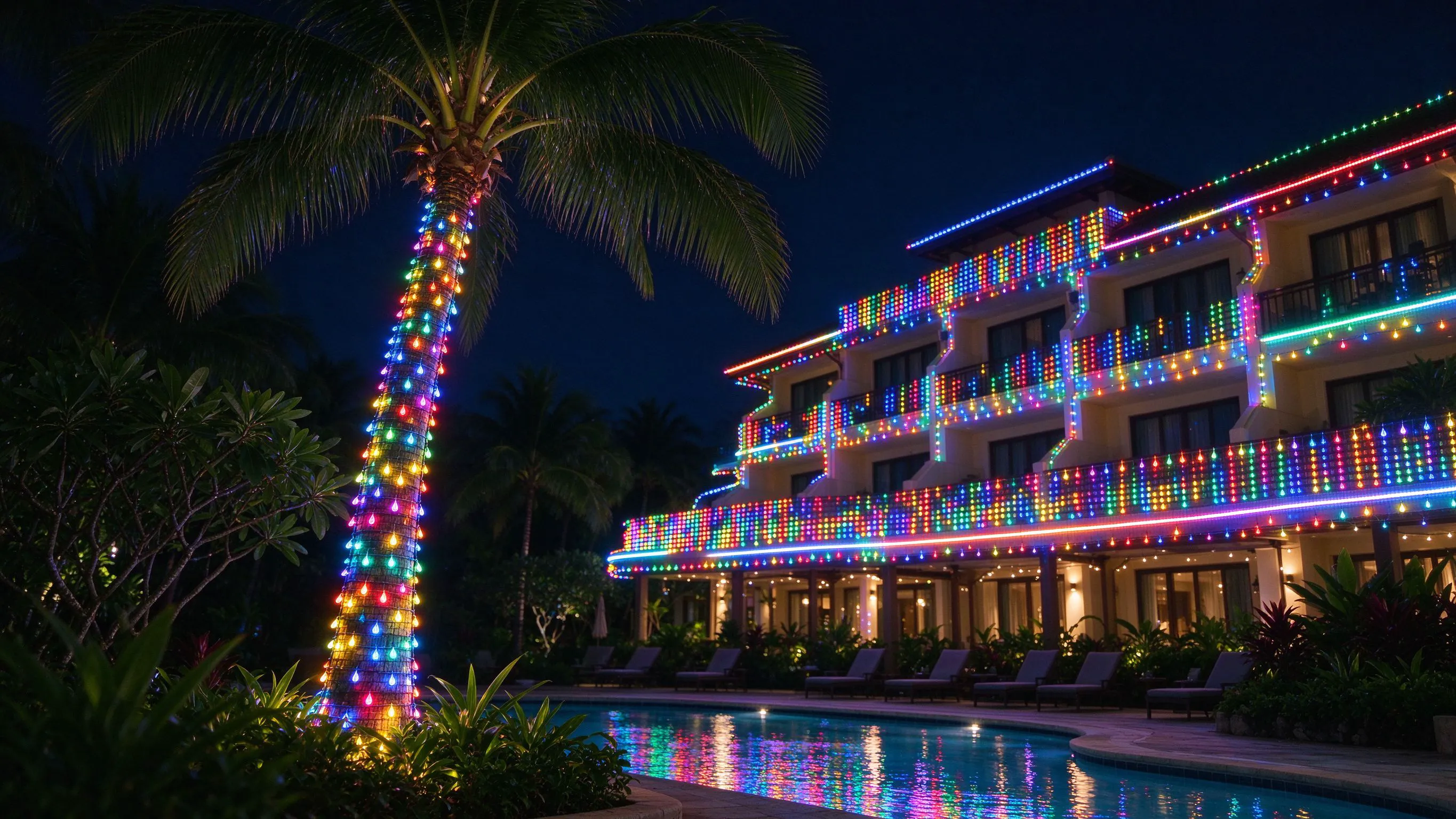
Static Outline vs Animated Outline
Neon flex produces a beautiful continuous line and is ideal where the building outline should glow in a fixed colour. But many festive, commercial and landmark installations want the outline to chase, ripple, change colour for events or display simple patterns along a roofline or tree, and a continuous neon line cannot address individual points to create that motion.
Animated outlines use pixel strings: a flexible wire carrying discrete addressable LED nodes at set spacing, each independently controllable, which can be draped or fixed along almost any linear or branching form.
What the Full-Colour Pixel String Does
- Discrete addressable RGB nodes spaced along a wire.
- Chasing, rippling and colour-changing animation.
- Follows rooflines, trees and branching shapes.
- Full-colour programmable output from a pixel controller.
- Flexible, drapable form for complex outlines.
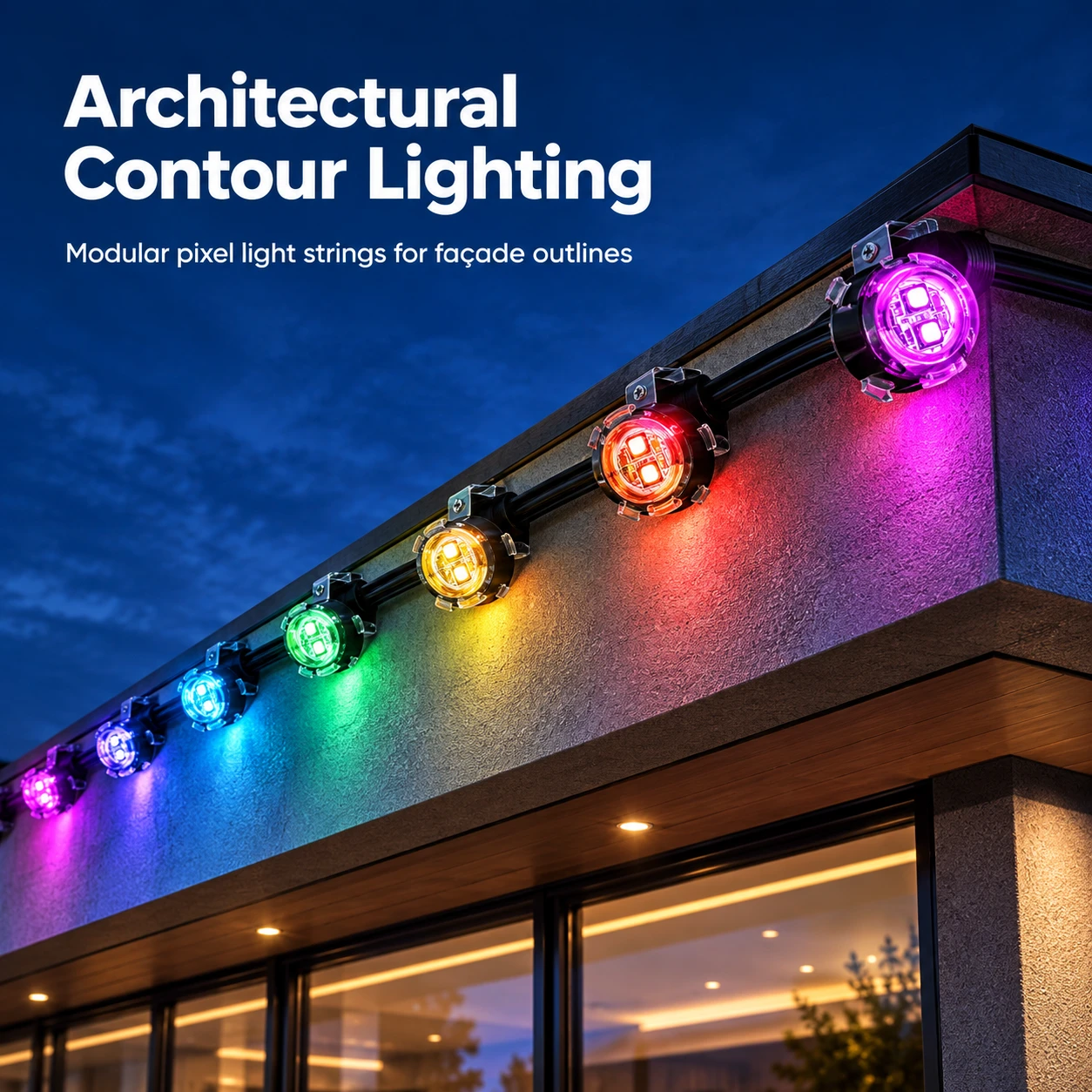
For animated building and tree outlines I use the full-colour pixel string (TM-202D3535RGB). Its separate nodes create motion a continuous neon line cannot.
Neon Flex vs Pixel String for Outlines
Choose by whether the outline is static light or moving content.
| Factor | Neon flex | Pixel string |
|---|---|---|
| Appearance | Continuous line | Points/nodes along a wire |
| Animation | Fixed colour/static | Chase, ripple, colour change |
| Shapes | Linear curves | Rooflines, branches, drapes |
| Resolution | Seamless line | Set by node spacing |
| Best for | Steady architectural line | Dynamic festive/commercial shows |
Where Pixel Strings Are Deployed
- Festive and seasonal roofline and facade outlines.
- Trees, palms and branching landscape features.
- Commercial plaza and theme-park animated displays.
- Building crowns and perimeter light shows.
- Temporary events needing programmable colour and motion.
Node Spacing and Viewing Distance
Pixel strings are defined by node spacing, which sets the resolution of the animation. Close spacing gives smooth effects for near viewing, while distant rooflines and tall trees can use wider spacing because the eye blends the nodes across the viewing distance. I choose spacing from the closest important viewing position, test the intended effect at that distance, and avoid over-specifying dense nodes on a high roofline where the extra resolution is invisible and the cost and data load are wasted.
- Set node spacing from the nearest viewing distance.
- Dense for close features, wider for high/distant outlines.
- Test chase and colour effects at real viewing range.
- Match spacing to the controller's pixel capacity.
Controllers, Power and Weather for Outdoor Strings
Each node draws power and counts as a pixel, so long strings require a controller capable of the total node count, weatherproof power injection along the run and, for large facades, distributed controllers. I specify exterior-rated strings and sealed connections, plan injection points before nodes dim or misbehave at the far end, and keep data runs within the protocol's limits. Animated trees in particular need power fed up the structure rather than only at the base.
Combining Neon and Pixels in One Scheme
The two products are not mutually exclusive. A polished scheme often uses neon flex for the steady architectural base line and pixel strings for the elements that animate, such as a crown, logo or tree, giving both a clean continuous outline and dynamic focal points. I design the control and power so the static and animated elements can be scheduled together, and I match colour quality between them so mixed white and colour elements do not clash.
Specifying an Animated Outline
Send the outline length and shape (roofline, tree, facade), nearest viewing distance, desired effects and colours, controller preference and exposure. I will confirm pixel string node spacing, total node count, controller capacity, injection and weatherproofing. We supply the full-colour pixel string and recommend testing a sample string with the intended effects at the real viewing distance before installing the full outline.
Animating a Hotel's Palm-Tree Canopy for the Season
A beachfront hotel wanted its entrance palms to become a festive animated feature for the holiday season and special events, with warm-white shimmer and the ability to shift to full colour for celebrations, then return to an elegant static look. The landscaper first proposed wrapping the trunks and fronds in neon flex, which would have produced a continuous glow but could not follow the branching fronds cleanly and offered no per-point animation, leaving the trees looking like glowing poles rather than twinkling canopy.
We specified full-colour pixel strings instead, choosing node spacing from the guest viewing distance, which for palms lining a driveway meant moderately spaced nodes that the eye blended into a shimmering canopy from the cars and entrance while keeping node count and cost sensible. The strings were draped from the crown outward along the fronds and spiralled lightly down the trunks, a branching geometry discrete nodes handle naturally but a continuous neon line cannot. We planned the installation around the physical reality of lit trees: weatherproof, exterior-rated string with sealed connections, power injected up into each crown rather than fed only from the base, and controllers sized to the total node count with the data runs kept within limits, because a tree fed only from the ground produces dim, misbehaving nodes at the top where the visual impact is greatest. The controller scenes gave the hotel exactly the range they wanted, a gentle warm-white twinkle for normal evenings, full-colour chase for events and a static elegant white for quiet nights, all scheduled rather than manually changed. We matched the canopy strings to a steady neon line used at the entrance so the static and animated elements shared a consistent white. The palms became the hotel's most photographed seasonal feature and the system was reused across multiple seasons by simply changing programs, with no reinstallation. The project demonstrates the core decision cleanly: when a feature must animate and follow a branching, three-dimensional form, discrete addressable nodes on a string are the right instrument, and the success of the installation depends as much on power delivered up the structure and node spacing matched to viewing distance as on the lights themselves.
Recommended Products
Frequently Asked Questions
What is a full-colour LED pixel string?
It is a flexible wire carrying discrete, individually addressable RGB LED nodes at fixed spacing, each controllable for colour and brightness so the string can chase, ripple and change colour. It drapes or fixes along rooflines, trees and branching shapes for animated outlines, unlike continuous neon flex which glows as a static line.
Should I use pixel strings or neon flex for a building outline?
Use neon flex for a clean continuous line in a fixed colour, and pixel strings when the outline must animate, chase, ripple or change colour for events. Pixel strings also follow branching forms like trees more naturally. Many schemes combine both: neon for the steady architectural base and pixels for animated crowns, logos or trees.
What node spacing do I need for a pixel outline?
Spacing sets the animation resolution and should be chosen from the nearest important viewing distance: dense nodes for features viewed close up, wider spacing for high rooflines and tall trees where the eye blends distant points. Test the intended chase and colour effects at the real viewing range and match total node count to the controller's capacity.
How are long outdoor pixel strings powered and controlled?
Each node is a powered pixel, so long strings need a controller sized for the total node count, weatherproof power injection along the run (and fed up into trees, not only at the base), exterior-rated string with sealed connections, and data runs within protocol limits, using distributed controllers on large facades.
Can neon and pixel strings be used together?
Yes, often to good effect: neon flex provides the steady continuous architectural base line while pixel strings animate crowns, logos or trees as dynamic focal points. Design the control and power so both can be scheduled together and match colour quality between the static and animated elements so mixed lighting does not clash.
Need help with your LED project?
Get factory-direct pricing, free samples and engineering support within 24 hours.
Email: info@arraystarled.com | Phone: +86-0755-2103-6746 | WhatsApp: 0086 1581 8514 077
Need to size your power supply? Use our LED Strip Power Calculator to find the right driver in seconds.







