48V IP67 COB Strips for Long Outdoor Linear Runs
- 2026-10-09 18:40
- /
- Arraystar LED
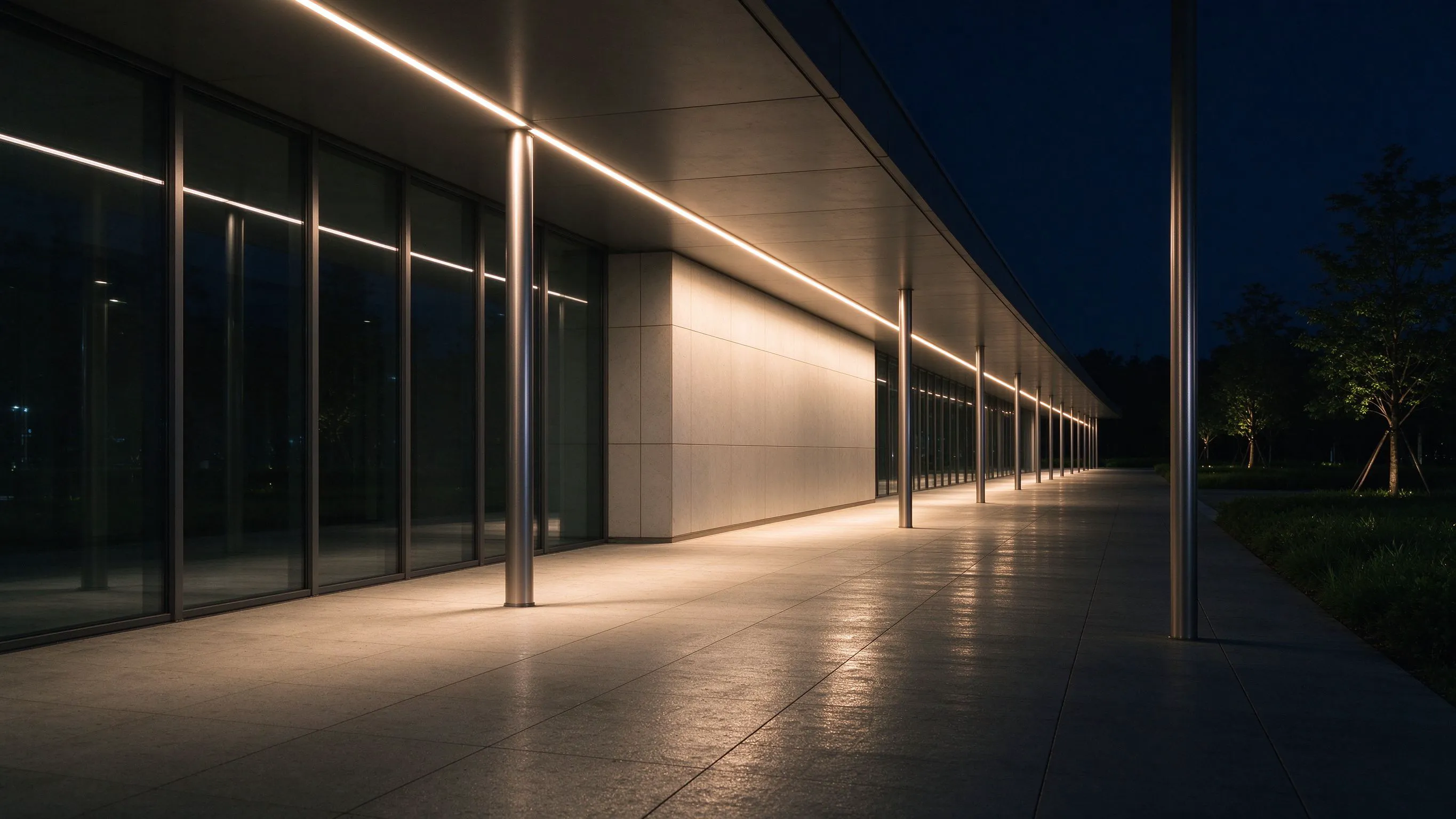
Long exterior architectural lines face two enemies at once: voltage drop over distance and moisture along the whole run. A 48V IP67 COB strip addresses both, using higher voltage to extend the distance between feeds and solid waterproofing to survive outdoors, while keeping the dot-free COB look. It is the practical choice for long facade, soffit and landscape outlines that would need constant injection on 12/24V.
Two Problems Hit Outdoor Lines at the Same Time
Indoor coves can usually hide a driver every few metres without much trouble. Outdoor architecture is less forgiving: a facade edge, a pergola outline or a landscape run may extend tens of metres with nowhere convenient to place power, and every feed point outdoors is also a potential water ingress point. On 12 or 24V strip, voltage drop forces frequent injection, multiplying both the hardware and the sealed junctions.
Raising the voltage and specifying genuine IP67 construction attacks both problems from the same product.
How 48V Extends the Run
- Higher voltage means lower current for the same power, cutting resistive voltage drop.
- Longer distances between feed points, so fewer drivers and sealed junctions outdoors.
- More even brightness from one end of a long line to the other.
- Thinner or simpler power cabling for a given load over distance.
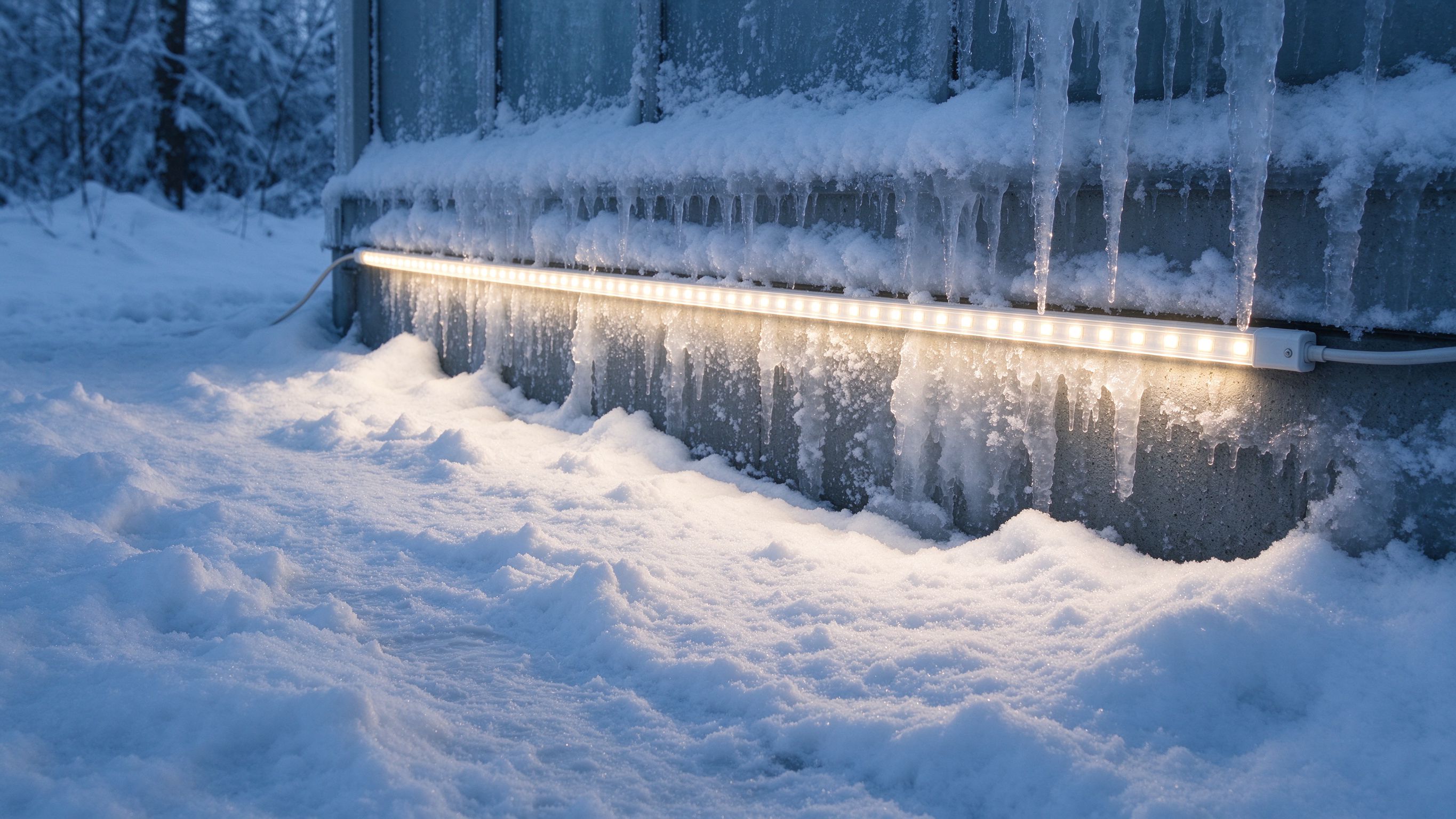
- IP67 encapsulation for continuous outdoor moisture protection.
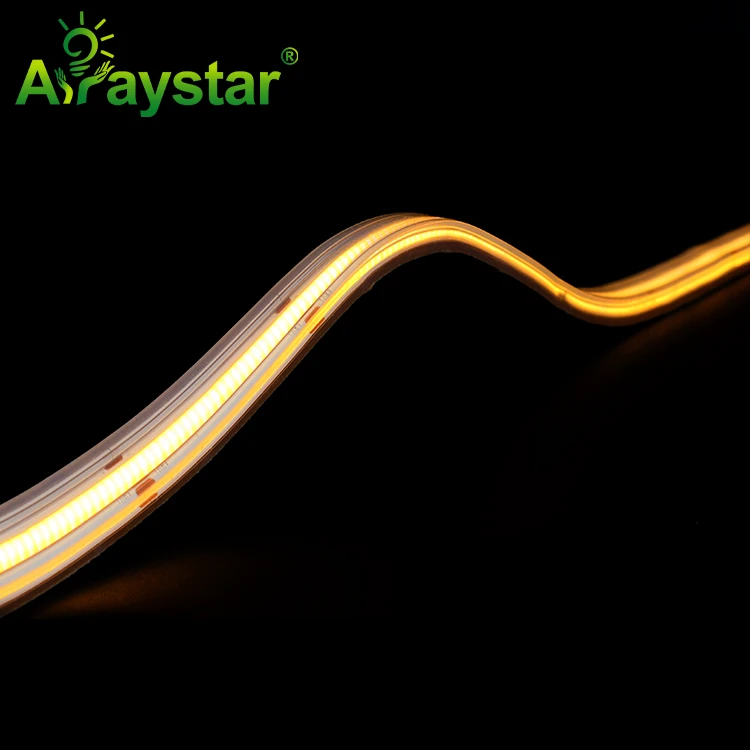
For long outdoor architectural lines I use the 48V IP67 COB. It combines the voltage headroom of 48V with full waterproofing and seamless COB emission in one strip.
12V, 24V and 48V for Outdoor Runs
Step up voltage as run length and feed difficulty grow.
| Voltage | Typical feed spacing | Best for |
|---|---|---|
| 12V | Short | Small signs, tight displays, short accents |
| 24V | Medium | General indoor and moderate outdoor runs |
| 48V | Long | Long facades, pergolas, landscape outlines |
| 220V driverless | Very long fixed perimeters | Mains-voltage specialist installs |
I move to 48V when the 24V feed count starts forcing drivers and waterproof junctions in places the architecture does not want them. The savings come from fewer supplies, less cable and fewer sealed connections across a long run.
Where 48V IP67 COB Fits
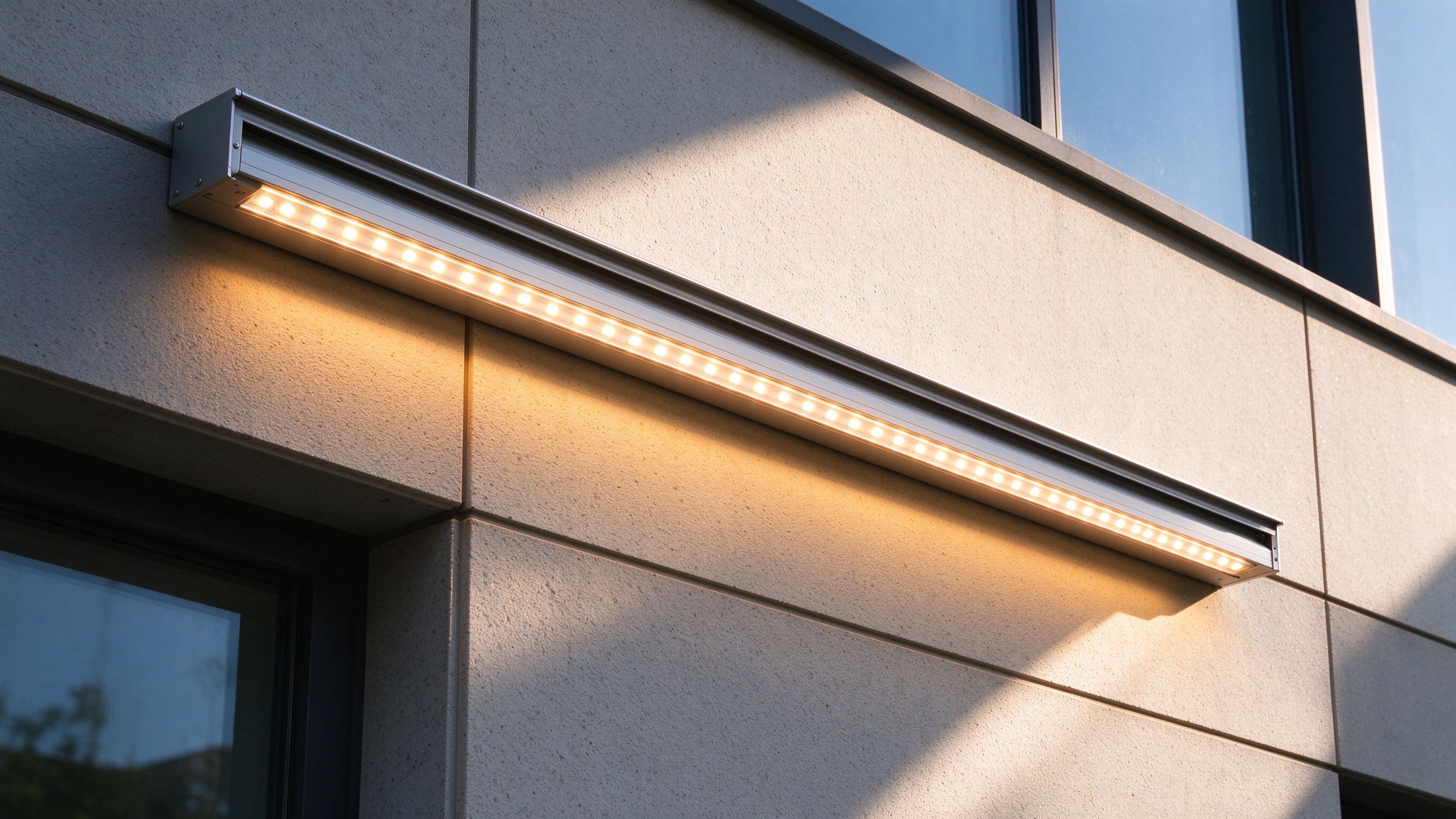
- Long facade and soffit outlines on commercial buildings.
- Pergola, gazebo and decking perimeter lines in gardens and hospitality.
- Landscape and pathway linear accents spanning long distances.
- Car park and canopy edges with limited power-access points.
- Architectural runs where every feed must be weather-sealed and hidden.
Safety and Compatibility Notes for 48V
48V is still a low, SELV-range voltage that suits outdoor use well, but it is not interchangeable with 24V hardware. The strip, drivers and any dimming/control equipment must all be rated for 48V; connecting a 48V strip to a 24V driver simply under-runs it, and mismatched control gear can cause damage. I specify matched 48V constant-voltage drivers with the appropriate outdoor rating and keep all mains-side work with qualified electricians.
Waterproofing the Few Connection Points
The advantage of fewer feeds is only realised if those feeds are sealed properly. With 48V reducing the number of outdoor junctions, I make each one count: matched IP67 connectors, quality gland entries into weatherproof driver enclosures, drip loops on cables and junction positions that shed water rather than collect it. Fewer, well-made sealed connections beat many rushed ones, and 48V naturally reduces how many there are.
- Use matched IP67 connectors and weatherproof driver enclosures.
- Add drip loops so water runs away from, not into, connections.
- Locate junctions where they shed water and remain serviceable.
- Use UV-stable clips and corrosion-resistant fixings for long exterior runs.
Heat, Dimming and Long-Run Consistency
Even with reduced voltage drop I still calculate the loaded wattage, size 48V drivers with headroom and mount the COB to thermally suitable profiles; long outdoor channels can trap heat if fully enclosed. For dimming I confirm the control method is compatible with 48V drivers from the start, because retrofitting dimming onto a mismatched long-run system is awkward. I commission long exterior lines at night from the viewing distance to confirm evenness end to end and no visible banding at feed boundaries.
Specifying a Long Exterior Line
Send the total run length, the mounting surface and profile, the number of realistic power-access points, dimming needs and exposure (covered soffit vs open weather). I will confirm whether 48V IP67 COB covers the run with acceptable feed spacing, the matched 48V drivers and sealed connection layout. We supply the 48V IP67 COB and recommend a lit trial on the longest single span before fitting the full facade, so brightness uniformity and the waterproof junction method are both proven first.
Running the Numbers on a 60-Metre Facade
The cleanest way to show why 48V wins on long outdoor lines is to price a real run, so on a 60-metre hotel canopy edge I laid out both schemes rather than arguing from per-metre strip prices. The 24V design needed a feed roughly every five metres given the chosen output and copper, which meant around a dozen driver or injection points along the canopy, each requiring a weatherproof enclosure, a penetration through the soffit, cabling back to a supply and a sealed connector.
The 48V IP67 COB scheme stretched the same lighting to a handful of feed positions, because the lower current for the same power kept voltage drop within tolerance across much longer spans. The strip itself cost a little more per metre and the 48V drivers were not the cheapest line items, but the savings stacked up everywhere else: far fewer enclosures, fewer soffit penetrations that the builder had to core and then seal against rain, less cable, and substantially less electrician labour. When the soffit contractor priced the penetrations and weather patching, the 48V scheme came out comfortably cheaper installed and it delivered the continuous unbroken line the architect wanted with no visible feed hardware repeating along the canopy. It also removed a dozen future failure points, each outdoor junction being a place water could eventually enter. I present this comparison on genuinely long runs because per-metre price alone always flatters the low-voltage commodity strip; the honest figure is total installed cost plus the number of sealed junctions that have to stay watertight for years. On a short sign the feed savings never materialise and 24V remains right, which is why I only step up to 48V once the span and the difficulty of placing feeds justify it.
Recommended Products
Frequently Asked Questions
Why use 48V COB instead of 24V for long outdoor runs?
At the same power, 48V draws lower current than 24V, which reduces resistive voltage drop and lets the strip run much further between feed points. That means fewer drivers, less cabling and fewer weather-sealed junctions along a long facade or landscape line, with more even brightness from end to end.
Is 48V LED strip safe outdoors?
48V sits in the low SELV voltage range well suited to outdoor use, and with IP67 encapsulation and matched weatherproof connectors and drivers it is safe for exterior architectural lines. All mains-side wiring and driver connections must still be done by qualified personnel to local regulations.
Can I use a 24V driver with 48V COB strip?
No. The strip, drivers and dimming/control gear must all be rated for 48V; a 24V driver will not run a 48V strip correctly and mismatched equipment can cause damage or poor performance. Specify matched 48V constant-voltage outdoor drivers from the start.
Does 48V remove the need for waterproof connectors?
No. 48V reduces the number of feed junctions, but each remaining connection outdoors must still be sealed with matched IP67 connectors, weatherproof enclosures, gland entries and drip loops. The benefit is having fewer, better-made sealed connections rather than eliminating sealing.
When should I choose 48V over 220V driverless strip?
Choose 48V IP67 COB for long architectural lines where you want low-voltage safety, dot-free COB quality and simple dimming with relatively few feeds. Reserve 220V driverless product for very long, fixed, non-touchable perimeters installed by qualified specialists, where minimal hardware matters more than low-voltage flexibility.
Need help with your LED project?
Get factory-direct pricing, free samples and engineering support within 24 hours.
Email: info@arraystarled.com | Phone: +86-0755-2103-6746 | WhatsApp: 0086 1581 8514 077
Need to size your power supply? Use our LED Strip Power Calculator to find the right driver in seconds.