
Cheap vs Premium Neon Tubes: The Silicone Grade Test I Use
- 2026-10-09 18:39
- /
- Arraystar LED
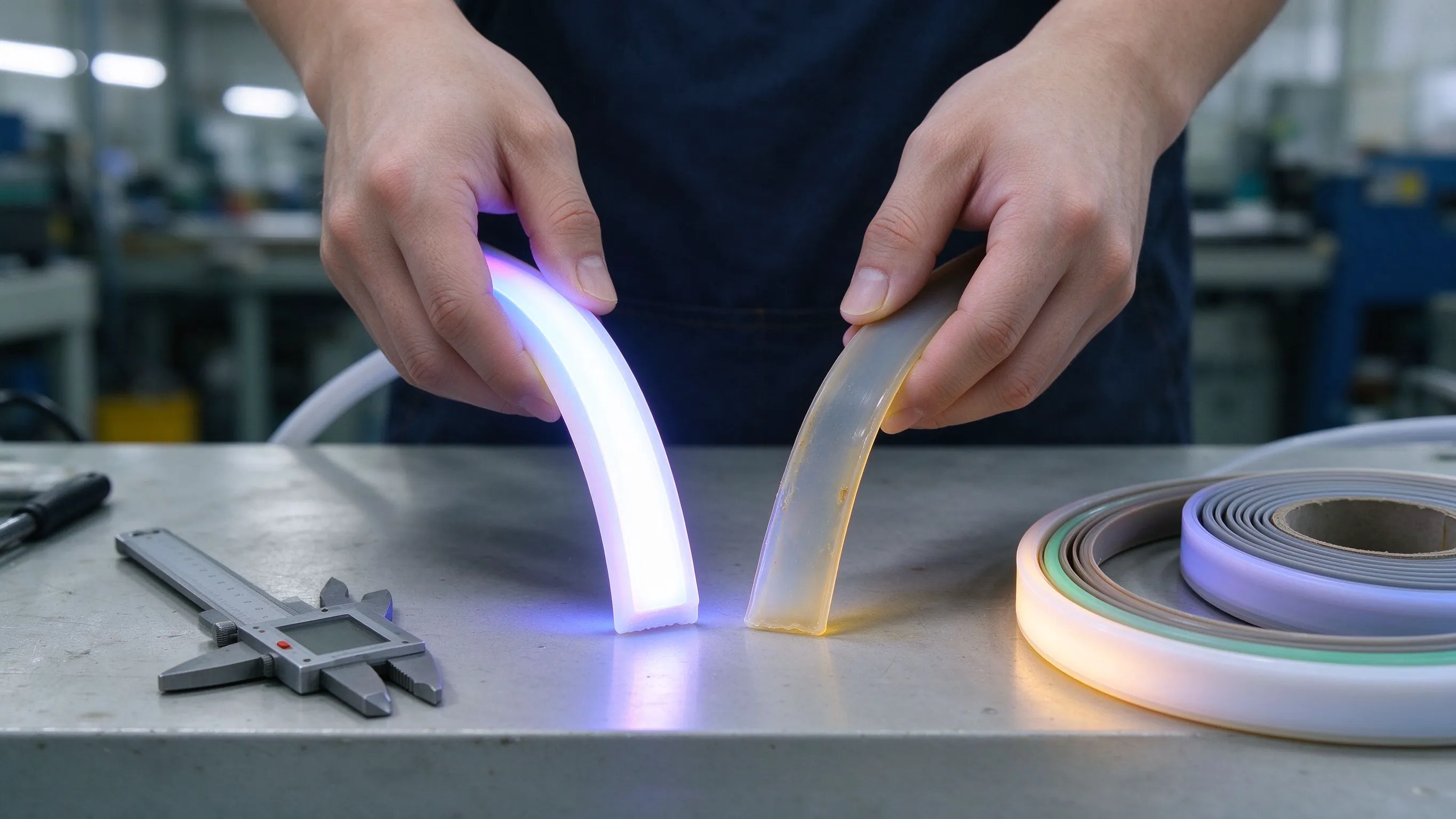
The price gap between economy and premium neon tubes is small per metre and enormous in outcomes. The difference is silicone grade: filler content, UV stability, hardness, tear resistance and whether the material is genuinely food-grade. I test all five on a sample rather than trust a price list, because two tubes can look identical new and age years apart.
Why the Cheapest Quote Keeps Winning (and Failing)
On a tender, neon sleeve is neon sleeve to whoever is comparing spreadsheets. One clear tube looks like another, so the cheapest price wins. Six months later the sign-maker is re-sleeving yellowed, brittle or tacky tubing under warranty and the saving is long gone.
I have cut open enough failed signs to know that the cost difference is not branding markup. It is raw material. Silicone can be heavily loaded with filler to reduce the amount of polymer, and it can be formulated with or without proper UV and heat stabilisers. Those choices change the price per kilogram and change how the tube ages.
The Five Things I Actually Compare
1. Filler content and weight
Heavily filled silicone feels denser or chalkier and can look slightly dull. A clean, premium compound has a consistent, slightly elastic feel. I compare equal-length samples by hand and by how cleanly they cut.
2. Hardness (Shore A)
Too hard and the tube is difficult to thread and cracks at bends; too soft and it sags, deforms and can go tacky in heat. A good sign-grade sleeve sits in a moderate, consistent hardness range that balances flexibility with shape retention.
3. UV and heat stability
Ask for accelerated UV-aging or yellowing-index data. Premium outdoor compounds are formulated with stabilisers; budget indoor compounds are not. If a supplier cannot produce any aging evidence for an 'outdoor' tube, treat it as indoor.
4. Tear and cut resistance
Pull the cut end and give the sleeve a reasonable tug. A quality tube resists tearing and springs back; a filled one tears easily or permanently stretches. This matters during threading and in wind.
5. Food-grade claims
Genuine food-contact silicone carries certification and is odourless. A tube that smells strongly of plastic, or that a supplier calls 'food safe' with no documentation, is not the same material.
A Side-by-Side Bench Test Anyone Can Run
- Smell: premium silicone is essentially odourless; strong chemical or oily odour signals cheap compound.
- Stretch and release: good silicone springs back cleanly; filled material stays deformed or whitens.
- Cut cleanly: a sharp blade should glide through with a clean, even wall thickness.
- Light it: thread identical strip and compare hot spots and face uniformity; a thin or inconsistent wall shows immediately.
- Sun test: leave offcuts outdoors for some weeks if the schedule allows; the cheap sample starts yellowing first.

There is a legitimate place for the economy tube. The ART-NT0808 economy profile is a sensible choice for short-rental, indoor and price-sensitive work where the sign will not see years of sun. The mistake is buying the economy grade and selling it as a five-year outdoor product.
Economy vs Premium: Where Each Belongs
Match the compound to the exposure, not just the price.
| Job characteristic | Economy tube | Premium / UV-stable tube |
|---|---|---|
| Indoor mall or store | Suitable | Suitable (often unnecessary) |
| Short-term rental / event | Good fit | Not cost-effective |
| Shaded outdoor, mild climate | Borderline | Recommended |
| Sun-facing facade or rooftop | Avoid | Required |
| Coastal / high-UV / extreme heat | Avoid | Required with test data |
| Food-contact / kitchen | Only if certified | Certified food-grade only |
| Brand rollout with warranty | Avoid | Required |
Reading the Silhouette of a Bad Tube
Beyond material feel, dimensional consistency is a giveaway. Budget extrusion can have uneven wall thickness, which produces a tube that looks fine unlit but shows a brighter thin side once the strip is inside. I hold a sample up to light before threading; a consistent glow through the wall means a consistent extrusion. Wavy inner channels, flashing along the seam and variable outer dimensions are all reasons to reject the batch.
How to Buy Without Getting Surprised
- Specify the silicone grade and application (indoor, outdoor, food-contact) in writing on the PO.
- Request UV-aging or yellowing-index data for outdoor grades and food-contact certificates where claimed.
- Order a short sample of each quoted grade and run the smell, stretch, cut and light tests on your bench.
- Inspect wall-thickness consistency against the light.
- Keep a labelled offcut from the approved sample so delivered goods can be compared.
We produce both economy and premium silicone tubes because both have honest uses, and we would rather tell you which one your job needs than sell you the wrong grade. Ask for a sample pack and a copy of the relevant test data so the choice is based on evidence rather than price alone.
Warranty Language and the Real Cost of Replacement
The strongest argument for premium silicone is rarely the tube price; it is the cost of fixing a failure once the sign is installed. A service visit involves travel, access equipment, opening letters, re-sleeving and often an unhappy client whose brand was running yellow for weeks before anyone noticed. Against that, the few percent saved on a budget sleeve is a terrible trade on any sign with a multi-year warranty.
- Match the warranty you give the client to the grade you install; do not promise five outdoor years on an indoor compound.
- Keep the approved sample and the batch or order reference so a warranty claim can be compared against what was approved.
- Specify UV-stable, outdoor-rated material in writing so there is no dispute about what was supplied.
- For brand rollouts, buy all locations from the same production batch to avoid slight colour or compound differences between sites.
I also separate two things suppliers sometimes blur: the silicone grade and the IP rating. A tube can be premium UV-stable silicone yet still be an unsealed indoor sleeve, or fully IP67 sealed but made from mediocre compound. For an outdoor warranty I want both the right compound and the right sealing, confirmed in writing. A manufacturer that understands this will quote the two separately and show test evidence for each rather than waving one generic 'outdoor' label at the whole product.
Recommended Products
Frequently Asked Questions
Why are some neon tubes so much cheaper than others?
The main difference is the silicone compound. Cheaper tubes use more filler and fewer UV and heat stabilisers, which lowers material cost but leads to faster yellowing, brittleness and tackiness. Premium compounds cost more per kilogram and last far longer outdoors.
Is an economy neon tube ever a good choice?
Yes. For indoor stores, shaded locations, short-term rentals and event builds that come down within months, an economy tube such as an 0808 profile is a reasonable, cost-effective choice. It should simply not be specified as a long-life outdoor product.
How can I check silicone quality without a lab?
Smell it (premium silicone is odourless), stretch and release it (it should spring back), cut it to check even wall thickness, light identical strip through it to compare hot spots, and leave offcuts in the sun to compare yellowing. Asking for UV-aging data adds a documented check.
What does food-grade silicone require?
A genuine food-contact silicone should be odourless and supplied with the appropriate food-contact certification. A tube marketed as food safe without documentation, or one with a strong plastic smell, should not be treated as food-grade for kitchen or servery use.
Will a premium tube survive any outdoor conditions?
A UV-stable premium tube dramatically extends outdoor life, but heat, exposure, colour and installation still matter. Avoid overdriving the strip, give the neon ventilation and match the IP rating to the exposure; even the best compound ages faster in extreme heat or sealed, overheated letters.
Need help with your LED project?
Get factory-direct pricing, free samples and engineering support within 24 hours.
Email: info@arraystarled.com | Phone: +86-0755-2103-6746 | WhatsApp: 0086 1581 8514 077
Need to size your power supply? Use our LED Strip Power Calculator to find the right driver in seconds.







