
Flat Surface-Cover Neon Tubes for Shallow Channel Letters
- 2026-10-09 18:39
- /
- Arraystar LED
Shallow channel letters with low returns cannot hide a round neon tube; the sleeve either pokes above the face or throws uneven light out the sides. A flat, wide surface-cover neon tube is built for exactly this geometry, sitting low and spreading light across the full face. Matching tube width to letter depth is the single biggest factor in an even sign.
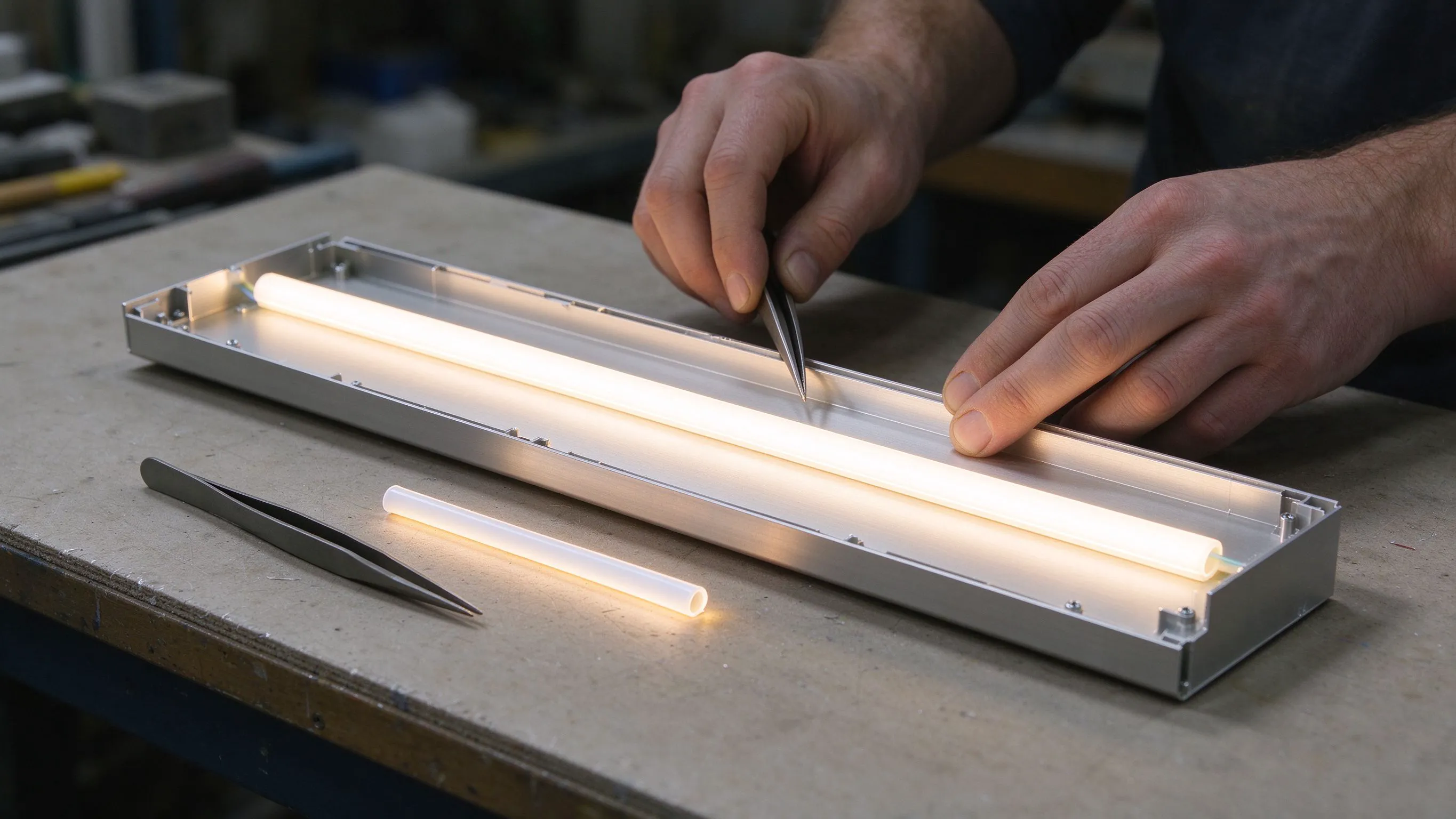
Why Shallow Letters Punish Round Tubes
Modern fabricated letters keep getting thinner. Architects and brand guidelines love a 25 to 40 mm return because it looks clean on the wall, but that slim profile was designed around low-profile LED modules, not a round 12 mm neon sleeve stuffed inside.
When you force a circular tube into a shallow letter, three things go wrong. The tube sits too high and can touch or show through the acrylic face. Light spills sideways off the curved body instead of forward, producing bright edges and a dim centre. And at the tight internal corners the round sleeve lifts away from the backing because it cannot sit flat.
The solution I reach for is a flat surface-cover neon tube, which is exactly what it sounds like: a wide, low-profile diffuser with a broad flat emitting face rather than a round one.
Anatomy of a Surface-Cover Tube
- Wide, low cross-section. The tube is broader than it is tall, so it fits inside shallow returns without crowding the face.
- Flat front window. A wide emitting face projects light forward and across the letter rather than radially.
- Flat or keyed base. It seats squarely on the letter backing, which makes mounting and adhesive far more reliable.
- Rounded side shoulders. Enough diffusion remains at the edges to stop the stroke looking like a hard stripe.
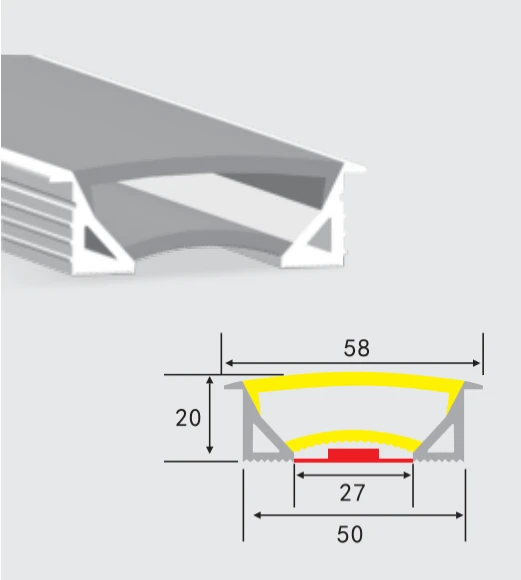
For wide, low letters I commonly use a broad surface-cover profile such as the ART-NT5020. Its 50 mm-wide flat face carries light across a generous stroke, which is what lets a big shallow letter read evenly from the front instead of glowing only down the middle.
Matching Tube Width to Letter Stroke and Depth
The rule I use is simple: the illuminated width of the tube should cover a good proportion of the stroke's internal width without crowding the side returns, and the tube's height must leave clearance under the face.
Field guidance; always clear the acrylic face and side walls.
| Letter return depth | Tube geometry I choose | Notes |
|---|---|---|
| 20-30 mm (very shallow) | Lowest-profile flat tube, narrow width | Check face clearance carefully; consider modules for ultra-thin letters |
| 30-50 mm (shallow) | Standard flat surface-cover tube | The sweet spot for this profile; seats low and even |
| 50-80 mm (medium) | Flat or round tube both work | Flat still gives the most uniform front face |
| 80 mm+ (deep letters) | Round tube or modules acceptable | Depth is no longer the constraint |
As a starting proportion I aim for the lit width to occupy roughly 60 to 80 percent of the stroke interior. Too narrow and you get a bright centre line with dark sides; too wide and the tube rubs the returns, causing hot edges and rubbing noise in wind.
Mounting Flat Tube So It Stays Even
Preparation
- Clean the letter backing with isopropyl alcohol; flat tubes rely on full contact along their base.
- Use a primer where the backing is powder-coated or textured, exactly as you would for high-bond tape.
- Dry-fit the full stroke first and mark any tight internal corners before peeling adhesive.
Fixing
- Press the flat base down firmly along its whole width; a flat tube gives you more adhesive area than a round one, so use it.
- Add small clips or silicone dabs at corners and ends so thermal expansion cannot lift the shoulders.
- Keep the tube centred in the stroke so the diffused light reaches both side walls evenly.
Front-Lit vs Halo-Lit Placement
Flat surface-cover tubes are primarily for front-lit letters where you want an even face. If the design is a halo-lit (reverse) letter, the geometry changes: you want light aimed backward at the wall with a controlled gap, and a flat forward-facing tube is the wrong tool. Match the product to the light direction the design calls for rather than using one profile everywhere.
Common Mistakes and Fixes
The four faults I see most often on shallow-letter repairs.
| Symptom | Usual cause | Fix |
|---|---|---|
| Bright edges, dark centre | Tube too narrow or round for the stroke | Use a wider flat surface-cover tube |
| Tube visible through face | Return too shallow for tube height | Step down to a lower-profile flat tube |
| Lifting at internal corners | Round tube cannot sit flat; poor prep | Use flat tube, primer and corner clips |
| Uneven letter to letter | Inconsistent tube centring | Make a simple centring jig for repeatable placement |
Specifying the Right Profile
Send the fabricator the letter return depth, stroke width, face material and whether the sign is front or reverse lit. With those four facts the correct flat profile can be matched instead of guessed. I also ask for a 100 mm offcut to test-fit inside the actual letter extrusion before ordering the full run, because channel dimensions vary between fabricators.
We stock surface-cover tubes across a range of widths for shallow and wide letters and are happy to send samples in two or three sizes so you can fit them to your channel profile and see which gives the most even face.
Powering and Cooling Shallow Letters
A shallow letter is a small, partly sealed box, which makes thermal and wiring decisions more important than on a deep can. When you add a wide flat tube you are also adding heat with very little air around it, and overheating is what kills both the LEDs and the diffuser early.
Keep the thermal load realistic
- Do not specify the highest-density strip a flat tube can accept just because it fits; a shallow return cannot dissipate the extra heat.
- Use an aluminium backing or heatsink letter base where possible so the strip has somewhere to conduct heat instead of trapping it.
- Confirm the strip current matches the rated wattage and avoid field over-driving to chase brightness.
- Leave whatever ventilation the letter design permits and avoid sealing every joint airtight on indoor work.
Route power for a low-profile build
Flat tubes and shallow returns leave little room for connectors, so I plan the wiring before the first tube goes in. I route power to enter near a natural low point in each stroke, use low-profile solder joints or compact solder-free connectors, and keep daisy-chained runs short enough that the last letter is as bright as the first. On multi-letter words I distribute feeds rather than looping power through every character, which both prevents voltage drop and makes a single failed letter easier to service. Documenting the feed layout on the back of the sign in chalk or a small label saves real time if a driver or section ever needs attention.
Recommended Products
Frequently Asked Questions
Can I use a round neon tube in a shallow channel letter?
You can physically fit a small round tube, but it usually sits too high, spills light sideways and lifts at corners, giving bright edges and a dark centre. A flat surface-cover tube is designed to sit low and spread light evenly across shallow letters.
How wide should the neon tube be inside a letter stroke?
As a starting point, the lit width should cover roughly 60 to 80 percent of the stroke interior while leaving clearance from the side returns and the acrylic face. Too narrow causes a centre hot line; too wide rubs the returns.
What return depth needs a flat tube?
Shallow letters with returns of roughly 30 to 50 mm are the classic case for a flat surface-cover tube. Very thin 20-30 mm letters may need the lowest-profile flat tube or even LED modules, while deep letters over about 80 mm can accommodate round tubes without trouble.
Why is my flat neon lifting at the corners?
Lifting usually comes from inadequate surface prep, skipping primer on textured or powder-coated backs, or using a round tube that cannot sit flat. Clean with alcohol, use primer, choose a flat profile and add clips or silicone dabs at internal corners.
Are flat surface-cover tubes used for halo-lit letters?
They are mainly for front-lit letters because the wide flat face projects light forward. Halo-lit letters need light aimed backward toward the wall, so choose the profile and mounting gap for reverse lighting instead.
Need help with your LED project?
Get factory-direct pricing, free samples and engineering support within 24 hours.
Email: info@arraystarled.com | Phone: +86-0755-2103-6746 | WhatsApp: 0086 1581 8514 077
Need to size your power supply? Use our LED Strip Power Calculator to find the right driver in seconds.







