
COB vs SCOB LED Strip: Differences, Pros & Cons (2026)
- 2026-09-21 11:03
- /
- Arraystar LED
COB is a flat, bare chip-on-board strip used inside channels and coves; SCOB is a fully silicone-encapsulated, often arc-shaped version with built-in diffusion for channel letters and neon replacement. Choose COB for hidden, high-efficiency lighting; choose SCOB for visible, outdoor, dot-free sign and neon-replacement light.
The Core Difference: Diffusion and Housing
Both COB (Chip On Board) and SCOB (Silicon/Surface Chip On Board) mount LED dies directly on the PCB with no individual SMD packages. The difference is what happens after the chips are mounted:
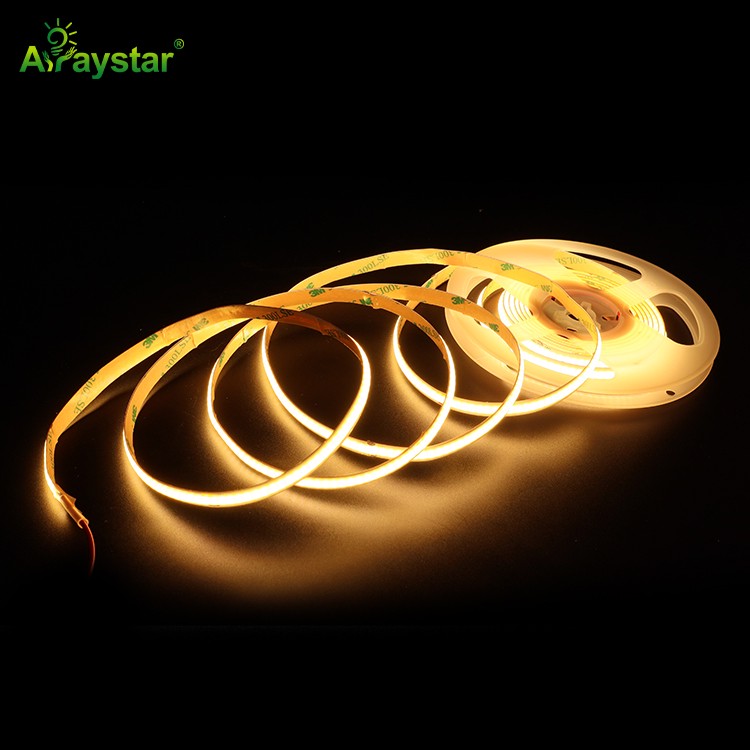
- COB — a flat strip with phosphor over the chips. It is extremely dot-free, but the light exits a flat ~120° plane and usually needs an aluminum channel diffuser to look finished.
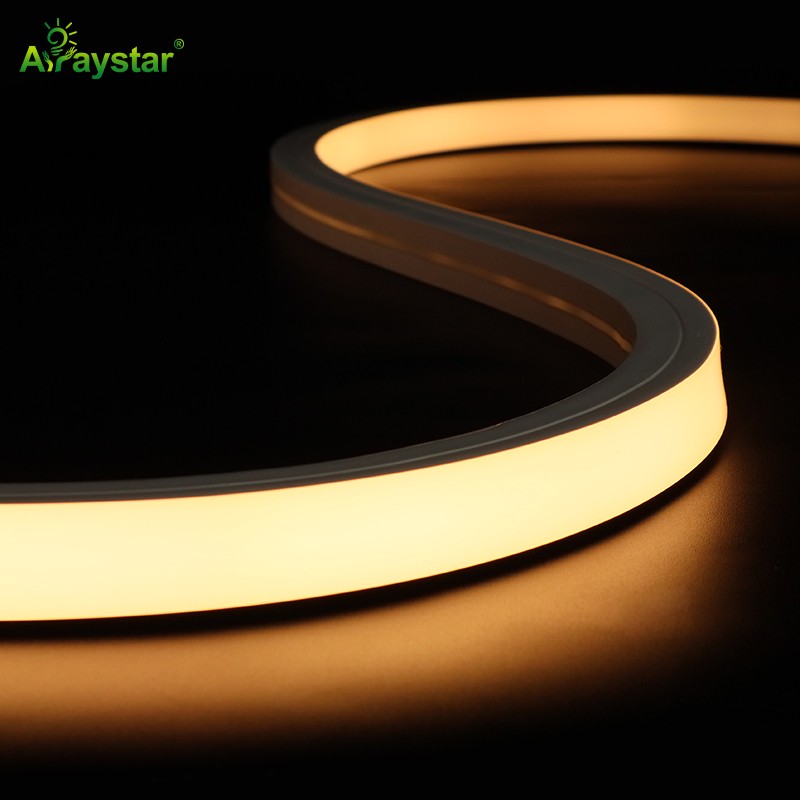
- SCOB — the same chips encapsulated in a thick, milky silicone body, often an arc-shaped hollow extrusion. Diffusion and weatherproofing are built in, so the strip looks like a finished line light by itself.

Full Comparison Table
COB LED strip versus SCOB LED strip
| Specification | COB LED Strip | SCOB LED Strip |
|---|---|---|
| Cross-section | Flat PCB, ~3–12 mm | Arc/hollow silicone body, e.g. 7×10 mm / 8 mm |
| Built-in diffusion | No — needs channel/diffuser | Yes (milky silicone) |
| Beam angle | ~120° top | 160–180° curved |
| Operating voltage | 12/24/48 V; 110/220 V variants | 24 V DC and 200–240 V AC |
| Power (typical) | 8–40 W/m (up to 40 W/m wide PCB) | ~10–11 W/m |
| CRI | Ra80 standard; Ra90+ available | Ra80 typical; high-CRI on request |
| CCT | 1800K–6500K, tunable, RGBW | 2700K/3000K/4000K/6000K |
| IP rating | IP20 bare; IP65/67 optional | IP65/IP67 built in |
| Heat management | Needs aluminum channel | Silicone body dissipates; lower W/m |
| Best for | Hidden coves, shelves, RGBW | Channel letters, sign faces, neon replacement |
Pros and Cons
COB — pros: highest efficiency (lumens per watt), wide CCT/RGBW choice, ultra-narrow 2–4 mm options, lowest cost when hidden. Cons: not finished-looking bare; needs an aluminum profile; higher wattage needs good heat sinking.
SCOB — pros: built-in dot-free diffusion and IP protection, curved/omnidirectional beam, no separate diffuser, ideal for signs. Cons: lower wattage/lumens per meter, fewer RGBW options, and it costs more than bare COB because the silicone extrusion is added.
Recommended Products
Frequently Asked Questions
Which is brighter, COB or SCOB?
A bare high-density COB strip (up to 40 W/m on a wide PCB) delivers more lumens per meter than a typical ~10 W/m SCOB. SCOB spreads that light through thick silicone, so it looks softer and more even rather than brighter.
Can I replace neon with SCOB?
Yes. Arc-shaped hollow SCOB is a common neon-replacement choice for sign faces and channel letters: fully sealed, even and flicker-free, with none of the glass or high voltage of old neon. For tight-radius bended letter shapes, choose round neon flex instead.
Does SCOB need an aluminum channel?
No — that is its main advantage. The silicone body is both diffuser and housing, so it clips directly into channel letters or signage. Use an aluminum channel only when you want a rigid, flush-mount architectural line.
Is COB or SCOB better outdoors?
For outdoor signs, SCOB's built-in IP65/IP67 silicone encapsulation is usually the simpler, more reliable choice. For hidden outdoor coves with a proper channel, an IP67 silicone-extrusion COB strip works equally well.
Need a SCOB or COB quote for your sign or project?
Factory-direct SCOB and COB strip with matched drivers, connectors and IP-sealed ends. Free samples and a custom layout within 24 hours.
Email: info@arraystarled.com | Phone: +86-0755-2103-6746 | WhatsApp: 0086 1581 8514 077
Need to size your power supply? Use our LED Strip Power Calculator to find the right driver in seconds.







