
CSP vs COB vs SMD LED Strips: Which Chip Package Actually Fits Your Project?
- 2026-09-29 12:07
- /
- Arraystar LED
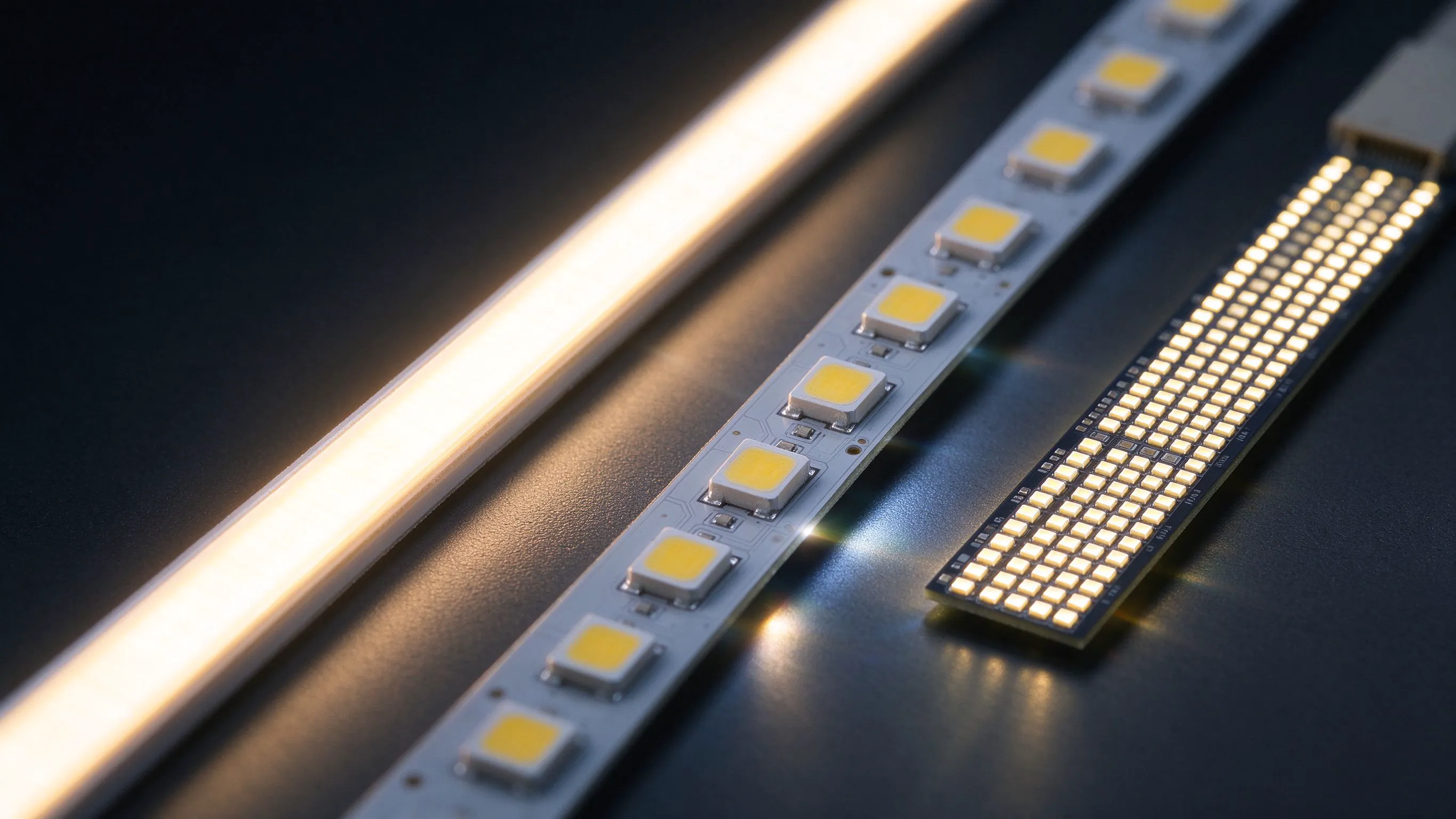
CSP, COB and SMD describe how the LED die is packaged and mounted, and they sit on a spectrum from many discrete packaged chips (SMD) to a near-continuous emitting surface (COB) to ultra-small chip-scale packages (CSP). There's no universal winner - SMD is cheap and flexible, COB is dot-free and smooth, CSP packs dense tunable light into tiny widths. Pick by dot-free requirement, bend radius, heat and budget.
What 'Package' Actually Means
Every LED strip is a row of tiny light-emitting dies mounted on a flexible PCB. The difference between SMD, COB and CSP is what sits between the bare die and that PCB - the package. The package handles electrical contacts, heat transfer, phosphor (which makes white light) and mechanical protection. Package choice drives the look (dots vs continuous line), the minimum bend radius, thermal behavior and cost.
The three packaging families at a glance.
| SMD | COB | CSP | |
|---|---|---|---|
| Structure | Discrete packaged chips (2835/5050) | Many dies bonded directly on PCB, one phosphor layer | Chip-scale package, near die-size, no substrate/lead frame |
| Look | Visible dots unless diffused | Continuous dot-free line | Very dense, near-continuous in slim width |
| Density | 60-240+ chips/m typical | 300-1000+ dies/m equivalent | Very high density in narrow PCB |
| Bend radius | Generous | Tight (continuous die matrix) | Very tight, ultra-slim possible |
| Cost / availability | Lowest, most universal | Mid, premium dot-free | Higher, niche/specialized |
SMD: The Workhorse You Already Know
SMD (surface-mounted device) chips like the 2835 and 5050 are individual packaged LEDs soldered to the board, named for their size in hundredths of a millimeter (2835 = 2.8x3.5mm). They're cheap, mature, available everywhere, and easy to source in every color, voltage and density. The trade-off is that at low density or without a deep diffuser you see individual dots, and the many solder points are theoretical failure locations.
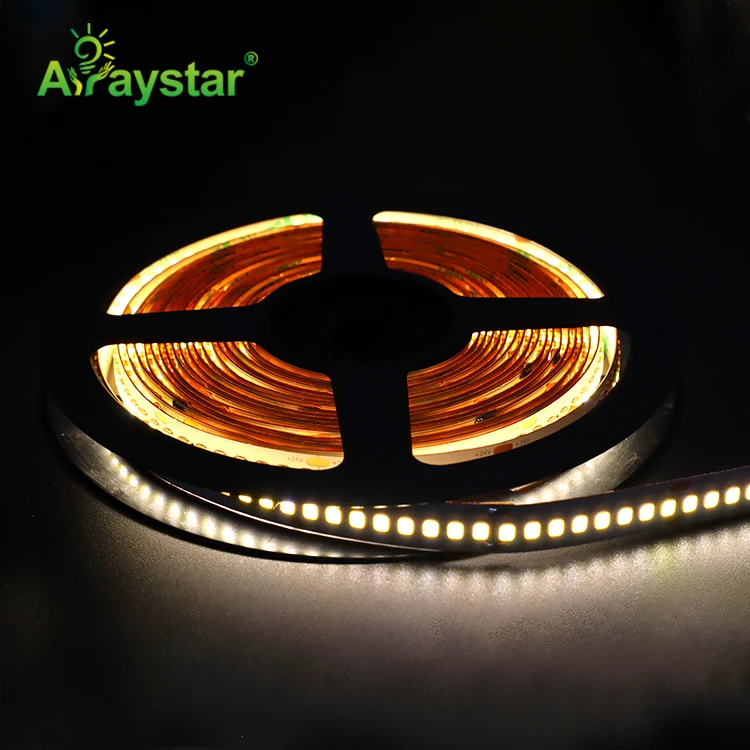
- Best when budget matters, runs are long, or a diffuser hides the dots.
- 2835 = efficient single-color/white workhorse; 5050 = brighter, hosts RGB/RGBW.
- Higher densities (168-240/m) close the dot gap for shallow profiles.
- Huge supplier base means easy replacement and competitive pricing.
COB: The Dot-Free Continuous Line
COB (chip-on-board) flips many tiny unpackaged dies directly onto the PCB and covers them with a single continuous layer of phosphor and encapsulant. Instead of dots you get a seamless glowing line that looks smooth even in a shallow or clear profile - the reason COB dominates premium cove, mirror and close-view work. The continuous matrix also bends tightly and spreads heat across more die bonds.
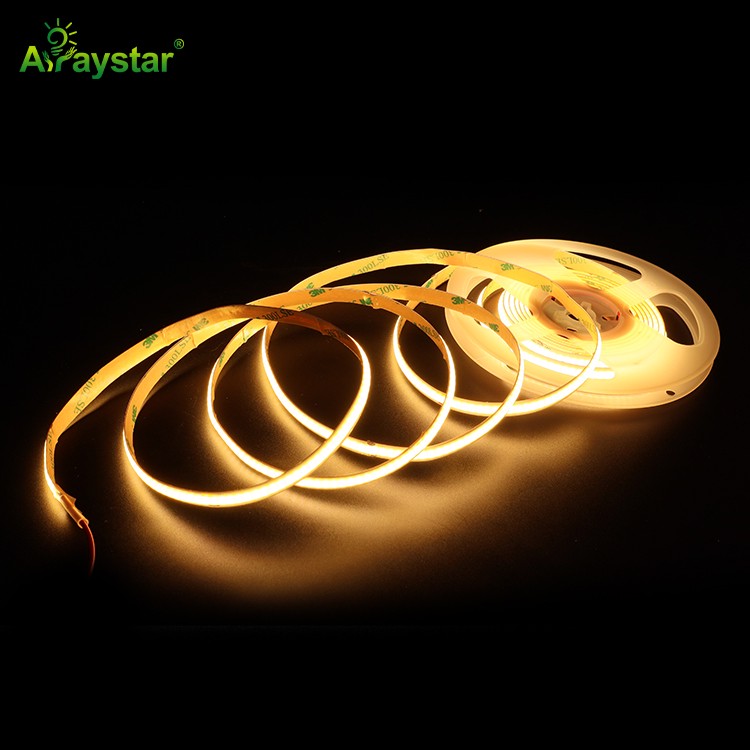
- Best where the strip is visible up close or the diffuser is shallow.
- Smooth color mixing and no speckle - ideal for high-CRI and tunable white.
- Tight bend radius for curved coves and signage.
- Costs more than SMD and historically offered fewer color/special-effect options.
CSP: Chip-Scale Packaging, the Dense Miniaturized Option
CSP (chip-scale packaging) shrinks the package to roughly the size of the die itself, removing the traditional substrate and lead frame. On strip it enables extremely dense emitter packing on very narrow PCBs - useful where you need tunable white or high output in a slim 5-8mm width that couldn't otherwise fit enough chips. It sits between SMD and COB: denser and smaller than conventional SMD, but built from discrete chip-scale devices rather than one continuous COB matrix.
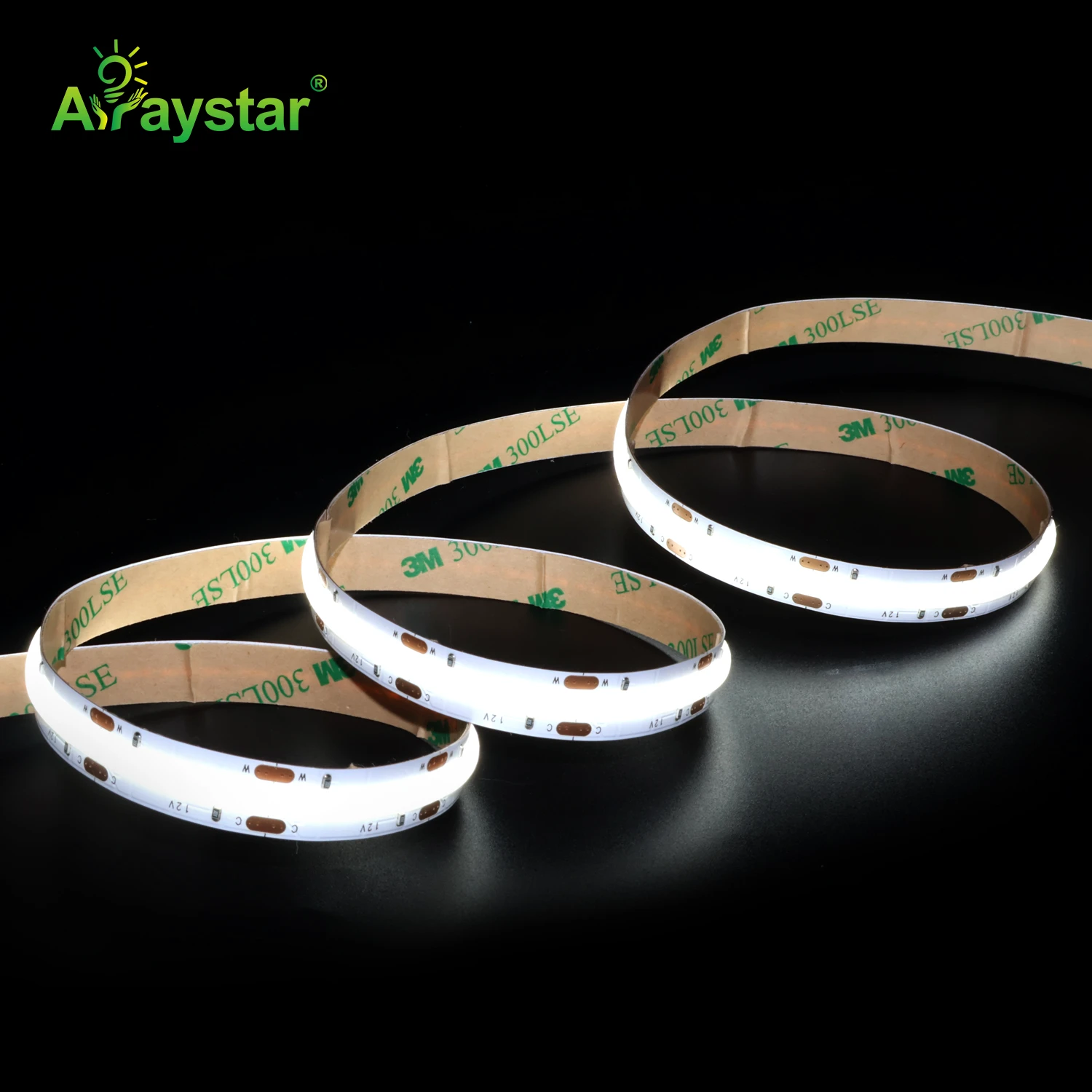
- Best for ultra-slim tunable-white and high-density narrow-board applications.
- Good thermal path thanks to the minimal package.
- More specialized range and pricing than mainstream SMD/COB.
- Specify it when a narrow COB isn't available but you need dense, dot-free light.
How to Choose for a Real Project
Decision mapping from application to package.
| Project need | Go with | Why |
|---|---|---|
| Visible cove / mirror / close viewing | COB | Dot-free smooth line in shallow profile |
| Budget long-run general lighting | SMD 2835 | Lowest cost, mature, widely available |
| Ultra-slim tunable white on narrow PCB | CSP | Dense emitters in minimal width |
| RGB/RGBW color effects | SMD 5050 or RGBW COB | Broadest color IC/options |
| Deep-profile or fully diffused fixture | SMD high-density | Dots hidden, best value |
| Tight curves and signage | COB | Flexible continuous die matrix |
In practice most projects mix them: COB where it's seen, SMD where it's hidden or budget-driven, CSP where a fixture's width leaves no other choice. Don't pay a COB premium for strip buried in a deep cove, and don't put cheap sparse SMD where a client stands 30cm away.
Reliability and Heat: Where Packaging Shows Up Later
All three fail prematurely from the same root cause - heat - but package design changes how they handle it. SMD concentrates heat at each packaged chip; COB spreads it across many small die bonds and a continuous phosphor layer, which can help but makes the phosphor layer critical; CSP's minimal package offers a short thermal path but demands a good PCB and profile. In every case, an aluminum profile used as a heatsink and a driver with thermal margin does more for lifespan than the package label.
- Verify output claims thermally - run the strip hot and check for color shift.
- COB relies on a quality encapsulant; cheap COB can develop uneven phosphor.
- SMD failures usually trace to a single chip or solder joint - easy to spot.
- Whichever package, derate and cool it; L70 life is temperature-driven.
Recommended Products
Frequently Asked Questions
What is the difference between SMD, COB and CSP LED strips?
SMD uses many individual packaged chips (like 2835/5050) soldered to the board and is cheap but can show dots; COB bonds many bare dies directly under one continuous phosphor layer for a dot-free line; CSP uses near-die-size chip-scale packages to pack dense emitters onto very narrow boards. They differ in smoothness, bend radius, size and cost.
Which is better, COB or SMD LED strip?
Neither is universally better. COB is superior for visible, close-view, dot-free cove and signage with tight curves; SMD 2835/5050 is cheaper, more widely available and ideal for long runs or fixtures where a diffuser hides the dots. Choose by whether the strip is seen directly and by budget.
What is a CSP LED strip used for?
CSP (chip-scale package) strip packs very dense emitters into minimal width using near-die-size packages, making it suited to ultra-slim tunable-white and high-output applications on narrow 5-8mm PCBs where conventional chips or COB can't fit enough emitting area.
Do COB LED strips run cooler than SMD?
COB spreads heat across many small die bonds and a continuous layer rather than concentrating it at discrete chips, which can help, but both are governed mainly by PCB copper, the aluminum profile heatsink and driver loading. A well-cooled SMD outlasts an uncooled COB, so don't assume package alone determines temperature.
Why are COB LED strips more expensive?
COB requires precise direct die-bonding and a continuous phosphor/encapsulant process to produce a seamless dot-free line, which is more process-intensive than placing standard packaged SMD chips. The premium buys smooth light, tight bend capability and a premium look, mainly valuable where the strip is directly visible.
Need help with your LED project?
Get factory-direct pricing, free samples and engineering support within 24 hours.
Email: info@arraystarled.com | Phone: +86-0755-2103-6746 | WhatsApp: 0086 1581 8514 077
Need to size your power supply? Use our LED Strip Power Calculator to find the right driver in seconds.







