
Large 50x25 Neon Tubes for Long-Distance Storefront Visibility
- 2026-10-09 18:39
- /
- Arraystar LED
Neon visibility from a distance is driven by the physical size and brightness of the glowing line, not by the LED count on the datasheet. A small tube on a tall rooftop sign reads as a thin, weak stroke from across the road; stepping up to a large 50x25 tube gives the line real visual weight. I size tube cross-section from letter height and viewing distance first, then choose LED density to suit.
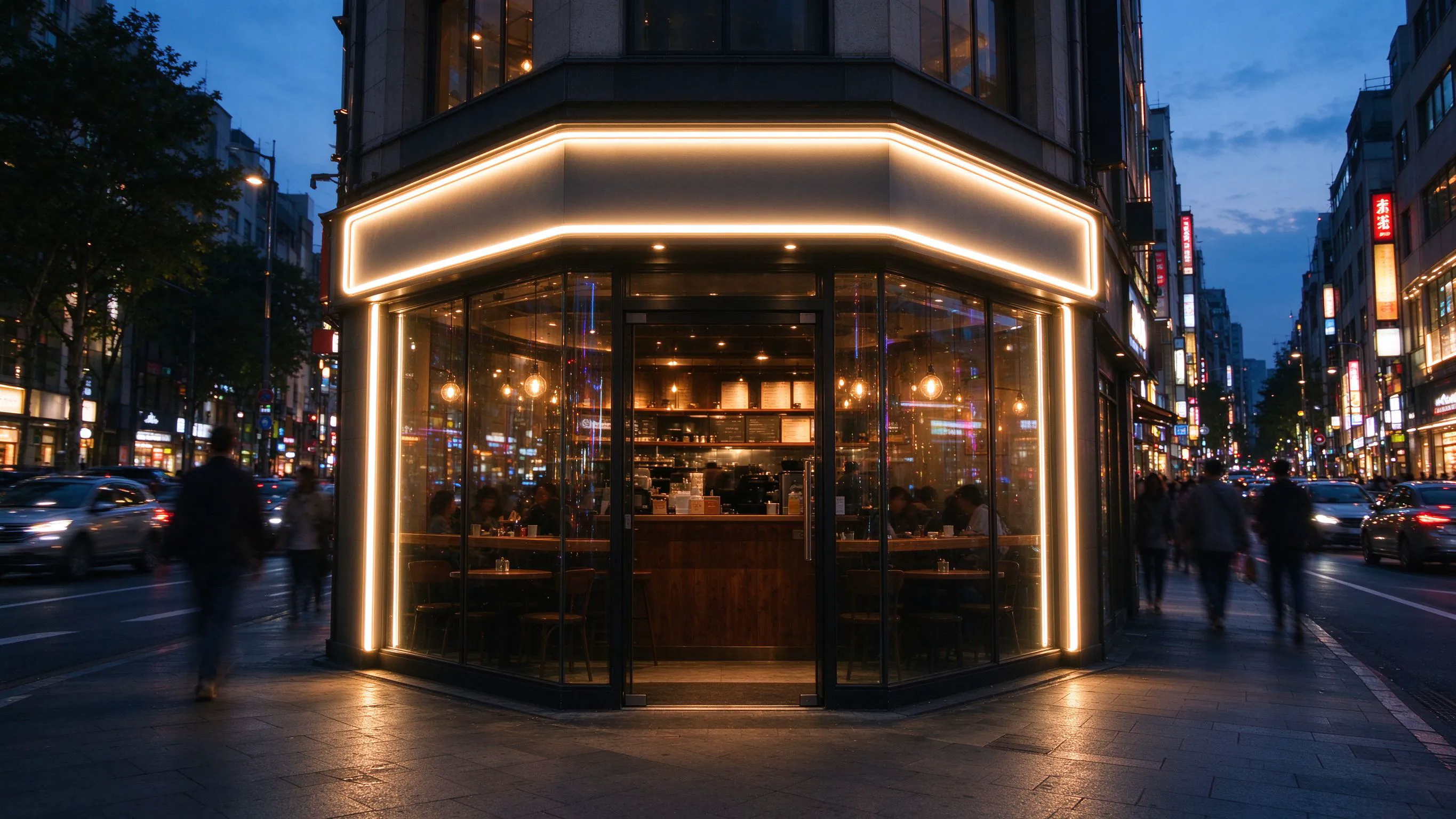
Why Small Neon Disappears at Distance
Up close in the workshop a 0812 or 1212 neon line looks crisp and bright. Mount that same line 15 metres up on a rooftop and view it from a moving car 80 metres away and it shrinks to a hairline. The LEDs did not change; the angular width of the glowing stroke did. At distance, your eye sees the apparent width and brightness of the line, and a small source loses both fast.
This is the most common mismatch I see on rooftop and roadside signage: a fabricator builds a beautifully neat small-tube sign for a viewing distance that actually demands a large-format tube. The fix is to size up the cross-section.
What a 50x25 Large-Format Tube Gives You
- A wider apparent stroke. The 50 mm-class face produces a bold line that holds together visually at long range.
- Room for more LEDs and copper. A large body can carry wider, higher-power strip and dissipate its heat better than a tiny sleeve.
- A bigger diffusing area. More emitting surface means higher total brightness and a smoother face even at elevated density.
- Presence in daylight and at night. A substantial stroke reads as a confident sign rather than a delicate outline.
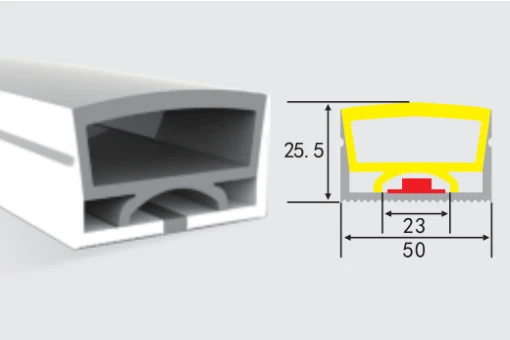
For tall letters and long-range identification I use the ART-NT5025, a 50x25 top-bend large-format tube. The top-bend body is oriented so the wide face lights the front of a letter, which is exactly what a rooftop or fascia sign needs to be read head-on from the street.
Matching Tube Size to Letter Height and Distance
There is no single correct size for every sign, so I work from two inputs: the letter height (or the thickness of the stroke being outlined) and the maximum viewing distance. As a rule, the larger and more distant the sign, the larger the tube.
Field guidance; confirm with a full-size visual at the real viewing distance.
| Sign type / viewing distance | Typical tube class | Why |
|---|---|---|
| Indoor / close (<10 m) | Small 0408-1212 | A delicate line is appropriate up close |
| Storefront fascia (10-30 m) | Medium 1616-3020 | Balanced stroke for foot and slow traffic |
| Roadside / pylon (30-80 m) | Large 4025-5025 | Needs visual weight to hold at speed |
| Rooftop / high-rise (80 m+) | 5025 and the largest profiles | Maximum apparent width and brightness |
The fastest way to convince a client (or yourself) is a full-size mock-up: print or mark the proposed stroke width at actual scale, walk it to the viewing position, and see whether it holds. A ten-minute mock-up prevents a rooftop sign that looks under-built from the street.
Brightness, Not Just Width
A big tube with underpowered strip still looks weak, so size and density go together. The large body is an advantage here because it can carry wider strip with more LEDs and better thermal headroom without the overheating that a tiny sleeve would suffer. I specify the LED density and wattage to match the daytime/nighttime contrast the site needs, rather than assuming the large tube alone is enough.
- Bright ambient environments (bright signage districts) need higher output to stand out.
- Dark rural sites can use slightly lower density because contrast is already high.
- Keep density within the tube's thermal limits; a large diffuser is not a licence to overdrive.
Structural and Wind-Load Considerations
Large rooftop tubes present more surface area to wind and more weight to the mounting than small neon. I make sure the letters, clips and fixings are engineered for the bigger profile, and I use the correct number of mounting points so the tube cannot sag or vibrate. On exposed rooftops, UV-stable silicone and corrosion-resistant clips matter just as much as they do on any outdoor product.
Powering a Large Long-Range Sign
Higher-density large tube draws more current, so voltage drop and driver sizing need attention. I calculate total wattage honestly, size drivers with headroom, and plan feed points so large letters are evenly lit from first stroke to last. On rooftop work I also prefer accessible driver locations, because nobody wants to abseil to a supply that was hidden inside a sealed letter.
Specifying the Right Large Profile
- Provide letter height, stroke width, mounting height and the furthest intended viewing distance.
- State whether the sign is read head-on (top-bend) or from the side (side-bend).
- Note the ambient brightness of the location and whether daylight visibility matters.
- Confirm outdoor grade, UV stability and the mounting/wind details.
We stock large-format top-bend tubes including the 50x25 NT5025 and can advise on the step up from medium profiles. Send the letter dimensions and a street-view distance and we will recommend the tube size and LED density so the sign holds up visually rather than disappearing on the building.
The Cost Conversation Worth Having Up Front
Large-format tube costs more per metre than small neon and needs heavier mounting, so clients sometimes push back at the quotation stage. I frame it against the cost of getting it wrong: an under-specified rooftop sign that cannot be read from the road fails at its only job, and re-sleeving or rebuilding it at height is far more expensive than the step up in profile during the original build.
- The tube and strip premium is a small fraction of total project cost once access, fabrication and installation are counted.
- A legible sign works 24 hours a day for years; a weak one is invisible for the night-time hours that often matter most for roadside brands.
- Large bodies also run cooler at equivalent brightness, which supports longer LED and sleeve life.
On one used-car-dealer pylon the original small-tube sign was effectively invisible from the approach road and the client assumed the LEDs were faulty. We re-lit the same letters with a 5025-class tube at higher density and the sign became readable from well down the road; nothing else about the structure changed. That single comparison is how I now sell the upgrade: I show the client the two stroke widths at the actual viewing distance and let the mock-up make the argument. The right question is never 'what is the cheapest tube that fits' but 'what is the smallest tube that is still legible from where the customers actually are'.
Recommended Products
Frequently Asked Questions
Why does my rooftop neon look thin from the street?
Because the apparent width of the glowing stroke shrinks rapidly with distance, and a small tube cannot provide enough visual width at long range. Step up to a large-format tube such as a 4025 or 5025 and match the LED density to the ambient brightness so the line has weight and output.
What size neon tube do I need for a roadside sign?
Viewing distance drives the choice. Close indoor work suits small 0408-1212 profiles, storefronts typically use medium 1616-3020 bodies, and roadside or rooftop signs viewed from 30 metres or more generally need large 4025-5025 tubes. Confirm with a full-size mock-up at the real viewing position.
Does a larger neon tube let me use brighter LEDs?
Yes, within thermal limits. A large body can carry wider, higher-density strip and dissipate heat better than a tiny sleeve, which supports higher total brightness. You still must stay within the rated wattage; the diffuser size does not make overdriving safe.
Do large rooftop neon tubes need special mounting?
Yes. Larger profiles add weight and wind surface, so the letters, clips and fixings must be engineered for the bigger tube with enough mounting points to prevent sag and vibration. Use UV-stable silicone and corrosion-resistant clips on exposed rooftops.
Top-bend or side-bend large tube for a rooftop sign?
Choose by viewing direction. A sign read head-on from the street wants a top-bend tube with the wide face toward the viewer; a sign seen mainly from the side needs a side-bend profile. For a 50x25 front-lit rooftop letter the top-bend NT5025 is the usual match.
Need help with your LED project?
Get factory-direct pricing, free samples and engineering support within 24 hours.
Email: info@arraystarled.com | Phone: +86-0755-2103-6746 | WhatsApp: 0086 1581 8514 077
Need to size your power supply? Use our LED Strip Power Calculator to find the right driver in seconds.







