Daisy-Chaining LED Drivers: When Parallel Input Is Mandatory
- 2026-10-28 10:04
- /
- Arraystar LED
Chaining six drivers on one switch wire trips the breaker every morning at sunrise, because each driver draws a sharp inrush on top of the last. I run parallel input feeds and size the circuit for the combined start-up current, not the steady load.
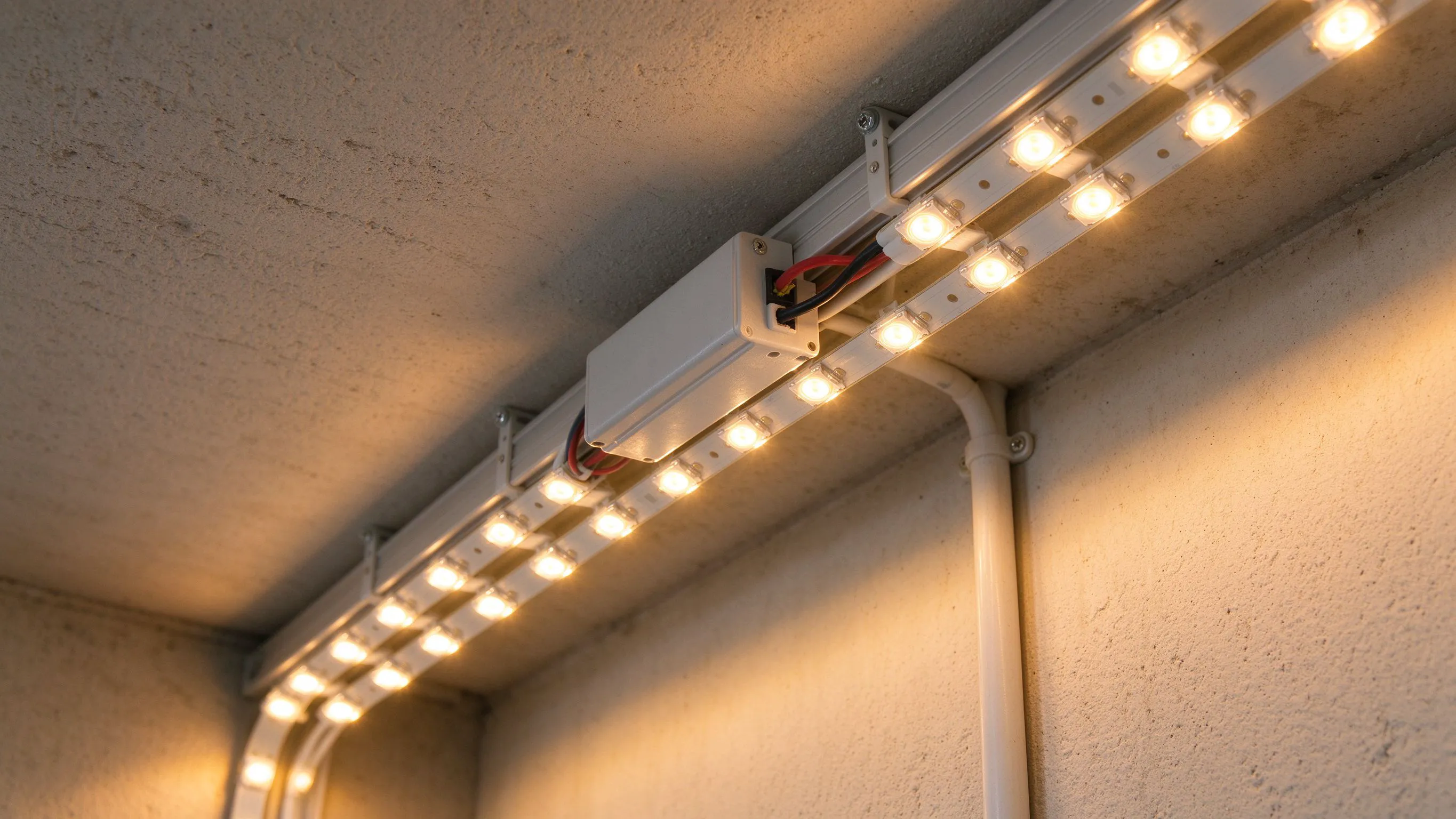
Daisy chain versus parallel input
A lot of installs run the mains feed to the first driver, then link a second short pair from the first driver output to the next driver input, and so on down the row. That is a daisy chain, and it looks neat. The problem is that every driver on that chain shares the one incoming feed, and the thin linking wire between drivers is sized for one unit, not for the whole row. Parallel input means a single spur from the switch, then a junction where each driver gets its own feed back to the same source.
On a long shelf run I once chained five 60 W drivers off one 1.0 mm spur. At switch-on the lights flashed and the breaker tripped three mornings running. The steady load was fine on paper; the inrush was not. Ripping out the links and running parallel spurs to each driver fixed it instantly.
The two wiring layouts
- Daisy chain: feed enters driver one, links run onward to drivers two, three, four.
- Parallel: feed enters a junction, each driver has its own spur back to it.
- Loop: drivers wired head-to-tail, which is the worst case for inrush.

The inrush current nobody puts on the schedule
A constant-voltage driver draws a brief charging pulse the moment mains is applied, typically three to seven times its steady input current for a few milliseconds. A single driver on a 10 A breaker is trivial. Six drivers switching together at dawn pull six pulses at once, and if the circuit also feeds a relay or a dimmer, the combined start-up can exceed the breaker trip point even though the running load is well under it. The breaker is not faulty; it is seeing a real instantaneous overload.
Inrush scales with driver count; steady load alone under-sizes the circuit.
| Number of drivers | Steady load | Combined inrush estimate |
|---|---|---|
| 1 x 60 W | 0.6 A | 3-4 A for 5 ms |
| 4 x 60 W | 2.4 A | 12-16 A for 5 ms |
| 8 x 60 W | 4.8 A | 24-32 A for 5 ms |
How I wire the parallel input
I put a small junction box at the head of the run and land the switched mains there. From that junction I run a separate, properly sized spur to each driver, usually 1.0 or 1.5 mm depending on distance, and I do not pass power through one driver to reach the next. Each driver sees the full mains directly at its input, the linking wires never carry the combined load, and the inrush on each spur is just that one unit. The junction box needs a sensible rating, but the spurs stay light.
- Land the switched feed in one junction, then spur out to each driver.
- Size each spur for one driver plus voltage-drop headroom.
- Never use a driver output terminal to feed another driver input.
For more than four drivers I also use a soft-start or inrush-rated contactor on the junction, which spreads the start-up over a few tens of milliseconds and stops even a well-sized breaker from nuisance-tripping on cold mornings.
Breaker and cable sizing rules
I size the circuit breaker for the steady running load, then derate it by the inrush behaviour, or pick a C-curve rather than a B-curve breaker where the install allows it. A B-curve trips at three to five times rated current; a C-curve tolerates five to ten times, which is exactly the window a row of drivers sits in. Cable between the junction and the distribution board must carry the total steady load plus future headroom, not just the first driver on the chain.

- Use C-curve breakers for circuits feeding multiple drivers.
- Keep total steady load under 80 percent of the breaker rating.
- Add an inrush-rated contactor above four drivers.
The switch-on test I run on site
Before I hand over, I switch the whole run off and on ten times in a row, cold, and watch the breaker hold. I also time it across a minute to catch a thermal trip. If the breaker holds through ten cold starts and the drivers all come up evenly, the parallel layout is doing its job. A layout that trips once in ten is a trip that will annoy the client on a freezing February morning.
- Switch the full bank on and off ten times cold.
- Feel each driver input terminal for warmth after the test.
- Verify no driver is slow to start, which signals a weak spur.
Recommended Products
Frequently Asked Questions
Is daisy chaining LED drivers ever acceptable?
On a short run of two small drivers it will usually work, but it is bad practice for anything permanent. Once you pass three drivers, run parallel input spurs from a junction. The small extra cable removes inrush, voltage-drop and service problems. Daisy chaining saves a few pounds of cable on the day and costs a breaker trip every winter afterwards.
Why does the breaker trip only on cold mornings?
Cold capacitors draw a heavier initial charge, so inrush is larger at low temperatures. The same bank that switches happily on a warm afternoon can trip on a five-degree morning. This points squarely at an inrush problem, not a faulty breaker. A C-curve breaker or an inrush-rated contactor tolerates that cold pulse and holds through the winter.
What size breaker do I need for several drivers?
Add the steady input watts, divide by mains voltage for amps, and keep that under 80 percent of the breaker rating. Then pick a C-curve rather than B-curve breaker because of the inrush pulse. For four or more drivers, add an inrush-rated contactor rather than oversizing the breaker to a rating the cable cannot justify.
Can a wireless sensor switch a whole bank of drivers directly?
Not directly for large banks. A wireless sender or receiver is rated for a modest switching current, and switching several drivers at once exceeds its contact rating and welds or burns the relay. Use the sensor to trigger a contactor at the junction, which then switches the heavy mains load. The sensor handles the logic, the contactor handles the current.
Does running drivers in parallel use more cable?
A little more, but each spur is short and light because it carries one driver. The heavy single cable from the distribution board to the junction stays the same. The extra length is trivial compared with a daisy chain that has to run through every driver in turn. Parallel wiring is cleaner to fault-find, since one driver can be isolated without dropping the whole row.
Need help with your LED project?
Get factory-direct pricing, free samples and engineering support within 24 hours.
Email: info@arraystarled.com | Phone: +86-0755-2103-6746 | WhatsApp: 0086 1581 8514 077
Need to size your power supply? Use our LED Strip Power Calculator to find the right driver in seconds.