Can You Reuse a Solderless LED Connector? Best Practice
- 2026-10-28 10:04
- /
- Arraystar LED
A push-in connector is built for one press, not a hundred. I reuse one only on a tidy test bench, and on a real job I fit a fresh clip every time I pull a run apart. The contact spring weakens after the first insertion, and a weak contact warms up.
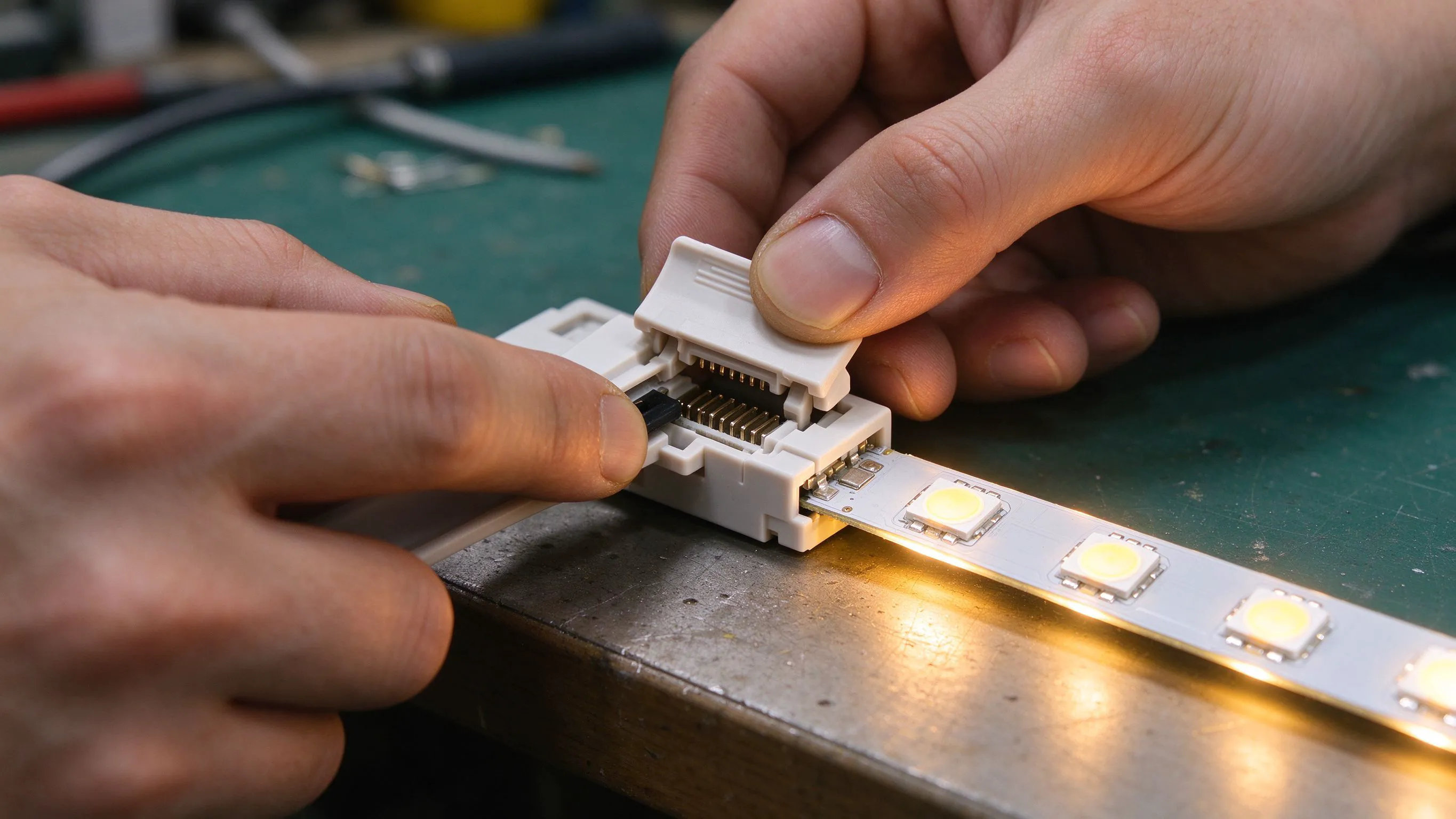
How a solderless connector actually grips
A solderless strip connector works by a sprung copper blade biting through the flex mask and pressing against the copper pads. The blade has a fixed contact force designed for one clean insertion. On the first press it cuts through the solder mask and bites home; on the second and third press the blade is already bent, the mask debris sits in the contact, and the spring has lost some of its preload. You feel the clip go on more easily the second time, which feels good but means the grip is weaker.
I learned this on a back-lit shelf install where I reused three clips to adjust the layout. Two weeks later the shelf was flickering at one end. The reused clip had gone high-resistance and warm. A new ten-cent clip fixed it, but the drive back and the reputation cost far more than the clip ever saved.
What wears inside the clip
- The contact spring weakens after the first opening.
- Blade edges dull with each press through the mask.
- Mask debris trapped under the blade raises resistance.
When I will actually reuse a clip
I am not militant about it. On a clean bench, with a clip that has been opened once on a bright, undamaged pad, I will reuse it to test a layout before final install. In the ceiling, on a finished run, on a strip that has been live and warmed, or where the pad shows any marking, I fit a new clip. The decision is about the condition of the contact, not about saving the unit. A clip costs less than a litre of fuel.
Reuse a clip only when the contact is still visibly pristine.
| Clip condition | Reuse decision | Reason |
|---|---|---|
| Opened once on bright pad | OK on bench | Spring still near new |
| Reused twice already | Replace | Force visibly weaker |
| Pad marked or blackened | Replace | Debris under blade |
| Installed in ceiling | Replace | No service access later |
Inspecting a clip before you trust it again
If I am on site and a spare new clip is genuinely not available, I inspect the reused one before I close it. I look at the blade: it must be straight, sharp and free of oxidation. I check the pad: bright copper, no black mark, no flex mask left bridging the contacts. I close it, give the flex a firm tug, and feel that it locks rather than slips. A clip that lets the flex move at all comes out.
- Tug-test the flex after closing; it must not shift.
- Look for a warm body after ten minutes on load.
- Never reuse a clip that has carried load and warmed up.

Cutting the strip end correctly
Half the reuse problems start with a bad cut rather than a tired clip. I cut the strip squarely at a marked cut line, strip 2 mm of mask if the connector requires it, and flatten the pads. A jagged or off-line cut means the blade lands half on copper, half on mask, and the clip never grips properly even when it is brand new. Spend the ten seconds on a clean cut and the connector behaves the way it should.
- Cut exactly on the marked copper line, never between pads.
- Flatten the flex so it goes in straight, not curled.
- Deburr any mask fleck off the pads before inserting.
The bench rule I hold to
My standing rule is one clip per connection, fitted once, and discarded if the run is pulled apart. On a job with adjustable layout I lay the strip out, test with temporary clips on the bench, then cut and clip the final run fresh on site. It costs a handful of clips and removes the single most common failure on a solderless install: a warm, reused connector that starts flickering six weeks after handover.

Recommended Products
Frequently Asked Questions
How many times can I safely reuse a solderless connector?
Treat it as a single-use part. One clean insertion is the design intent. A second reuse on a bright bench pad is acceptable for testing, but a third press is a gamble. On any finished, concealed or loaded run, fit a new clip. The ten cents saved is never worth a flickering shelf you cannot reach later.
What happens electrically if I reuse a weak clip?
A weak contact raises resistance, and resistance turns into heat. The clip warms, the pad oxidises further, and the resistance climbs in a loop until the connection flickers, drops out, or burns. It is a slow, quiet failure that usually appears weeks after install. Replacing the clip at the first sign of warmth breaks that loop immediately.
Is soldered joint always better than a reused clip?
For a permanent concealed run, yes. A soldered joint protected by adhesive-lined heat shrink is lower resistance and does not fatigue. Solderless clips stay on the job where the client may need to disconnect for servicing. I solder fixed joints and use fresh clips only where serviceability is genuinely required, rather than reusing clips to save money.
Can I clean and re-tension a clip instead of replacing it?
Not in practice. The spring inside a cheap clip is stamped thin metal; once it is opened it does not spring back to factory preload, and there is no adjustment screw. Cleaning the blade helps, but it cannot restore the lost force. On a premium connector with a serviceable screw terminal I can re-tighten, but for the common push-down clip the correct move is to replace the unit.
Does the strip age affect whether I reuse a clip?
Yes. An old strip that has seen thousands of on-off cycles has a slightly oxidised, harder mask, and its pads are less forgiving. On ageing strip I always cut back to a fresh section of copper and use a new clip. Reusing a tired clip on aged strip stacks two problems at once, and that joint is the first to fail in winter.
Need help with your LED project?
Get factory-direct pricing, free samples and engineering support within 24 hours.
Email: info@arraystarled.com | Phone: +86-0755-2103-6746 | WhatsApp: 0086 1581 8514 077
Need to size your power supply? Use our LED Strip Power Calculator to find the right driver in seconds.