
LED Strip LED Density: How Many LEDs Per Meter Do You Need?
- 2026-09-22 11:53
- /
- Arraystar LED
"How many LEDs per metre do I need?" is a better question than people realize, because density drives almost everything else — the dot-free look, brightness, power draw, heat, and price all move together. Pick too sparse and you see individual dots; pick 240 when 60 would do and you pay for power and heat you don't need. Here's how to choose by the effect you're after.
What the common densities look like
- 30 LEDs/m — clearly visible individual emitters. Fine for low-cost accent, toe-kicks, and places where the strip is hidden and bounced off a surface.
- 60 LEDs/m — the workhorse. Looks even from a normal viewing distance in indirect/cove use; dots only become obvious if you look straight at the strip up close.
- 120 LEDs/m — very even, dots essentially disappear in most installs, higher brightness. Great for under-cabinet and task lighting.
- 240 LEDs/m — near-continuous ultra-even light at high output, but high power and heat; needs good thermal management.
COB strip sidesteps this whole question by packing a very high count of tiny dies under continuous phosphor, giving a seamless line even at low nominal density.
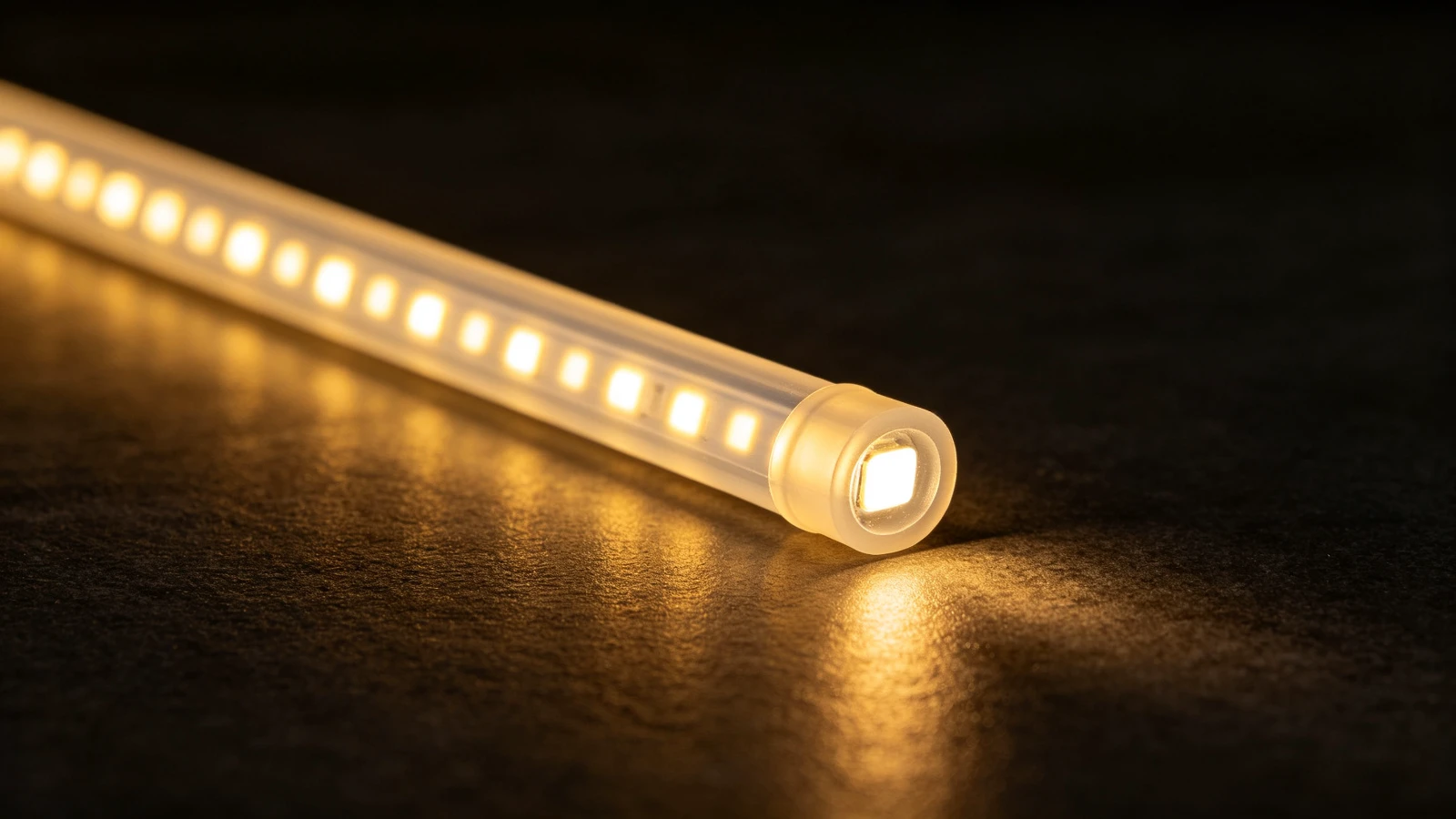
The dot-free rule: viewing distance and diffusion
Whether you see dots depends on three things, not just density: how far the viewer is, whether the strip sits behind a diffuser, and whether it's pointed at a surface indirectly. A 60 LED/m strip inside a deep aluminium profile with a frosted diffuser looks perfectly continuous; the same strip bare and viewed at 20cm shows dots. Before you jump to 240, check whether a cheaper 120 in a diffused profile gives the same look — it usually does.
The tradeoffs nobody mentions
- Power and heat scale with density — a 240 LED/m strip can draw 20+ W/m and genuinely needs an aluminium profile; a 60 LED/m strip runs cool and barely needs one.
- Voltage drop gets worse at higher current, so dense long runs need 24V and power injection.
- Diminishing returns — behind a diffuser, 120 and 240 are often indistinguishable, but the 240 costs more to buy and run.
Sizing the driver for whichever density you pick follows the same process — see the power consumption guide.
How I choose by application
- Cove/indirect ambient — 60 LEDs/m (or low-density COB), hidden and bounced.
- Under-cabinet task — 120 LEDs/m in a diffused profile.
- Bare visible feature/linear fixture — 120–240 or COB for a seamless line.
- Toe-kick/stair guidance — 30–60, low output.
- Retail display close-up — high density or COB for flawless evenness.
FAQ
Is higher LED density always brighter?
Generally yes at the same LED spec, but brightness also depends on the LED size and drive current. Two strips with the same density can differ in lumens, so check the lumen figure too.
Do I need 240 LEDs/m if I use a diffuser?
Rarely. A frosted profile smooths 120 LED/m into a continuous line; step to 240 mainly for bare, close-viewed fixtures.
Does denser strip last less long?
Not inherently, but high-density strip runs hotter without a heatsink, and heat is what shortens LED life. In an aluminium profile, dense strip lasts just as well.
Tell me where the strip goes, the viewing distance, and whether it's behind a diffuser and I'll recommend the density — or point you to a seamless COB strip if you want zero dots without the guesswork.







