
LEDs per Metre: How to Pick Strip Density (60/120/240 SMD vs 320/480/528/700 COB)
- 2026-10-08 17:37
- /
- Arraystar LED
LEDs-per-metre is the spec that quietly decides whether a strip looks like a continuous line of light or a row of bulbs, and it drives everything downstream - minimum profile depth, power draw and driver size, heat and price. Low densities are fine for indirect cove light hidden far from the surface and for tight budgets; medium densities cover most general accent and task work in normal profiles; high and ultra-high densities are what make shallow channels, close viewing and dot-free linear fixtures possible. Choose density from the viewing distance and the profile depth you can fit, then size power and cooling for the watts that come with it - never buy the densest strip by default, because you pay for light and heat you may not need.
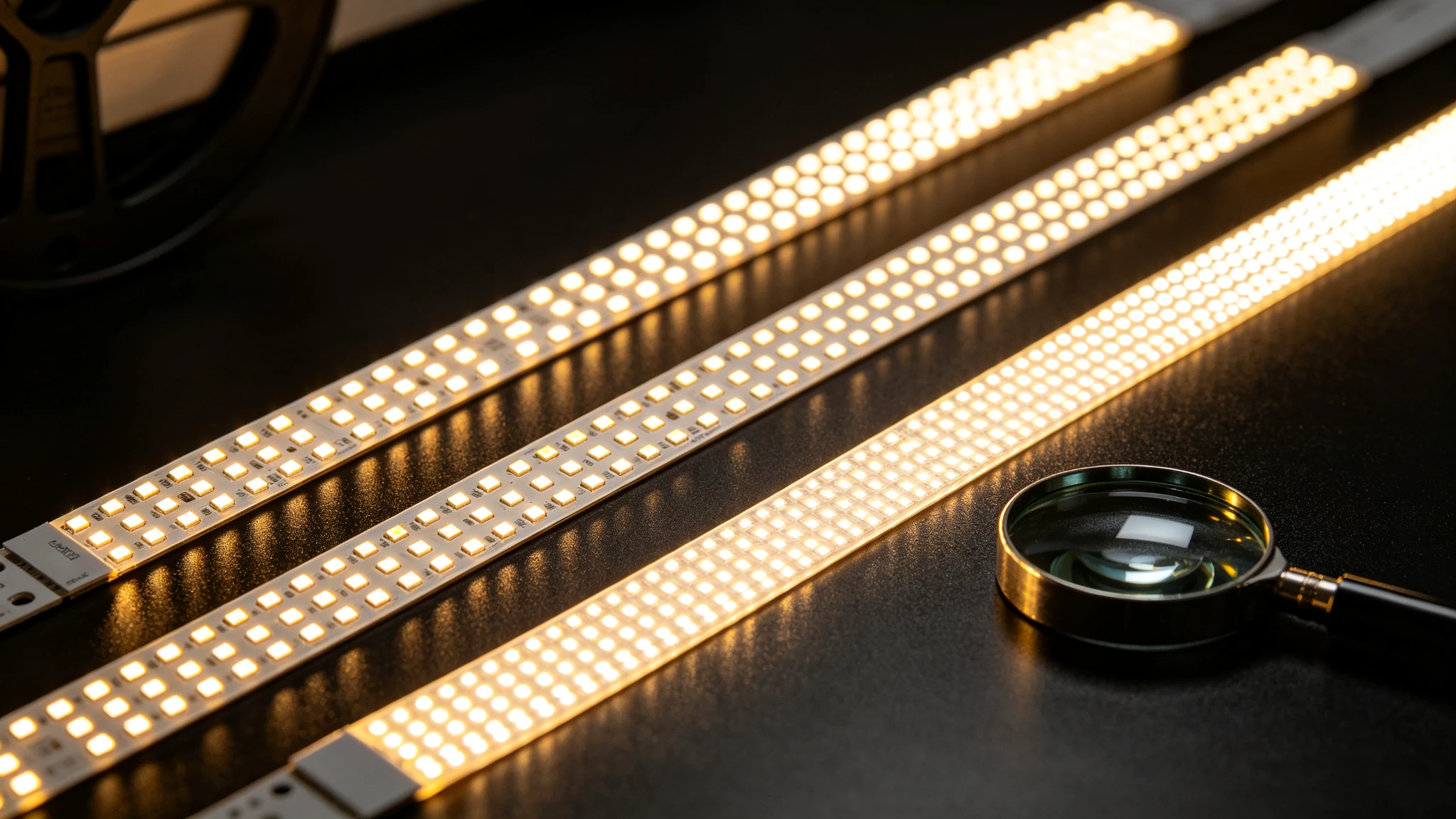
What LEDs-per-Metre Actually Determines
Density is simply how many LED packages are mounted per metre (30, 60, 120, 144, 240, 324, 528, 630 and higher on COB). It sets three things at once: the visual smoothness of the line, the power per metre (more emitters = more watts and heat), and the minimum distance the strip needs from a diffuser or lit surface before the individual points blend together. Two strips with the same colour and voltage can therefore look completely different purely because of density, and the higher-density one needs a bigger driver and better heat sinking.
- Smoothness - higher density shortens the gap between emitters for a seamless line.
- Power & heat - W/m rises with density, sizing the driver and the profile needed.
- Dot-free distance - denser strip blends closer to the cover or surface.
- Cost - denser strip and its power/cooling cost more, so match it to the viewing condition.
- Beam continuity - dense strip also gives more even illumination edge to edge.
The Dot-Free Distance Principle
Individual LEDs blend into a continuous line once the light has enough distance to overlap - either through a diffuser cover or across the gap to a lit surface. A low-density strip viewed up close in a shallow channel shows obvious dots and scallops, while the same strip hidden high in a deep cove looks perfectly smooth because the ceiling gives it distance. This is why density cannot be chosen in isolation: it pairs with profile depth and mounting setback. As a rule, closer viewing and shallower channels demand higher density; indirect light thrown across a large gap can use much less.
Higher density buys dot-free light at closer distance and in shallower profiles.
| Density (LEDs/m) | Character | Typical use |
|---|---|---|
| 30-60 | Clearly individual points | Indirect deep cove, plinth, budget runs viewed far |
| 120-144 | Smooth with a diffuser at depth | General cove, shelving, backlighting |
| 240 | Continuous in standard profiles | Most accent and task linear fixtures |
| 324 | Dot-free in moderate channels | Close-viewed cabinets, displays, shallow cove |
| 528-630+ (COB) | Seamless even in shallow profiles | Pendant/linear fixtures, close task, dot-free accent |
324 COB - The Versatile Mid-High Workhorse
A 324 LED/m COB is my default when a fixture will be seen fairly close in a normal-to-shallow profile but the budget and thermal budget still matter. The chip-on-board construction packs many small emitters in a continuous phosphor line, so 324/m reads smooth through a modest frosted cover without the watts and heat of the ultra-dense options. It covers display shelving, under-cabinet task lighting, moderate coves and compact linear fittings where 240/m would be marginal.
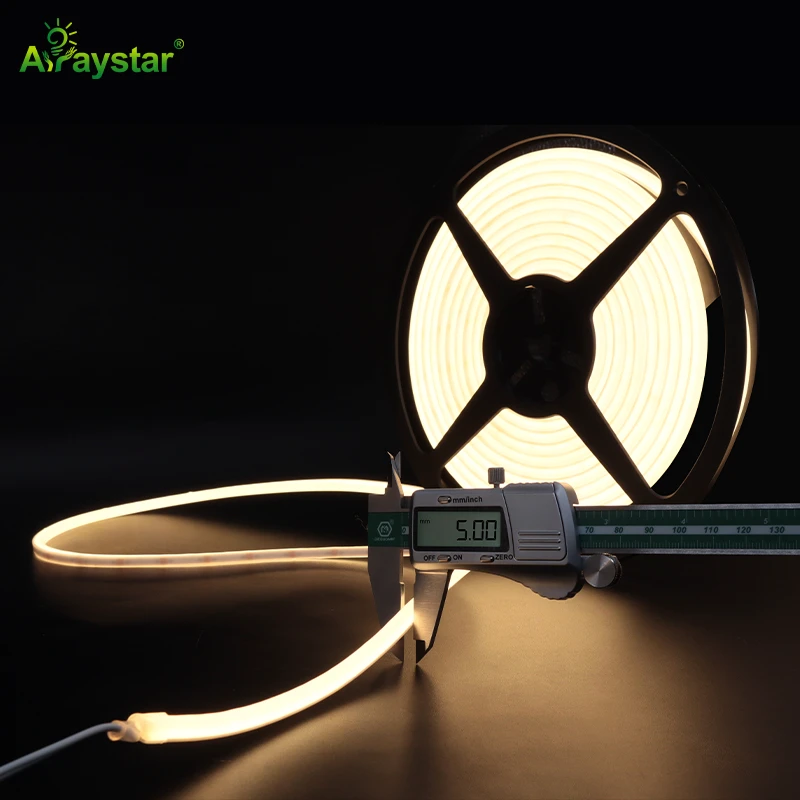
It is the density I reach for when I want a guaranteed clean line without paying for or cooling 600-plus emitters - for most interior accent and close-task work it is the point where smoothness and running cost cross.
630 Ultra-High Density for Shallow and Close Work
When the channel is very shallow, the diffuser sits almost on the LEDs, or the fixture is a pendant or task light viewed directly at close range, step up to ultra-high density around 630/m. At that packing the phosphor line is effectively continuous, so even a slim low-profile cover shows no dots and the beam is seamless end to end. The trade-off is real: wattage and heat per metre are high, so these strips need genuine aluminium heat sinking, correctly sized drivers and, in long enclosed fixtures, attention to thermal build-up.
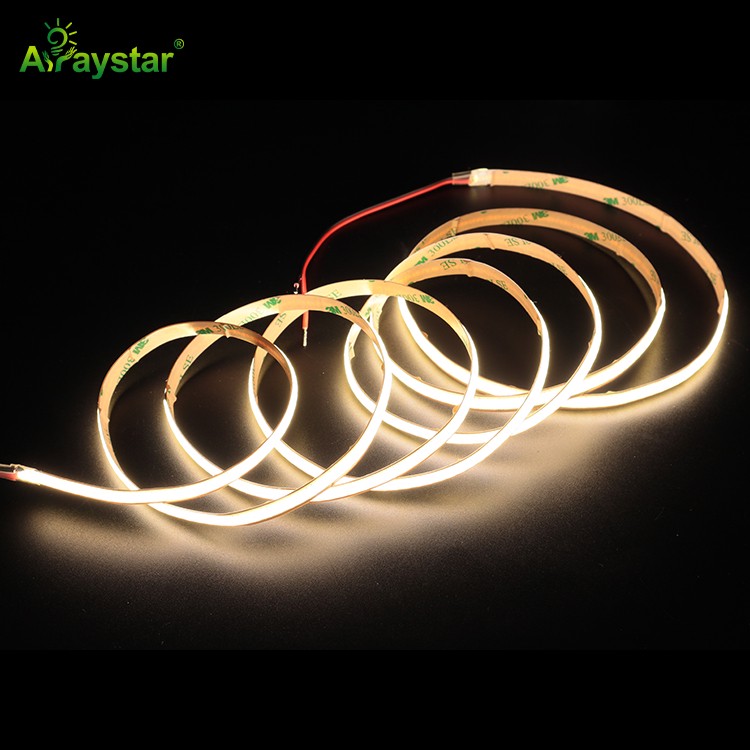
- Specify ultra-high density for shallow diffusers, pendants and close direct viewing.
- Budget the W/m - pair with adequate drivers and real aluminium heat sinking.
- Avoid enclosing 600-level strip in tiny sealed channels; heat shortens life and shifts colour.
- Do not use it for hidden deep cove work - the extra density and watts are wasted there.
High Density in Sealed Product for Wet Zones
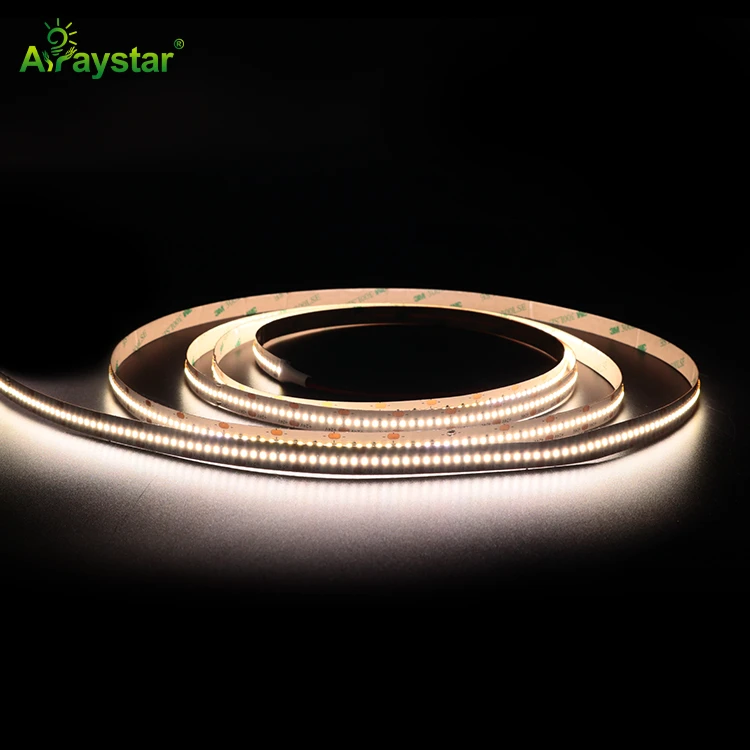
Bathrooms, kitchens and exterior features need both smooth light and sealing, which is where a high-density IP67 COB such as 528/m comes in. The dense emitter line stays dot-free even though the solid silicone jacket adds a little diffusion, and the sealed extrusion handles splash and wash-down. Specifying a high-density sealed strip avoids the common mistake of using low-density waterproof tape in a shallow bathroom channel, where the jacket and shallow cover combine to show obvious dots.
Matching Density, Profile, Power and Cooling
The correct selection sequence is: define the closest viewing distance and whether the source is direct or indirect; choose the shallowest profile the design allows; pick the lowest density that reads dot-free in that profile at that distance; then size the driver and aluminium for the resulting W/m. Buying denser than needed wastes power and creates heat problems; buying too sparse creates the dotted look that cheapens a job. When in doubt, test a short offcut in the actual profile and at the real viewing distance - dot visibility is a geometry question, and a ten-second bench check beats a specification argument.
- Indirect deep cove viewed from far away: 60-144/m is often enough.
- Standard profiles and general accent: 240-324/m for a smooth line.
- Shallow channels, pendants, close task: 528-630/m with proper cooling.
- Sealed wet-zone runs: high-density IP67 COB so the jacket does not reveal dots.
- Always re-size driver watts and profile mass whenever you raise the density.
A recent kitchen shows the logic neatly: the deep ceiling cove viewed from across the room was perfectly served by 120/m strip, while the shallow under-cabinet channels seen at arm's length needed 528/m COB to stay dot-free. Specifying the same dense strip everywhere would have tripled the driver and cooling budget for zero visible gain in the cove; matching density to each viewing condition delivered a seamless look and a sensible bill on the same job.
Recommended Products
Frequently Asked Questions
What LED strip density (LEDs per metre) do I need?
It depends on viewing distance and profile depth. Indirect deep-cove and plinth light viewed from far away can use 60-144/m; standard profiles and most accent/task work suit 240-324/m; shallow channels, pendants and close direct viewing need 528-630/m to stay dot-free. Choose the lowest density that looks seamless in your actual profile at the real viewing distance, then size the driver and heatsinking for the higher wattage that dense strip draws.
Do more LEDs per metre make the strip brighter?
At a comparable LED generation, higher density raises total output per metre, but the main reason to choose it is visual smoothness and a shorter dot-free blending distance, not raw brightness. Denser strip also draws more watts and produces more heat, requiring bigger drivers and better aluminium heat sinking. For indirect light thrown across a gap, a lower-density strip can deliver the same perceived brightness, so do not equate density with brightness you actually need.
Why can I still see dots through my LED profile diffuser?
Because the LED-to-cover distance is too small for the strip density, or the cover is too clear. Fix it by using a deeper profile, increasing to a higher-density (or COB) strip, or switching to an opal diffuser - ideally a combination. Test a short offcut in the actual channel before committing: dot visibility is geometry, and dense strip in a deep frosted channel reads seamless while sparse strip in a shallow clear one always scallops.
Does high-density LED strip run hotter and need a bigger driver?
Yes. More emitters per metre mean higher watts-per-metre and more heat, so high and ultra-high-density (500-630/m) strip should run in genuine aluminium profiles with adequate mass, sometimes with ventilation on long enclosed runs, and drivers must be sized to the total W/m plus headroom. Specify the density, then re-check driver size and thermal management - treating a 630/m strip like a 60/m one causes overheating, colour shift and early failure.
What density waterproof LED strip should I use in a bathroom?
Use a high-density IP67 COB (around 528/m) rather than low-density waterproof tape, because the solid silicone jacket adds a layer that makes sparse emitters look dotted, especially in shallow bathroom channels. The dense sealed line stays smooth while handling splash and wash-down; reserve full IP68 for actual submersion. Pair it with sealed end caps and glands, and keep the driver outside the wet zone.
Need help with your LED project?
Get factory-direct pricing, free samples and engineering support within 24 hours.
Email: info@arraystarled.com | Phone: +86-0755-2103-6746 | WhatsApp: 0086 1581 8514 077
Need to size your power supply? Use our LED Strip Power Calculator to find the right driver in seconds.







