Extending the Wire from LED Strip to Driver: Gauge and Voltage Drop
- 2026-10-28 10:04
- /
- Arraystar LED
A thin long wire running from a distant driver to the start of a strip dims the whole run, and nobody notices until the first evening. I size the cable by the load and the run length, and keep the volt loss under three percent between driver and strip.
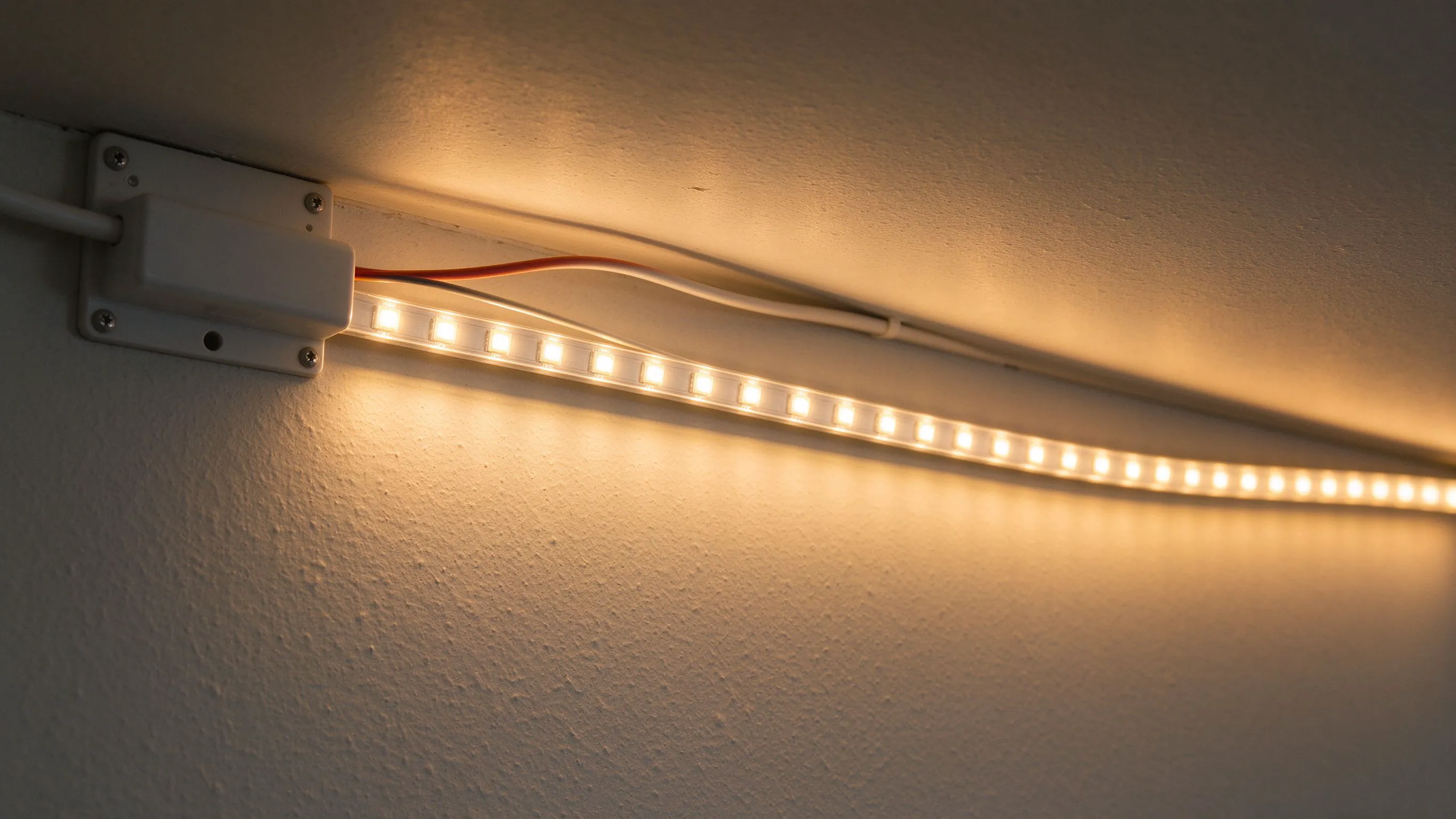
Where the brightness actually drops
LED strip runs at 12 V or 24 V, and even a small resistance on the feed wire turns into a measurable voltage drop at the strip end. A 2 m length of thin 22 AWG cable carrying 3 A can lose half a volt by itself, which on a 24 V system is about two percent brightness across the whole run. The strip at the far end looks fine up close, but compared with a correctly sized feed it is dim and slightly warm in colour. The driver is not at fault; the cable between driver and strip is.
On a kitchen job the driver sat in a basement cupboard and the strip ran up to the worktop. The owner said the light looked yellow and weak. The feed was a twin 0.5 mm bell run over six metres. Resizing to 1.5 mm brought the strip back to a clean white. The driver and strip were never touched.
The drop points on a long feed
- Thin cable over a long run from driver to strip.
- A poor connector adding contact resistance.
- A second long run beyond the strip itself.
- Undersized wire inside a channel crossing a room.

Sizing the wire by current and length
I size the feed so the voltage drop stays under three percent from driver output terminals to the strip start. For a 24 V system that means losing no more than 0.7 V; for 12 V, no more than 0.4 V. Use the load current and the one-way length, and remember the return wire counts double because current travels out and back. A 3 A load over 5 m on 1.0 mm cable is usually fine; the same load over 10 m wants 1.5 or 2.5 mm.
Size for round-trip length; the return wire counts as well.
| Load at 24 V | Run up to 5 m | Run 5-10 m | Run over 10 m |
|---|---|---|---|
| Under 2 A | 0.75 mm | 1.0 mm | 1.5 mm |
| 2-4 A | 1.0 mm | 1.5 mm | 2.5 mm |
| 4-6 A | 1.5 mm | 2.5 mm | Move driver closer |

Why the driver voltage adjustment helps
Many constant-voltage drivers have a small trim pot on the output, usually allowing the 24 V to be set up to 26 or 27 V. If a long feed is unavoidable, I set the output a little high, say 25 V, so that after the cable drop the strip still sees a true 24 V. This only works within the driver trim range and only if the strip is rated for that tolerance. It is a band-aid, though; the clean fix is to move the driver closer or upsize the cable.
- Trim the driver output up to compensate for a known small drop.
- Never exceed the strip rated input tolerance.
- Treat the trim as a fix-up, not the design solution.
Two-way feeding and the far end
On long strip runs, the strip itself also drops voltage from its feed end to its far end, which is why a five-metre COB run often looks brighter at the start. For runs over four metres I feed both ends of the strip, or run a second wire from the driver to the far end. That splits the current in half along the strip and evens the brightness. Combined with a properly sized driver feed, the whole run looks uniform edge to edge.
The voltage check I do on site
I always measure the voltage at the strip start, not at the driver terminals, after the install. A multimeter across the strip pads tells me the truth: if I read 23.2 V at a 24 V strip with a long feed, the drop is 0.8 V and I either upsize the cable or nudge the trim. The number on the driver label means nothing once the cable is in the wall. Measure the light at the business end.
- Measure voltage at the strip, not at the driver.
- Compare a long run against a short reference run for colour.
- Keep total feed drop under 3 percent on 24 V, under 3 percent on 12 V.
Recommended Products
Frequently Asked Questions
What cable size do I use for a long LED strip feed?
Base it on the current and the round-trip length. Under 2 A over 5 m, 0.75 to 1.0 mm is fine. At 2 to 4 A over 10 m, use 1.5 mm. Above 4 A over a long run, either upsize to 2.5 mm or move the driver closer. Remember the return wire carries current too, so size for the full two-way length.
Why does my LED strip look dim at the far end?
Voltage drops along the strip itself from the feed point to the end, so the far end runs at a slightly lower voltage and looks dimmer and warmer. On runs over four metres, feed both ends or run a second wire to the far end. That splits the current and evens the brightness. Also check the driver-to-strip feed is not adding its own drop on top.
Can I just turn the driver voltage up to fix a dim strip?
You can nudge the trim pot on many drivers to compensate for a small known drop, but only within the strip rated tolerance and only for a small loss. If the feed is dropping more than 0.7 V on 24 V, turning the driver up to compensate masks a wiring problem that will warm the cable. Up-sizing the feed or moving the driver closer is the durable fix.
Is 12 V or 24 V better for long extensions?
24 V, because at half the current for the same wattage, voltage drop on the feed is halved. A long extension that dims a 12 V run often works perfectly on 24 V with the same cable. If you have a long run to plan, choose 24 V strip from the start. It costs a little more per metre and saves you re-sizing the feed cable later.
How much voltage drop is acceptable?
Keep it under 3 percent. On 24 V that is about 0.7 V from driver terminals to the strip start; on 12 V it is about 0.4 V. Above that, the visible brightness and colour shift becomes noticeable, especially compared with a reference run. Measure at the strip end with a multimeter after install rather than trusting the driver label reading.
Need help with your LED project?
Get factory-direct pricing, free samples and engineering support within 24 hours.
Email: info@arraystarled.com | Phone: +86-0755-2103-6746 | WhatsApp: 0086 1581 8514 077
Need to size your power supply? Use our LED Strip Power Calculator to find the right driver in seconds.