0612 Long-Run Neon: 6mm Slim Body, 10W/m, IP67 Field Notes
- 2026-11-06 16:15
- /
- Arraystar LED
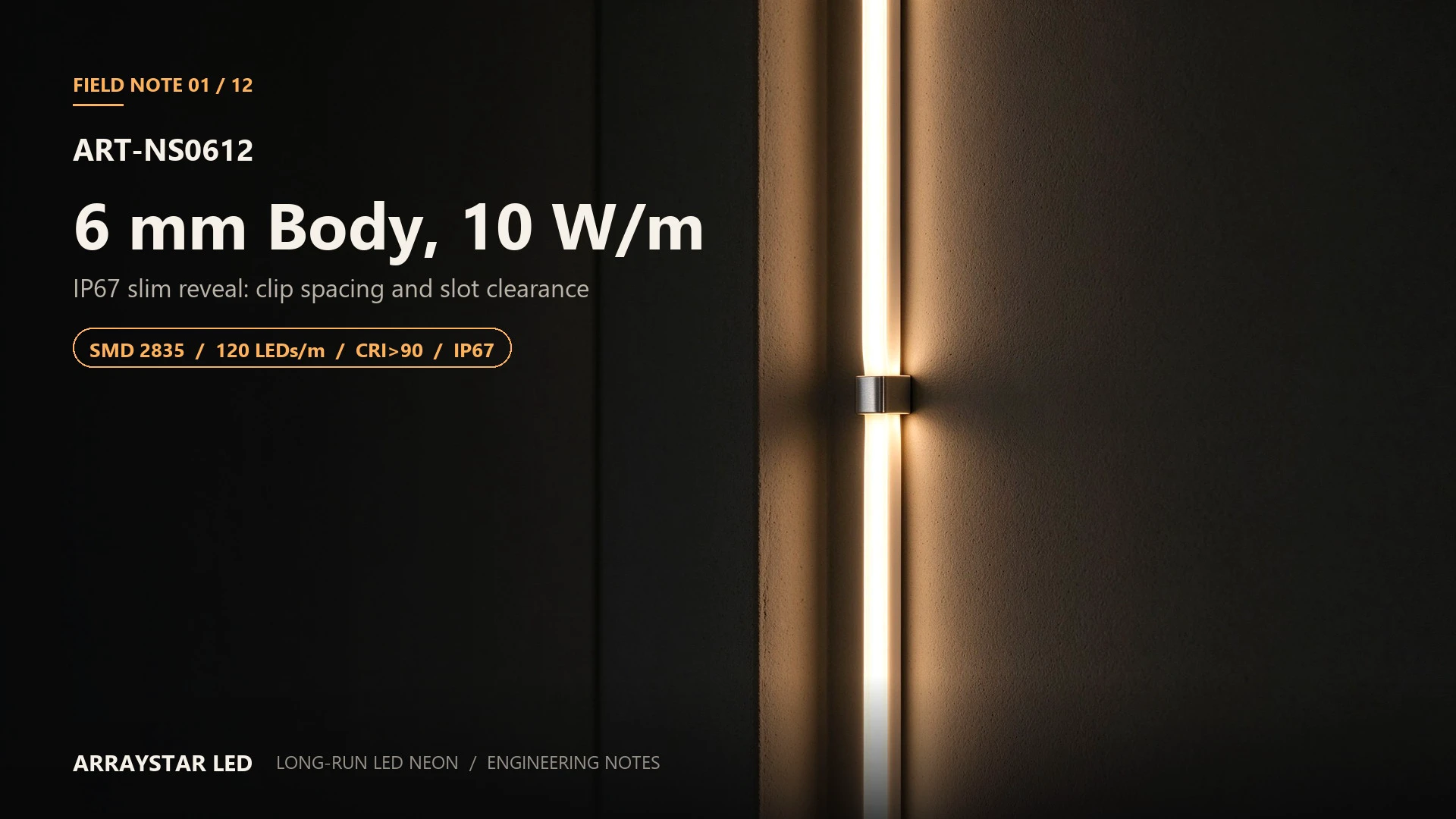
The first sign is a bright band, not a dark one. A 6 mm neon body is pushed into a slot that is only a little wider than the body, the clip is tightened, and the silicone wall compresses against the PCB. Three months later that section reads brighter than the rest of the run — the diffuser has been squeezed thinner over the emitters — and the client reads it as a colour inconsistency.
Nothing is wrong with the LEDs. The installation changed the optical path.
A 6 × 12 mm profile is the slimmest body in the Long Run range, and its limits are mechanical before they are electrical. The 6 mm face gives you a discreet line in a narrow reveal; the same 6 mm wall gives you very little material to absorb clamp pressure, thermal expansion, and the bend stress at a corner. Design the slot and the fixing around that, and the run behaves. Ignore it, and the body fails at the clamp, not at the driver.
1. The three failure points specific to a 6 mm body
| What fails | Why it fails on 0612 specifically | What you see |
|---|---|---|
| Bright or dark band under a clip | 6 mm wall deflects under clamp load; diffuser thickness changes over the emitter | Local hot spot along one straight section |
| Crease at a corner | Thin wall has less material to distribute bend stress | Milky line at the inner radius, visible at grazing angle |
| Water at the end cap | Small cross-section leaves little surface for adhesive; cap is proportionally heavy | Condensation and flicker at the tail after a wet season |
None of these appear on a 12 × 12 body at the same clamp force. The difference is wall thickness, not LED quality. This is the reason a slim profile needs its own fixing schedule rather than a scaled-down version of the 1212 detail.
2. Optical behaviour at 6 mm: a line, and only a line
120 × SMD 2835 per metre gives an emitter pitch of 8.33 mm. Behind a 6 mm diffused face, that pitch is not fully blended at close range. Two consequences:
- Viewing distance. At 200 mm and beyond, the line reads continuous. Below 150 mm — a handrail detail, a display case edge, a door reveal at eye level — individual emitters can still be read as a faint ripple.
- Diffuser width. A 6 mm face has roughly half the diffusion width of a 12 mm body. The trade is deliberate: a narrower line, with less blending margin.
If the design calls for a perfectly uniform line at 100 mm viewing distance, this is the wrong profile; step to 12 × 12 or add a deeper reveal. If the detail is seen from 300 mm outward — a façade reveal, a sign edge, a ceiling slot — 6 mm is the correct choice and the ripple is not visible.
Colour range is 1800 / 2700 / 3000 / 4000 / 6000 K plus single colours, CRI >90 on white. For a run where two rolls meet, keep both rolls from the same bin lot; at 6 mm there is less diffuser to hide a bin step.
3. Electrical and thermal: 10 W/m in the smallest body
The arithmetic is simple; the thermal consequence is not.
- 10 W/m × 5 m = 50 W
- 50 W ÷ 24 V = 2.08 A per 5 m run
- Driver with 20 % headroom = 60 W at 24 V
For a 10 m outline, do not series-chain two 5 m lengths. Feed each length from the driver, or arrange a two-end feed. The 6 mm body has the least copper cross-section in the range, so its internal track resistance is the tightest constraint — the reason the profile is sold as a short-feed long-run product rather than a single-feed one.
The thermal point that catches people: a 6 × 12 section has about 25 % less surface area per metre than a 12 × 12 section at the same wattage. In free air that is manageable. Inside a narrow closed slot with no substrate contact, it is not. The body must sit against a metal channel, or the slot must be vented at both ends. A 10 W/m run in an unvented 8 mm slot will run materially hotter than the same run in a 12 mm channel, and the silicone will yellow from the inside long before the LED reaches end of life.
Feed drop at the segment current (5 m out + 5 m back):
| Conductor | Loop resistance | Drop at the segment | % of supply |
|---|---|---|---|
| 0.50 mm² | 0.37 Ω | 0.77 V | 3.2 % |
| 0.75 mm² | 0.25 Ω | 0.52 V | 2.2 % |
| 1.00 mm² | 0.18 Ω | 0.37 V | 1.6 % |
Use 0.75 mm² as the floor; step up to 1.00 mm² where the driver sits more than 5 m from the first tap.
4. IP67 and food-grade silicone: what the rating does and does not cover
This model carries IP67 in a food-grade silicone body. That combination is useful beyond food areas: silicone resists UV and cleaning agents far better than PU, and a food-grade compound has low extractables, which matters in display cases, hospitality counters, and any space where the strip sits near hands or food.
What IP67 does not cover:
- Continuous immersion. IP67 is temporary immersion. A fountain edge or a planter that holds water needs the IP68 extrusion range, not this body.
- A failed end cap. The rating is maintained only if the cut end is sealed with the matching cap and a potted joint. A 6 mm cap has a small bonding area; adhesive alone is not enough outdoors.
- Clamp damage. A crushed wall is no longer a sealed wall. The rating assumes the body is installed without point loads.
5. Site practice for a 6 mm profile
Slot width. Leave at least 2 mm clearance on each side for thermal expansion. A slot cut exactly to 6 mm will pinch the body as it warms.
Fixings. Clips at 150–200 mm centres, not 250 mm. The thinner wall needs more support points, and the shorter spacing keeps the body from bowing between clips. Never clamp directly over an emitter; offset the clip by half a pitch.
Bending. Bend in the thin plane, on a formed template, not by hand. The minimum radius is set by the 6 mm wall, and it is larger than the number a 5 mm COB strip would accept. Confirm the batch datasheet before templating a tight corner.
Cutting. Cut only at the marked points — 50 mm intervals, six LEDs at 120 LEDs/m on 24 V. Count from the mark, not from the cap.
Sealing. Moulded cap plus potted joint on every outdoor cut end. Keep the joint on a vertical face.
6. Commissioning checks
| Check | Method | Pass criterion |
|---|---|---|
| Clamp load | Visual after 30 min at full output | No bright band, no visible compression |
| Feed drop | Measure head and tail under load | ≤ 3 % of 24 V |
| Slot temperature | IR probe after 60 min | ≤ 45 °C surface in still air |
| End seal | Visual + continuity | Potted, off the water plane |
| Line continuity | View at the specified distance | No ripple at the design viewing distance |
7. Engineering FAQ
Can this run be mounted without an aluminium channel?
Only where the slot is vented and the surface is thermally conductive. At 10 W/m the body itself is the only heat path; in a closed plaster or aluminium composite reveal with no venting, the surface temperature climbs and the diffuser yellows. Use a channel, or leave both ends of the slot open.
Is IP67 enough for an outdoor sign edge?
Above the splash line and with a moulded end cap and potted joint, yes. For a sign base that sits in standing water or a coastal location with direct wave spray, step to the IP68 full-extrusion model and pot every connection.
Will 6 mm read as bright as 12 mm at the same wattage?
It will read as a narrower, slightly sharper line at the same 10 W/m. The 12 mm body spreads the same flux over a wider face, so it looks softer and dimmer per millimetre of face width, but brighter in total. Choose 6 mm for a fine line, 12 mm for a fuller glow — not for more output.
8. Specification summary
| Parameter | Value |
|---|---|
| Model | ART-NS0612 |
| Cross-section | 6 × 12 mm |
| Bending / emission | Top-bend, top-emitting |
| LED | SMD 2835, 120 LEDs/m |
| Input | 24 V DC |
| Power | 10 W/m |
| CRI | >90 (white) |
| Colour | 1800 / 2700 / 3000 / 4000 / 6000 K, single colours |
| Cut unit | 50 mm (6 LEDs) |
| Ingress | IP67 |
| Body | Food-grade silicone |
| Warranty | 3 years |
Specifying a 6 mm reveal? Send the slot width, viewing distance, and run length. We will return a clip schedule, a feed plan, and the correct channel detail for this body.