1018 Long-Run Neon: 10×18mm, 12W/m, Cornice Detail
- 2026-11-06 16:15
- /
- Arraystar LED
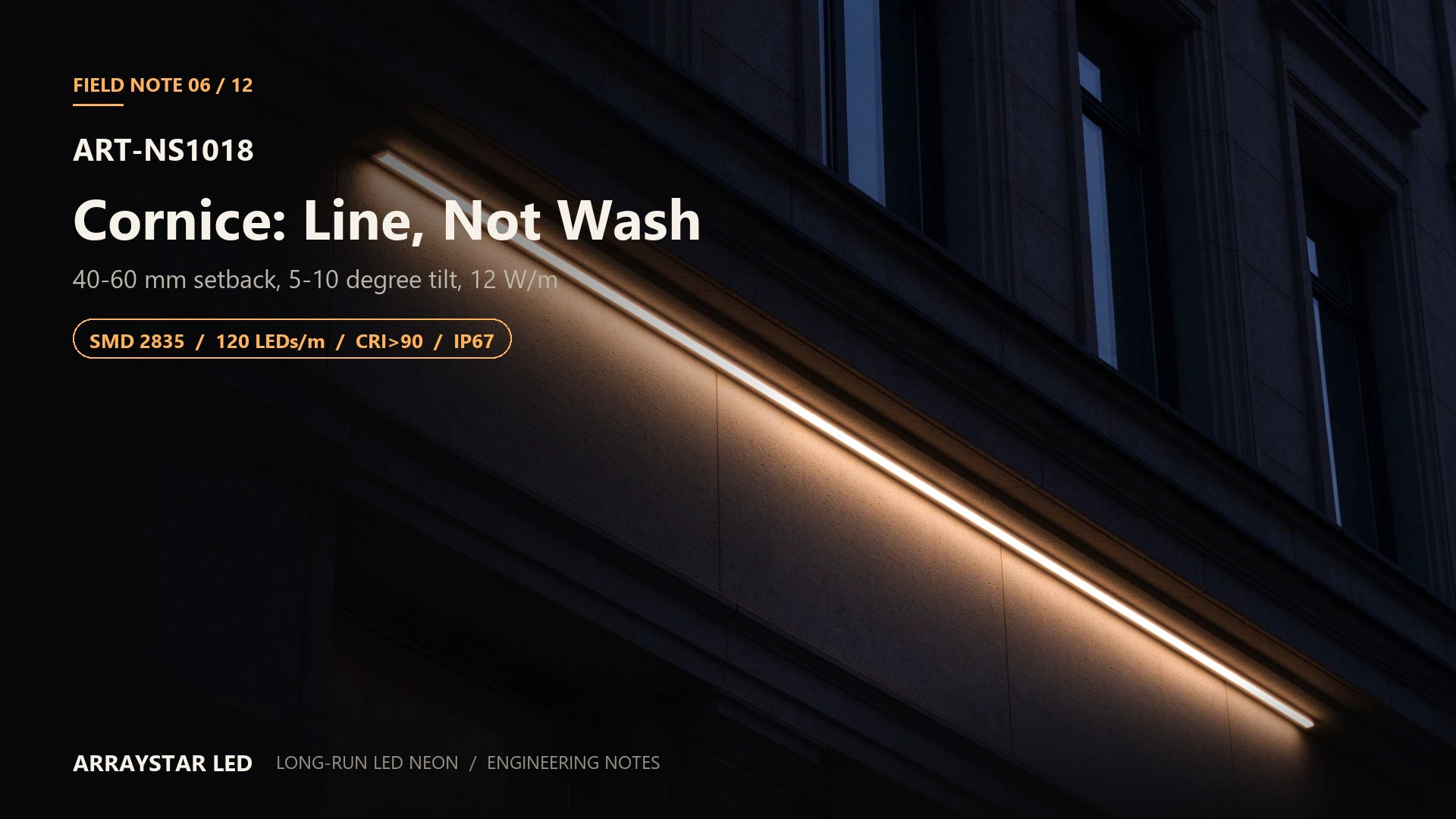
The design intent was a soft wash down the wall. The installed result is a hard bright line at the cornice with the wall below it almost untouched. The body is working exactly as specified — a 10 mm emitting face at 12 W/m — but a linear emitter at the top of a wall does not wash a surface unless the geometry gives it somewhere to throw the light.
A 10 × 18 mm profile is the shallow-wide body in the Long Run range: 10 mm face, 18 mm depth. It is built for cornices, soffits, and recessed edges where the body sits back and the line reads as an architectural contour. Specifying it as a wall-washer is the wrong brief, and no driver setting will correct it.
1. The cornice geometry problem
Light leaves the 10 mm face in a Lambertian pattern, with a strong component normal to the face. On a horizontal cornice, that means most of the output goes across the ceiling or into the room, not down the wall.
| Mounting | Where the light goes | Result |
|---|---|---|
| Face up, at the ceiling line | Across the ceiling | Ceiling glow, wall dark |
| Face down, at the cornice edge | Down, but masked by the 18 mm body | Narrow line, wall partially lit |
| Face out, at the wall plane | Across the room | Line, no wash |
| Set back 50 mm, face down | Grazing the wall | Soft wash, if the setback is right |
The usable wash comes from setback, not from output. A 10 mm face set 50 mm back from the wall and angled slightly down produces a soft gradient; the same body flush at the wall produces a line.
2. Optical behaviour at a 10 mm face
120 × SMD 2835 per metre gives an 8.33 mm pitch. A 10 mm diffused face covers the pitch, so the line is continuous from about 200 mm outward.
- Line width: the lit line reads at roughly 10–12 mm at close range, widening with distance.
- Colour: 1800 / 2700 / 3000 / 4000 / 6000 K, CRI >90. On a cornice the white is usually seen against a ceiling, so a bin step between rolls is more visible than on a façade.
- Glare: at eye level, a flush-mounted 12 W/m line is a direct view of the diffuser. If the cornice is below eye height, add a baffle or set the body back; the 18 mm depth gives you room to do it.
3. Electrical: 12 W/m, 24 V and 36 V
| Supply | Current per metre | 5 m segment | 10 m load |
|---|---|---|---|
| 24 V | 0.500 A/m | 2.50 A / 60 W | 120 W / 5.0 A |
| 36 V | 0.333 A/m | 1.67 A / 60 W | 120 W / 3.3 A |
For a cornice run of 10 m or more, the 36 V option reduces the current by one third and extends the practical feed interval. Use the same segment logic as any 24 V long run: 5 m per feed on 24 V, longer intervals only where a slight tail tolerance is acceptable.
Cut at the marked points: 50 mm, six LEDs.
Feed drop at the segment current (5 m out + 5 m back):
| Conductor | Loop resistance | Drop at the segment | % of supply |
|---|---|---|---|
| 0.50 mm² | 0.37 Ω | 0.93 V | 3.9 % |
| 0.75 mm² | 0.25 Ω | 0.63 V | 2.6 % |
| 1.00 mm² | 0.18 Ω | 0.45 V | 1.9 % |
Use 0.75 mm² as the floor; step up to 1.00 mm² where the driver sits more than 5 m from the first tap.
4. Thermal: the 18 mm depth is an advantage
The 10 × 18 section has 56 mm of perimeter, more than a 12 × 12 body, with a larger cross-section. At 12 W/m it runs cooler than a 10 × 10 body at the same wattage — roughly 11–15 K above ambient in free air.
That matters on a cornice because the body is often enclosed on three sides. The 18 mm depth gives you room to leave an air gap behind the body and vent the ends; a shallower body would sit against the substrate and cook.
5. Fixing, sealing and the detail that makes the wash work
- Setback: 40–60 mm from the wall plane for a soft wash; flush for a line.
- Angle: a 5–10° downward tilt turns a line into a gradient. Build the tilt into the channel, not into the clip.
- Clips: 200–250 mm on straights, 100 mm on bends. Offset by half a pitch.
- Sealing: on an outdoor cornice, the body is exposed to wind-driven rain. Every cut end gets a moulded cap and a potted joint, and the joint sits at the high end of the run.
- Drainage: do not trap water in the channel behind the body. Leave the low end open.
6. Commissioning checks
| Check | Method | Pass criterion |
|---|---|---|
| Wall gradient | Measure at 0.3 / 0.6 / 1.0 m below the cornice | Smooth fall-off, no hard line |
| Glare | View from the occupancy zone | No direct view of the emitter |
| Feed drop | Head and tail under load | ≤ 3 % of supply |
| Channel temperature | IR probe after 60 min | ≤ 45 °C surface |
| End seal | Visual + continuity | Potted, off the water plane |
7. Engineering FAQ
Can this body wash a wall if I use a higher wattage?
No. The limitation is geometry, not flux. A 10 mm face at the top of a wall throws light across the surface, not down it. For a wash, use a wall-washer profile or set this body back 50 mm and angle it down 5–10°.
Should I use 24 V or 36 V on a 12 m cornice?
36 V if the driver is remote or the run would need more than two 24 V taps. The lower current reduces feed drop. Confirm the 36 V model and driver before designing the segment map.
Is a flush cornice detail bad for glare?
Only if the cornice is at or below eye height. Above eye height, a flush line is usually acceptable. Below eye height, set the body back or add a baffle; the 18 mm depth gives you space for either.
8. Specification summary
| Parameter | Value |
|---|---|
| Model | ART-NS1018 |
| Cross-section | 10 × 18 mm |
| LED | SMD 2835, 120 LEDs/m |
| Input | 24 V DC / 36 V DC |
| Power | 12 W/m |
| CRI | >90 |
| Colour | 1800 / 2700 / 3000 / 4000 / 6000 K |
| Cut unit | 50 mm (6 LEDs) |
| Warranty | 3 years |
Detailing a cornice or soffit? Send the section drawing and the wall finish. We will return the setback, tilt, and clip schedule that turns this body into the effect you actually specified.