Suspended 360° Neon Flex: Wire, Spacing and Sag Control
- 2026-10-28 10:03
- /
- Arraystar LED
Round 360° neon flex looks easy to hang until it sags at mid-span and twists its bright side away from the street. I tension the wire, space hangers by the catenary, and pin the rotation so the sign stays flat and readable.
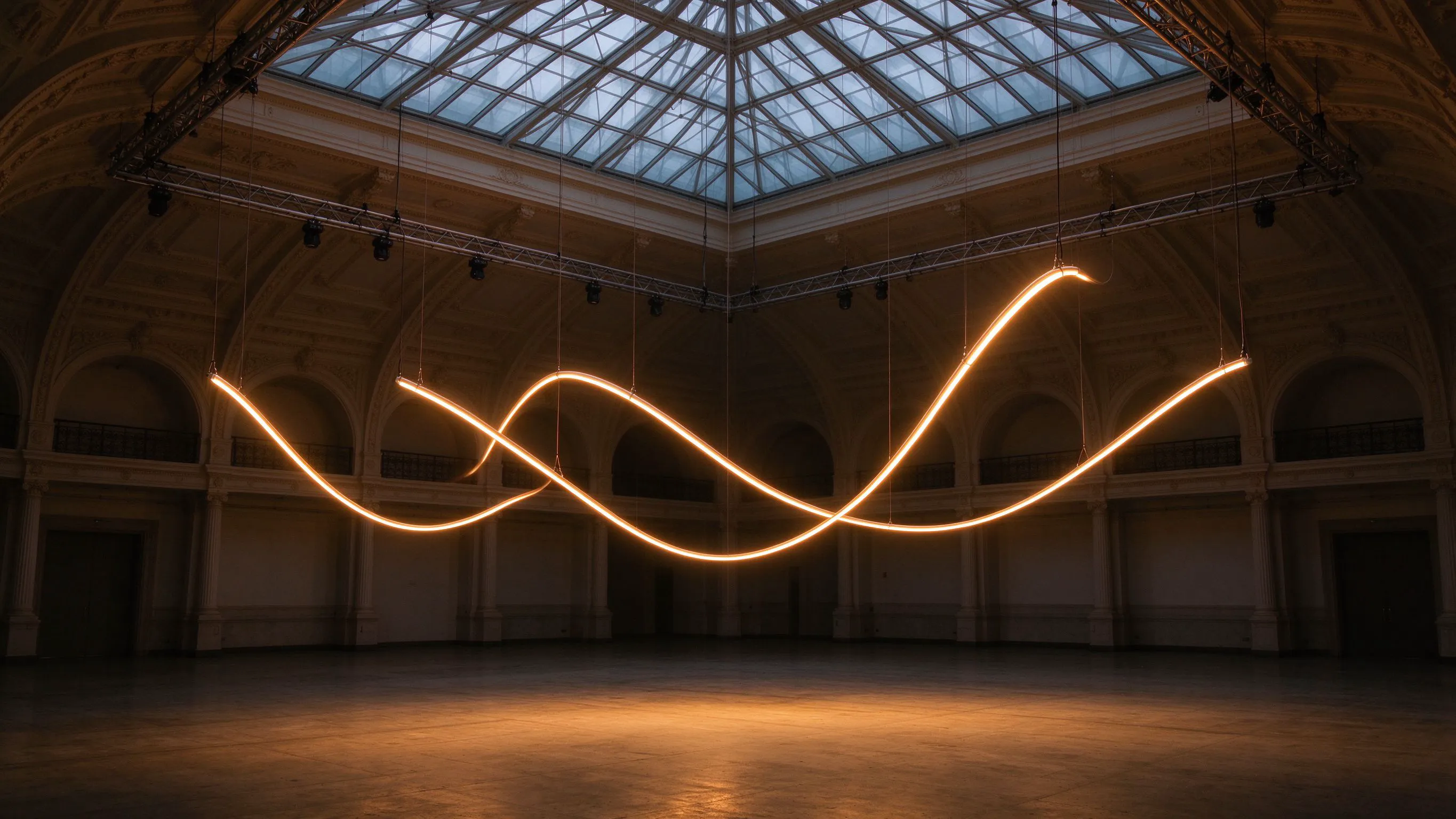
Why round 360° neon flex sags when you hang it
A round neon flex is a soft silicon tube, usually 10–16 mm across, weighing 60–120 g per metre depending on the section. Suspend it between two anchors and its own weight pulls it into a curve rather than a straight line. Ignore that curve and you get a sign dipping 20–50 mm at the centre on a 3–4 m span — visible from across the car park.
The other problem is rotation. A circular tube has no flat face to register against the hanger. A small breeze will spin it 90°, and because most 360° tubes are still brighter on the emitter side, that spin shows up as a banded glow. I once had a 6 m word sign that twisted every evening; by morning the brightest line was pointing at the floor.

What you are actually fighting
- Tube self-weight: 60–120 g/m for 10–16 mm round profiles
- Wind load: 0.3–0.6 kN/m² on a fully exposed facade
- Thermal expansion: silicon runs 0.1–0.2 mm per metre per °C
- Rotational freedom: zero registration on a round section
Wire selection and tension — what I actually use
I no longer use bare copper picture wire. For spans up to 4 m I run a 1.0 mm stainless-steel cable (7×7 strand), and for 5–8 m clear spans I step up to 1.5 mm. A 1.0 mm cable breaks around 80–100 kg, giving a safety factor above 10 on a neon run weighing under a kilogram. That margin is what survives a January gust.
Tension matters more than people think. I set the cable so it deflects about 10–15 mm under the neon weight, then add 20% extra turn on the tensioner. A loose wire looks soft; a wire hammered drum-tight in the afternoon buckles when the tube warms at night. I leave a turnbuckle so the client can adjust in spring.
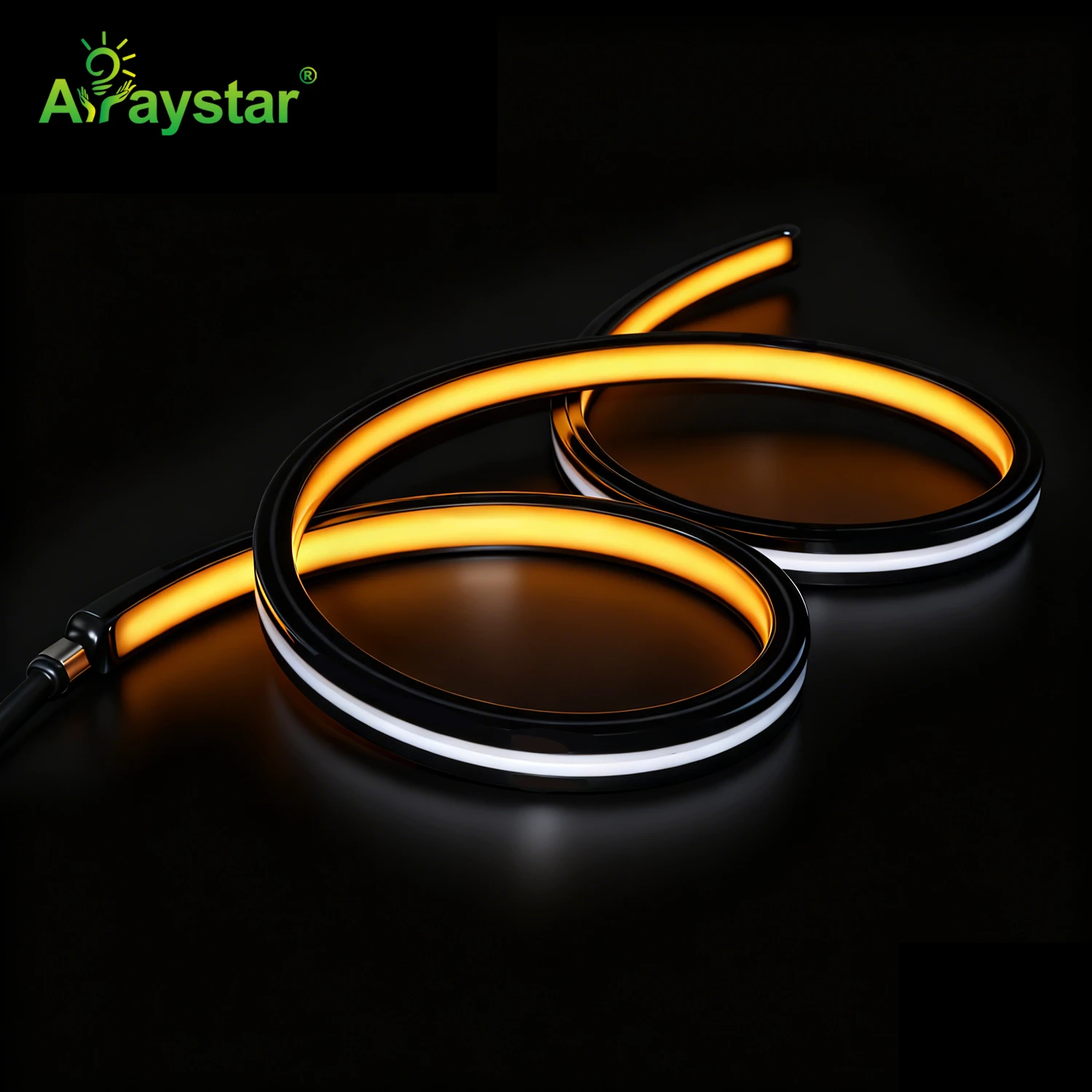
Hardware I specify
| Item | Typical choice | Why |
|---|---|---|
| Cable | 1.0–1.5 mm A4 stainless 7×7 | Corrosion, no sag over years |
| Tensioner | Turnbuckle or wire gripper | Field-adjustable |
| Anchors | M6 chemical anchor into brick or concrete | No plug pull-out |
| Insulators | PBT or ceramic stand-off | Keeps LV feed away from steel |
Hanger spacing and the catenary maths
The quick rule I use: hangers every 600 mm on straight runs, every 400 mm on bends, and always within 150 mm of each end cap. Skip a hanger in the middle of a 3 m letter and the tube curves between anchors; the letters look wavy from the road.
For a free-hanging span without intermediate hangers, sag is roughly d = W·L² / (8·T), where W is weight per metre in newtons, L is span in metres, and T is cable tension in newtons. A 100 g/m tube (about 1 N/m) on a 4 m span at 50 N tension gives about 1·16 / 40 = 0.4 m of sag — far too much. Bump tension to 150 N and sag drops to around 13 mm, which is the number I am happy with.
Spacing cheatsheet
- Straight run: 600 mm max between hangers
- Curved section: 400 mm max
- Within 150 mm of end caps and feed points
- Never span more than 2 m without an intermediate anchor
Twisting and rotation — keeping the bright side out
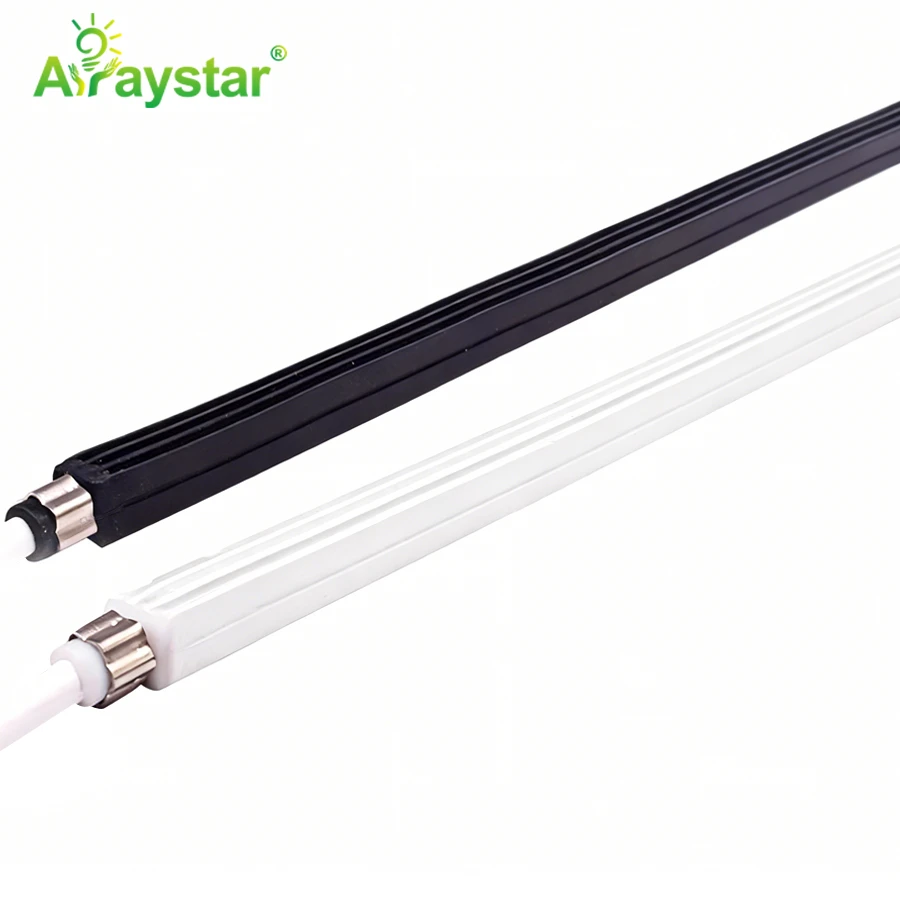
To stop a round tube spinning, I do not rely on the hanger gripping it. I add a small cable tie at every hanger, snug but not crushing the silicon, and rotate the tube by hand until the emitter seam sits at 12 o clock before cinching. For tubes that genuinely glow evenly all around this matters less, but most 360° products are still brighter on one side.
On one exterior job I used a black housing strip because the client wanted the cable invisible by day. The black sleeve also made rotation less obvious — even if the tube turned 30°, the daytime appearance stayed uniform.
Rotation checklist
- Mark the emitter seam with a dry pen before hanging
- Cable-tie at every hanger, alternating left and right
- Re-check after the tube has warmed for 20 minutes
End terminations and electrical feeds for long hangs
A suspended sign is a voltage-drop problem in the air. On a 6–8 m neon run I feed from both ends rather than one middle feed, and I use 24V or 48V circuitry with a 20 AWG lead to the driver. Feeding both ends halves the per-half current and keeps colour consistent across the word.
The end cap must be glued, not just pushed on. I use a neutral-cure silicon, over-fill the cap by about 2 mm, and leave it cured for 24 hours before tensioning. A cap that slips under load is where water and rotation both start.
Feed pattern I use
| Span | Feed strategy | Lead size |
|---|---|---|
| Up to 3 m | Single end | 22 AWG |
| 3–6 m | Middle feed | 20 AWG |
| Over 6 m | Both ends | 2×20 AWG |
Recommended Products
Frequently Asked Questions
How far apart should neon flex hangers be?
On a straight suspended run I keep hangers at 600 mm maximum spacing. On bends and radiused letters I tighten that to 400 mm, and I always place a hanger within 150 mm of each end cap and each feed point. Skipping a hanger in the middle of a long letter is the most common reason a sign starts to wave at mid-span.
What wire gauge for suspended neon?
I use 1.0 mm A4 stainless 7×7 cable for spans up to 4 m, and 1.5 mm for 5–8 m clear spans. A 1.0 mm cable breaks around 80–100 kg, giving a safety factor above 10 on a neon run weighing well under a kilogram. Add a turnbuckle or wire gripper so tension can be adjusted in spring.
How do I stop round neon from twisting?
Do not rely on the hanger gripping a round tube. Mark the emitter seam, rotate the tube until the seam sits at 12 o clock, then cable-tie at every hanger, alternating left and right so tie pressure cancels out. Re-check after the tube has warmed for 20 minutes; silicon softens slightly and rotation can shift.
Can I hang neon flex outdoors?
Yes, provided the profile is at least IP65 and the end caps are properly siliconed. Use A4 stainless hardware, chemical anchors into brick or concrete, and keep the driver indoors or in an IP67 enclosure. Winter contraction and a −10°C morning are where poorly anchored signs fall down.
What is the maximum suspended span without intermediate hangers?
I keep it under 2 m. Beyond that, even at high tension the sag becomes visible, and wind loading flexes the tube. If the design demands a longer clear span, step up to 1.5 mm cable, bump tension toward 150 N, and accept that you will be back on site in spring to re-tension.
Need help with your LED project?
Get factory-direct pricing, free samples and engineering support within 24 hours.
Email: info@arraystarled.com | Phone: +86-0755-2103-6746 | WhatsApp: 0086 1581 8514 077
Need to size your power supply? Use our LED Strip Power Calculator to find the right driver in seconds.