Two Reels Show a Visible Brightness Line at Dusk on My Sign
- 2026-11-02 15:54
- /
- Arraystar LED
A faint vertical line where two reels meet only shows up when the sky goes dark because daylight was hiding a small bin difference all day. This is almost never a wiring fault. It is two reels from slightly different lots, and the fix is ordering one continuous length next time, not swapping drivers.

The line that only appears at dusk
Clients call me at 6 p.m. in the summer because the sign looked perfect all afternoon, and the moment the sun drops, a soft brightness step appears exactly at the join between two reels. One side reads 4000 K, the other 4200 K, or one side is 5 percent brighter than the other. In full daylight, the surrounding light masks the difference. At dusk, the contrast jumps out.
I have seen this on straight building outlines, on bar signage, and on cove lighting. It is consistently at a reel join, never in the middle of a run. That pattern alone tells me it is a binning and lot issue, not voltage drop, because voltage drop fades smoothly toward the far end of the run rather than stepping at one specific joint.
Why reels from the same product look different
LED bins are sorted within tolerance windows, not to a single value. A warm white reel might be binned at 2700 K plus or minus 150 K, which means one reel lands at 2600 K and the next reel lands at 2800 K. To the naked eye in daylight, both look warm. On a dark sign face side by side, the 200 K step is obvious. Brightness bins shift the same way, by 3 to 5 percent between lots.
What to ask the supplier for
- Ask for the same lot number on every reel for one sign, not just the same part number.
- Request a CCT and flux bin label on each reel, not just the nominal 2700 K.
- Ask for a 300 mm sample of each lot lit side by side before the full order.
- For colour-critical signs, ask for chromaticity coordinates on the 1931 diagram.
How to diagnose it on the wall
Before you condemn the reels, rule out the two other things that cause a brightness step. First, measure the voltage at both sides of the join. A poor connector or a long feed drop can make one side run at 21.5 V and the other at 23.5 V, which also looks like a step. Second, swap the two reel ends around and see if the line moves with the reel or stays at the same joint.
- Measure DC voltage 100 mm on each side of the join; a gap above 0.3 V points to a connector.
- Swap the two reel segments electrically and relight; if the line follows the reel, it is binning.
- Film the sign at dusk with a phone on a tripod and compare the two sides on the photo.
- Check for a half-lit pad at the join, which is a solder fault, not a bin fault.
Ordering strategy that avoids the line
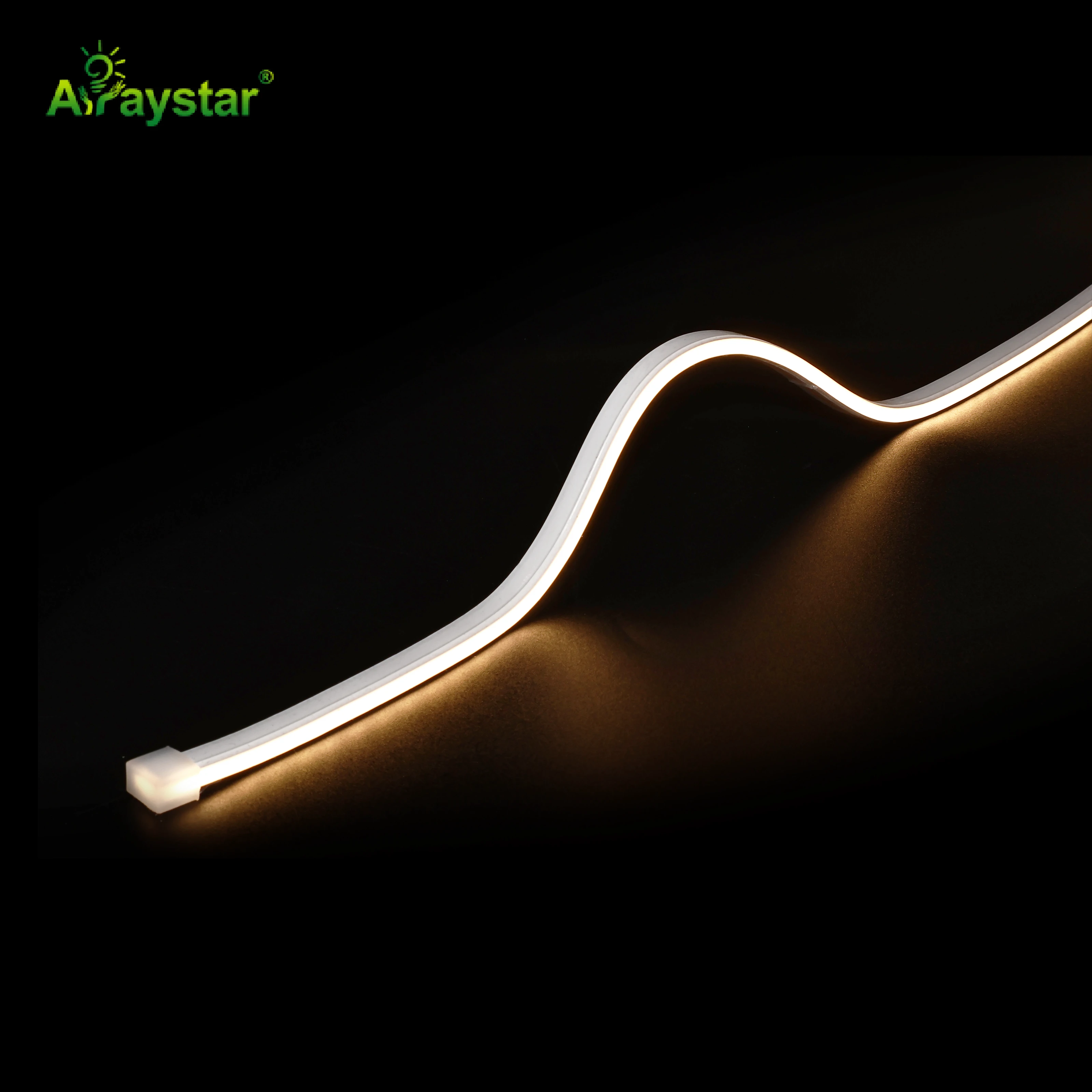
The cleanest fix is ordering one continuous reel long enough for the whole run. Most neon flex comes in 5, 10, or 20 metre reels, and if your total sign length is 8 metres, one 10 metre reel beats two 5 metre reels from different lots. If you must join reels, ask the supplier to pull both from the same production lot before they ship.
One continuous reel beats two matched reels every time.
| Run length | Best order | Likely mismatch? | Backup plan |
|---|---|---|---|
| Up to 5 m | One 5 m reel | None | No join needed |
| 5 to 10 m | One 10 m reel | Low | Same-lot join if split |
| 10 to 20 m | One 20 m reel | Low | Centre-feed injection |
| Over 20 m | Multiple reels, same lot | Medium | Request bin match in writing |
When the line is actually a driver or wiring fault
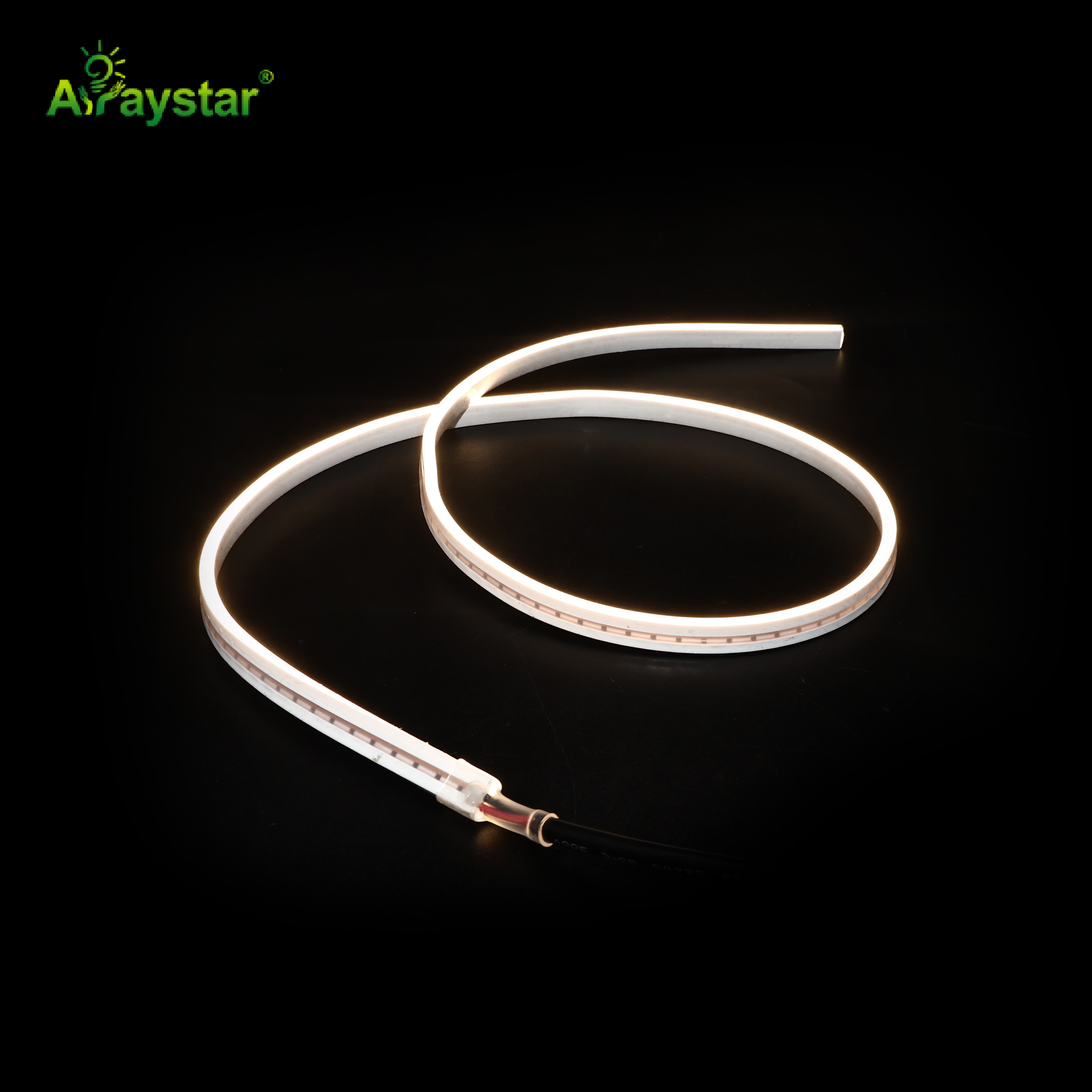
A step that follows the connector, not the reel, is a wiring problem. Common causes are a loose solder joint at the join, a corroded push connector, or two reels fed from different drivers with slightly different output voltages. I feed long runs from a single driver at the centre and inject at both ends, so both sides see the same source.
- Inject power at the centre of runs over 10 metres so voltage drop is symmetric both ways.
- Use one driver per sign, not one per reel, to avoid voltage and PWM differences.
- Resolder any join that shows a half-lit pad rather than replacing the whole reel.
- Measure driver output with a multimeter; a 0.5 V difference is enough to show at dusk.
Recommended Products
Frequently Asked Questions
Why does the brightness line only show up at dusk?
Because daylight masks small differences. A 5 percent brightness step or a 200 K CCT difference is invisible when the sun is washing the sign out. When the ambient drops, the eye adapts to the dark and the contrast jumps. This is normal human vision, not a fault that appeared at 6 p.m.
Can I fix a bin mismatch by dimming one side?
You can fake it with a tunable driver, but you are chasing a moving target because both sides age at slightly different rates. A 5 percent current trim on the brighter side can make them match on day one, but in a year the mismatch returns. The honest fix is replacing one reel from a matched lot.
How do I ask a supplier for matched reels?
Ask in writing for the same lot number on every reel for that project, plus the CCT and flux bin on each reel label. For colour-critical work, ask for a 300 mm sample of each reel lit side by side in a dark box. A supplier who cannot produce lot numbers is a supplier you do not want for a facade sign.
Does centre feeding hide a reel mismatch?
No, it hides voltage drop, not binning. Centre feeding makes both halves of a long run see the same voltage, which removes a smooth fade toward the end. It does nothing for a 200 K colour step at a reel join. You still need same-lot reels for colour consistency.
How much CCT shift is acceptable on a single sign?
Under 100 K between adjacent sections is usually invisible on a dark sign. Up to 150 K is defensible on a building outline where you view from ten metres away. Anything over 200 K is visible at dusk and worth fixing. Brightness differences should stay under 3 percent; above 5 percent the step is obvious.
Need help with your LED project?
Get factory-direct pricing, free samples and engineering support within 24 hours.
Email: info@arraystarled.com | Phone: +86-0755-2103-6746 | WhatsApp: 0086 1581 8514 077
Need to size your power supply? Use our LED Strip Power Calculator to find the right driver in seconds.