Glass vs Silicone Dome Neon Tubing: Where Each One Belongs
- 2026-10-28 10:02
- /
- Arraystar LED
Glass dome and silicone dome neon are not rivals on quality; they are rivals on geometry. Silicone bends around curves and survives a knock, glass holds a crisp brand hue and a sharp straight line. I pick the material from the drawing, not from habit.
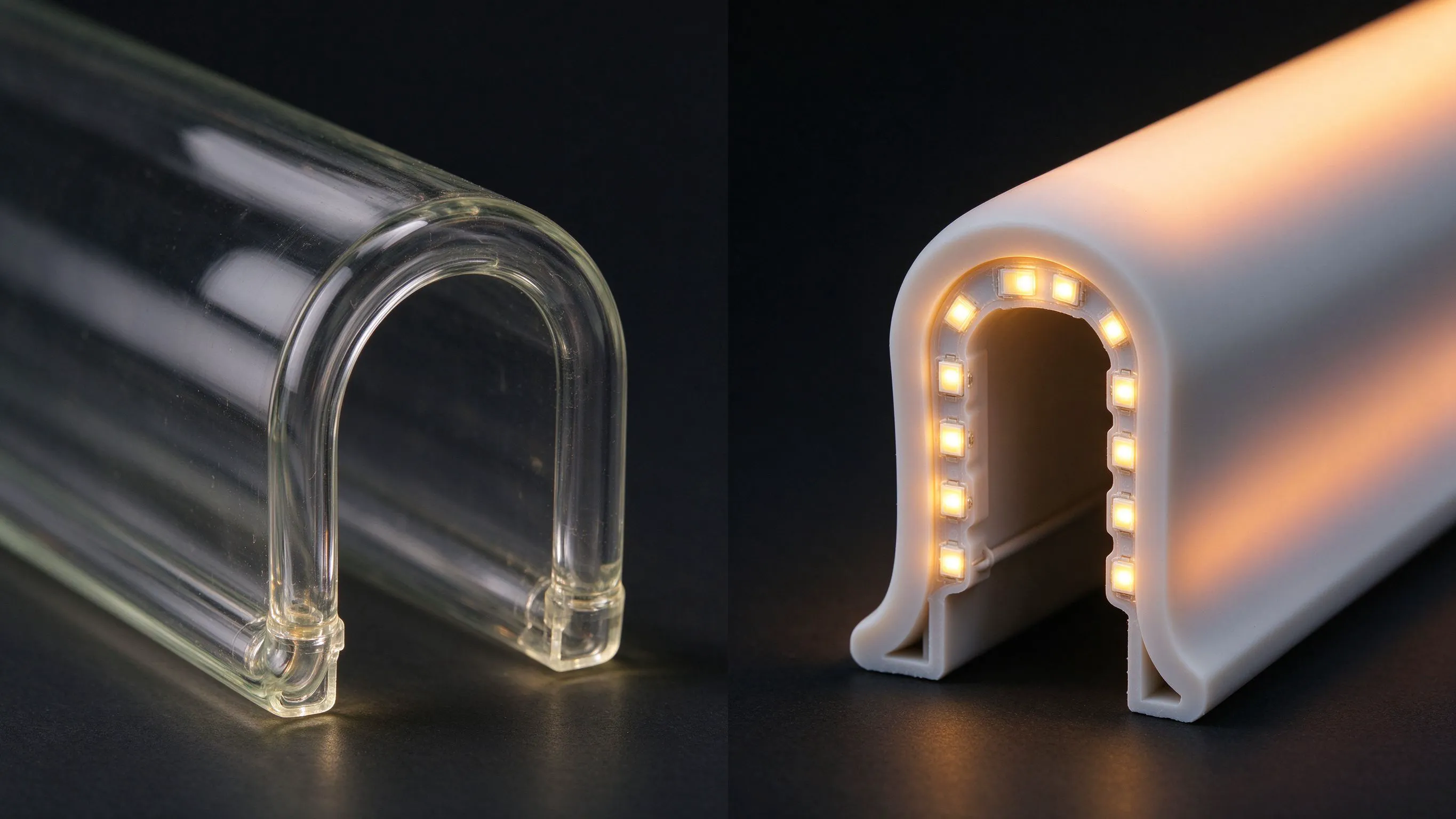
What each diffuser is actually good at
A silicone diffuser is extruded over a PCB, flexible along its length, and tolerant of a two-hundred-millimetre bend radius. It survives a ladder knock, a thrown ball and a cold winter night without complaint. A glass dome diffuser is rigid, made of a polycarbonate or PMMA extrusion that clips over a straight PCB run, and it holds a sharp, crisp edge because it never bends. What it will not do is follow a curve without segmented joints, and a hard knock cracks it.
I used to default to silicone on every job because it is forgiving. Then a client asked for a corporate sign where every letter had to read the same on a rooftop at forty metres, and silicone diffused the brand hue too broadly from that distance. Switching to a rigid dome on the straight letterforms gave the edge definition the brand guide wanted, and I kept the silicone only on the curved graphic beside the wordmark.
The split I now plan for
- Straight letterforms and sharp corners: rigid dome for edge definition.
- Curves, arcs and freehand graphics: silicone for a continuous bend.
- High-walkway or vandal-prone locations: silicone for impact tolerance.

Geometry drives the choice
Look at the drawing before you look at the price. If the sign is made of straight lines and ninety-degree corners, a rigid dome will give you a cleaner result. If the outline has a flowing curve, an S-bend or a tight radius, silicone is the only honest answer. For mixed geometry, I run both materials on the same sign: silicone on the curves, dome on the straights, joined with a small inline connector hidden in a corner.
Match the diffuser to the geometry of the drawing, not to the price list.
| Trait | Silicone dome | Rigid glass/PMMA dome |
|---|---|---|
| Minimum bend radius | 50-200 mm | Straight only, or segmented |
| Impact tolerance | High, flexible | Cracks on hard knocks |
| Edge sharpness at distance | Soft bloom | Crisp outline |
| Colour consistency | Slight spread | Tight, brand-true |
The viewing distance matters too. On a sign read from fifteen metres or more, the soft bloom of silicone can look like a blurry outline. Up close, at a bar counter or a shop window, the crispness of a rigid dome is less noticeable than its fragility.
Heat and ageing behaviour
Silicone runs cooler because it breathes around the PCB, but it yellows over five to seven years in direct UV. A rigid PMMA dome also yellows, roughly on the same timeline, but it reflects more radiant heat off the surface so the LEDs inside run a few degrees cooler. Polycarbonate domes resist UV better than acrylic, which is why I specify polycarbonate for exterior rigid runs and acrylic only behind a window line.
- Specify UV-stabilised polycarbonate for exterior rigid domes; acrylic yellows faster.
- Keep silicone tubes out of direct south-facing sun where possible, or accept a recycle in year six.
- On long rigid runs, leave a 2 mm expansion gap between dome segments; thermal movement will buckle a tight joint.

Cost, installation and repair
Silicone flex is cheaper per metre and faster to install because it sticks or clips in one continuous run. Rigid dome sections are sold in straight lengths, typically one or two metres, and each corner needs a separate connector and a careful alignment. Installation time on a rigid sign is easily double that of a silicone equivalent. The trade-off is that a cracked dome section is a cheap, clip-in replacement, whereas a cut silicone run means a new joint and a longer repair visit.
I price both options on the drawing and let the client choose once they see the trade-off. Most pick silicone for the budget and the speed, and a surprising number upgrade to rigid once they see the edge-sharpness mock-up at the right viewing distance.

The decision rule I hand to estimators
When a new estimator joins me, I give them a one-page rule. If the outline has any radius under three hundred millimetres, use silicone. If the sign is read from over twenty metres, use rigid. If it is within reach of hands or balls, use silicone. If it sits on a rooftop or behind a window, rigid is fine. Mixed signs get both. That rule has stopped more wrong-spec orders than any training session.
- Draw the geometry first; price the material second.
- Photograph the wall at night with a torch to judge the viewing distance.
- Confirm the expected life: five years for sunny silicone, seven for UV-stabilised rigid.
- Keep a 100 mm offcut of each material on the shelf for colour-matched repairs.
Recommended Products
Frequently Asked Questions
Is silicone neon or glass dome neon the better quality?
Neither is better in absolute terms; they suit different geometry. Silicone flexes, absorbs knocks and follows curves, but it softens the edge and yellows in UV. A rigid polycarbonate dome holds a crisp, brand-true outline at distance, but cracks on impact and cannot bend. Pick from the drawing, not from a quality ranking.
Can I mix silicone and rigid dome on the same sign?
Yes, and I do it often. Run the silicone along the curved graphic and the rigid dome along the straight letterforms, joined by a small inline connector hidden in an internal corner. Match the LED bin between the two so the brightness and hue do not step at the joint. On a mixed sign, order both materials from the same production batch.
Which diffuser lasts longest in direct sun?
UV-stabilised polycarbonate rigid domes last longest outdoors, around seven to eight years before visible yellowing. Silicone lasts five to six years in full southern sun, and acrylic rigid domes yellow fastest of all. If the sign faces the equator, skip acrylic entirely and either use polycarbonate or accept a planned silicone recycle.
Does rigid dome neon look brighter than silicone?
At distance, yes, perceptively. A rigid dome throws a tighter, sharper outline, which the eye reads as brighter even when the lumen output is identical. Up close, silicone looks warmer and softer. If the goal is legibility from a road at thirty metres, the rigid dome wins; if the goal is a cosy bar glow, silicone wins.
Can a cracked rigid dome section be repaired on site?
Yes, that is the advantage of the clip-in system. Order a spare straight section of the same length, pop the damaged dome off the PCB, slide the new one on, and re-clip. The PCB and LEDs are usually undamaged. Keep at least one spare dome section in the workshop cupboard for every outdoor rigid sign you install, because replacements take a week to arrive.
Need help with your LED project?
Get factory-direct pricing, free samples and engineering support within 24 hours.
Email: info@arraystarled.com | Phone: +86-0755-2103-6746 | WhatsApp: 0086 1581 8514 077
Need to size your power supply? Use our LED Strip Power Calculator to find the right driver in seconds.