Reflective Back Panels for Neon Signs: Boost Brightness Without Extra Power
- 2026-10-28 10:02
- /
- Arraystar LED
A reflective back panel is the cheapest brightness upgrade you will ever fit, and the most overrated one at the same time. It doubles the glow on a dark wall, but on a pale or textured surface it just makes glare. I choose the substrate deliberately, not by default.
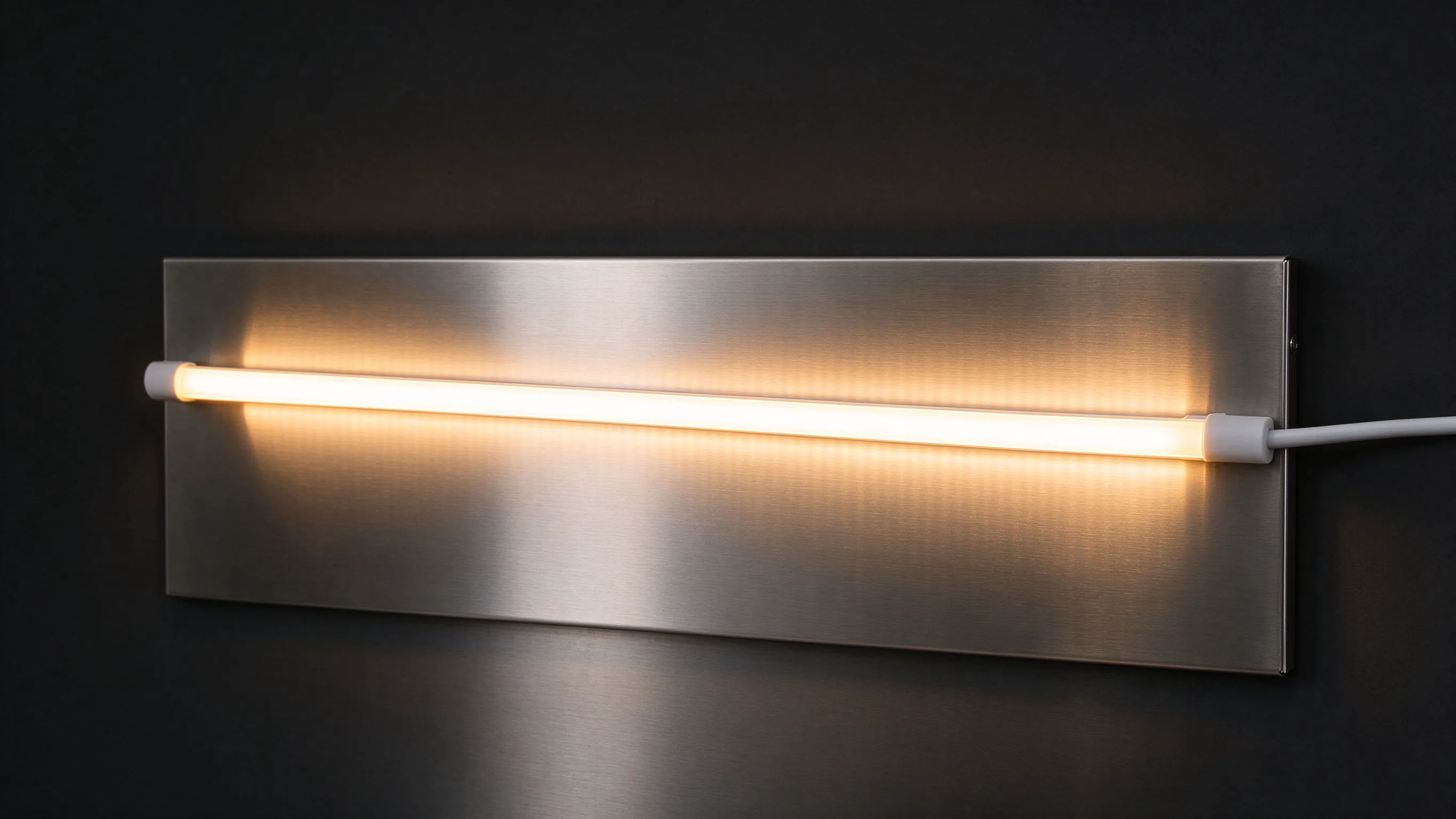
What a back panel actually does
A neon tube on its own emits light forward and sideways, but a large share of that light spills backward onto the wall behind. On a dark, matte facade that spill vanishes into the surface and is wasted. A reflective backing catches that backward light and bounces it back through the diffuser, raising the apparent brightness of the tube by somewhere between thirty and sixty percent with no extra watts drawn from the driver. It is free lumens, which is why fabricators reach for it on every job.
The catch is that the same reflected light also floods the wall immediately around the tube. On a pale brick or a smooth render, that flood shows up as a bright halo that makes the sign look cheap, like a strip light taped to a wall rather than a designed outline. I now treat the back panel as a material choice driven by the substrate, not as a default upgrade.
Three back-panel finishes I keep in stock
- Brushed aluminium: a soft, even bounce, works on most dark facades.
- Mirror acrylic: maximum brightness, but only on a sign that is mounted off the wall with standoffs.
- White laminated PVC: cheap, flat, and fine for interior boxes where the edge is hidden.

When the panel helps and when it hurts
The decision is simpler once you look at the wall. On a charcoal render, a black tile facade or a dark timber slat, a reflective panel is almost always worth it. On a pale cream brick, a white pebble-dash or a glass curtain wall, the panel adds more halo than brightness and I skip it. The table below is the quick reference I use on site.
Match the panel to the substrate; a one-size panel looks wrong on half the walls you meet.
| Wall substrate | Reflective panel? | Why |
|---|---|---|
| Dark render / charcoal | Yes | Reclaims otherwise wasted rear light. |
| Pale brick / cream stone | No | Halo outweighs the brightness gain. |
| Glass or mirror facade | No | The wall already reflects; double bounce glares. |
| Timber slats | Yes, matt white | Breaks up shadow gaps between slats. |
There is a middle ground: a low-gloss white panel rather than a mirror. It gives you the recovered rear light without the specular hotspot, and it reads as a designed backing rather than a fluorescent reflection. For most retail fascia work this is the finish I specify first.

Stand-off gap and edge detail
If you mount the tube directly onto a reflective panel, the contact shadow under the tube reads as a dark line and the reflection looks uneven. I keep a 5 to 8 mm gap between the tube base and the panel, using small standoff clips. That gap lets the reflected light wrap around the lower half of the tube, which is where the diffuser usually looks thin.
- Trim the panel 15 mm outside the tube outline so a dark reveal line frames the sign.
- Use a black edge trim on the panel side; a raw white edge catches streetlight and glows.
- Seal the back of the panel if it is outdoors; laminated PVC swells if water gets behind it.
- Predrill every fixing; acrylic cracks if you screw it straight through.
Brightness maths without extra watts
A typical 12 W per metre silicone tube sends roughly thirty percent of its light out the rear half. On a dark wall that light is lost; on a reflective panel, about seventy percent of it bounces back through the diffuser. That is roughly a 0.30 x 0.70, or twenty-one percent more light out of the front face, before you count the perceived boost from contrast against the panel. In practice, clients read the sign as almost twice as bright, even though the driver output has not changed.

The call I make on every site visit
I take a phone photograph of the proposed wall at night with a torch held where the sign will sit. The photo shows me the halo behaviour before I commit the panel specification. If the torch creates a wide, soft bloom on the wall, a mirror panel will do the same; I switch to matt white. If the torch disappears into a dark surface, the panel earns its cost. It is a ten-second test and it saves me from arguing with a client about glare six months later.
- Confirm the panel finish against the wall colour in natural daylight, not under shop lighting.
- Check the panel edge will be hidden by the tube outline; a visible white border looks unfinished.
- Price the panel as a separate line on the quote so the client can opt out if the wall is pale.
- Keep a small offcut of the chosen finish with the sign drawings for future extensions.
Recommended Products
Frequently Asked Questions
Does a reflective back panel double the brightness of a neon sign?
Perceptually, often close. Measured, it reclaims the thirty percent of light that spills rearward and bounces off the wall. On a dark substrate that reads as a near-doubling of perceived glow, but on a pale wall the same panel just creates a halo. The brightness gain is real only when the substrate is dark enough to absorb the original spill.
Mirror acrylic or brushed aluminium, which should I choose?
Mirror acrylic gives the maximum brightness bounce, but it also reflects every streetlight and headlight passing the facade, which reads as glare. Brushed aluminium gives a softer, more even bounce and is the safer default for retail fascias. I reserve mirror acrylic for signs mounted well off the wall on long standoffs, where the reflection has space to settle.
Can I use a back panel on a pale brick wall?
Not a mirror panel, and usually not even a white one. On pale brick the reflected light spreads into the mortar joints and makes the whole sign look like a luminous blob. If the client wants the brightness, switch to a darker paint wash on the wall behind the sign, or accept the tube without backing and add a slightly higher LED density to compensate.
How far off the panel should the tube sit?
Five to eight millimetres on small sections up to 13 mm, and up to 12 mm on larger 20 mm plus tubes. Too close and the tube casts a hard contact shadow; too far and the standoff clips become visible against the reflective surface. The gap lets the bounced light wrap around the lower half of the diffuser, which is where tubes usually look thin.
Does a back panel add heat to the LED run?
A little. The panel traps some rearward radiation, especially on a closed box. On long runs in direct sun, I derate the current by about five percent and ensure the panel has a 10 mm air gap behind it so heat can escape. Sealing a panel tight to a dark facade in summer is how you get early lumen fade.
Need help with your LED project?
Get factory-direct pricing, free samples and engineering support within 24 hours.
Email: info@arraystarled.com | Phone: +86-0755-2103-6746 | WhatsApp: 0086 1581 8514 077
Need to size your power supply? Use our LED Strip Power Calculator to find the right driver in seconds.