Cleaning Neon Sign Tubing Without Killing the Diffuser
- 2026-10-28 10:02
- /
- Arraystar LED
A clouded diffuser is almost never an LED problem. It is almost always a cleaning problem: the wrong cloth, the wrong solvent, or both. I hand site managers a one-page routine and it eliminates ninety percent of the service calls I used to get.
What clouds a silicone diffuser
Silicone and polycarbonate diffusers look indestructible, but they are not. They cloud for three reasons: dust and nicotine film that builds up over months, over-aggressive wiping with a paper towel that micro-scratches the surface, and solvent contact that attacks the polymer. Once the surface is chemically etched, no amount of wiping brings the glow back. The only fix is a new diffuser extrusion, which is why prevention beats cure every time.
A hotel manager once rang me at nine on a Sunday evening because the bar sign had gone dull. I drove over expecting a driver fault and found the cleaner had wiped it that afternoon with an alcohol spray for general glass. The silicone had turned milky along the whole front face. I replaced the tube the next week and wrote the cleaning routine that I still use today.
The three things that kill a diffuser
- Alcohol, acetone or general-purpose spray cleaners on the silicone surface.
- Paper towels, scouring pads or abrasive sponges that micro-scratch the polymer.
- Pressure washers held close enough to force water past the end seals.

The cleaning routine I hand to site managers
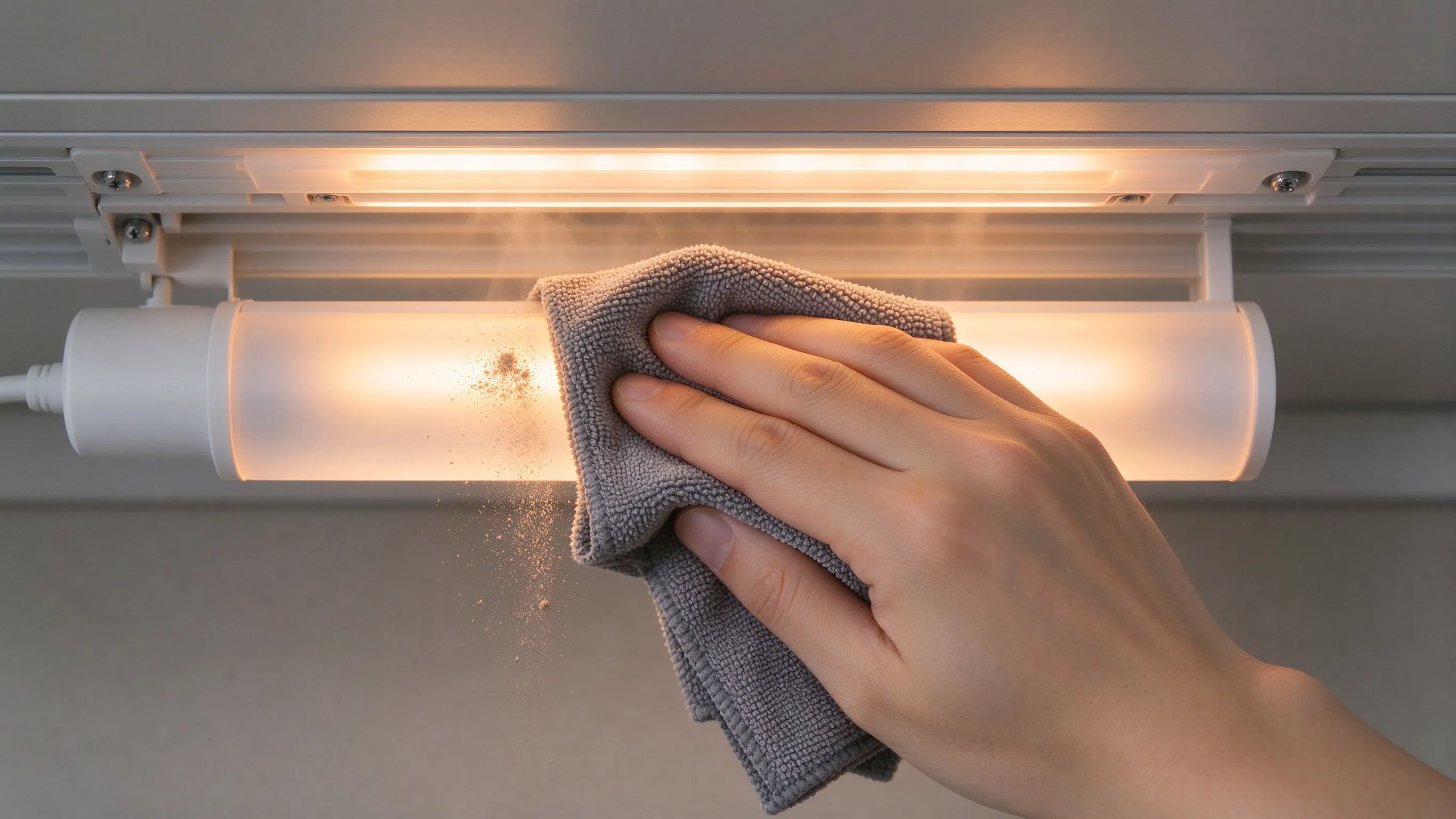
I give every client a printed card with four steps. First, switch the sign off and let it cool for ten minutes; warm silicone attracts dust. Second, dust the tube with a dry microfibre glove, not a cloth, so you do not drag grit across the surface. Third, wipe with a damp microfibre using only warm water and a single drop of dishwashing liquid. Fourth, buff dry with a second clean microfibre. That is the whole job. No sprays, no glass cleaner, no magic.
Keep it to water and a drop of soap; every extra product is a risk.
| Cleaning agent | Safe on silicone? | Why |
|---|---|---|
| Warm water + drop of soap | Yes | Cuts film without attacking the polymer. |
| Isopropyl alcohol | No | Crazes and clouds the surface. |
| Glass cleaner (ammonia) | No | Dries chalky and leaves residue. |
| Pressure washer | No | Forces water past end seals. |
Frequency depends on location. A shop window facing a dusty road gets a monthly clean. A bar with cigarette smoke indoors gets a six-weekly wipe. A protected fascia under a canopy needs two cleans a year. Over-cleaning is its own risk: the more you touch the diffuser, the more chance of a micro-scratch.

What to do when the diffuser is already cloudy
If the clouding is a thin film on the surface, a magic eraser melamine sponge used dry, with no pressure, can lift the worst of it. I say no pressure because melamine is mildly abrasive and will satin the surface if you lean on it. If the clouding is uniform and milky across the whole face, the polymer has already been attacked by solvent and the only honest fix is to swap the diffuser extrusion or the whole tube. Trying to polish it at that stage wastes an afternoon.
- Try the dry melamine pass first; it is cheap and reversible.
- If the surface is still cloudy after two gentle passes, stop and order a replacement.
- Photograph the cloudy tube next to a known-good segment so the client sees the difference.
- Check the end seals at the same time; water ingress often accompanies a dull tube.
End seals, glands and the wet zone
When you wipe a tube on a sign that is mounted outdoors, keep the damp cloth away from the end caps and the cable entry. Water forced past a seal is the number one cause of early driver failure. I tell cleaners to keep the cloth just damp, not wet, and to stop 30 mm short of every end cap. On a wall-washer tube, angle the damp wipe away from the wall so any run-off sheds outward rather than into the gland.

The annual service visit
Once a year I do a proper service on every neon sign I installed. I bring a ladder, a bag of fresh microfibre cloths, a small screwdriver and a torch. I check every standoff, tighten any loose gland, wipe the tube, feel the end caps while it is powered, and photograph the result. The client gets a one-line report. It is a twenty-minute job and it stops surprise failures in peak trading season.
- Carry at least two clean microfibre cloths; one dusty one ruins the second half of the run.
- Never clean a lit tube; cool it first and label the switch.
- Re-seat any clip that has popped out; a loose clip vibrates in the wind and fractures solder.
- Note the serial number on the driver; replacement parts need it.
Recommended Products
Frequently Asked Questions
Can I use glass cleaner on a neon diffuser?
No. Glass cleaner contains ammonia and often alcohol, both of which attack silicone and polycarbonate. Within a few wipes the surface goes milky and the glow drops sharply. Use only warm water with a single drop of dishwashing liquid, applied with a microfibre. Keep every spray bottle well away from the sign.
How often should I clean an outdoor neon sign?
Twice a year under a canopy, monthly on a dusty roadside facade, and every six weeks in a smoky bar interior. Over-cleaning is its own risk: each wipe adds micro-scratches, so more often than monthly is rarely useful. Keep a simple schedule card on the switchboard so the cleaner does not guess.
Why is my neon tube suddenly cloudy after cleaning?
Almost certainly solvent contact. If the cleaner used alcohol, glass spray or a general purpose spray, the polymer has been chemically etched and the clouding is permanent on the surface. A dry melamine sponge may lift the worst of it, but the honest fix is a replacement diffuser or tube. Check the end seals for water ingress at the same time.
Can I pressure-wash an IP65 neon sign?
Not at close range, and never at the end caps. A light rinse from a metre away, with the pressure wand held along the run rather than square on, is fine. Holding the nozzle at the end gland forces water past the seal and into the PCB, which kills the LEDs within weeks. Stick to a damp microfibre for the detailed work.
Should I switch the sign off before cleaning?
Yes, and let it cool for ten minutes. Warm silicone attracts dust like a magnet, and wiping a hot tube with a damp cloth risks thermal shock on the diffuser. Label the switch so the sign is not accidentally powered on while the cloth is still on the tube. It is a small habit that avoids a trip hazard on a wet floor.
Need help with your LED project?
Get factory-direct pricing, free samples and engineering support within 24 hours.
Email: info@arraystarled.com | Phone: +86-0755-2103-6746 | WhatsApp: 0086 1581 8514 077
Need to size your power supply? Use our LED Strip Power Calculator to find the right driver in seconds.