Neon Tube Cut Length Limits for Shipping (and How Fabricators Route Long Pieces)
- 2026-10-28 10:02
- /
- Arraystar LED
After one courier dropped a six-metre reel on a loading dock and bent the silicone past repair, I stopped pretending long neon travels like a parcel. The cut-length limit is not a supplier whim; it is the longest run a freight network will actually accept.
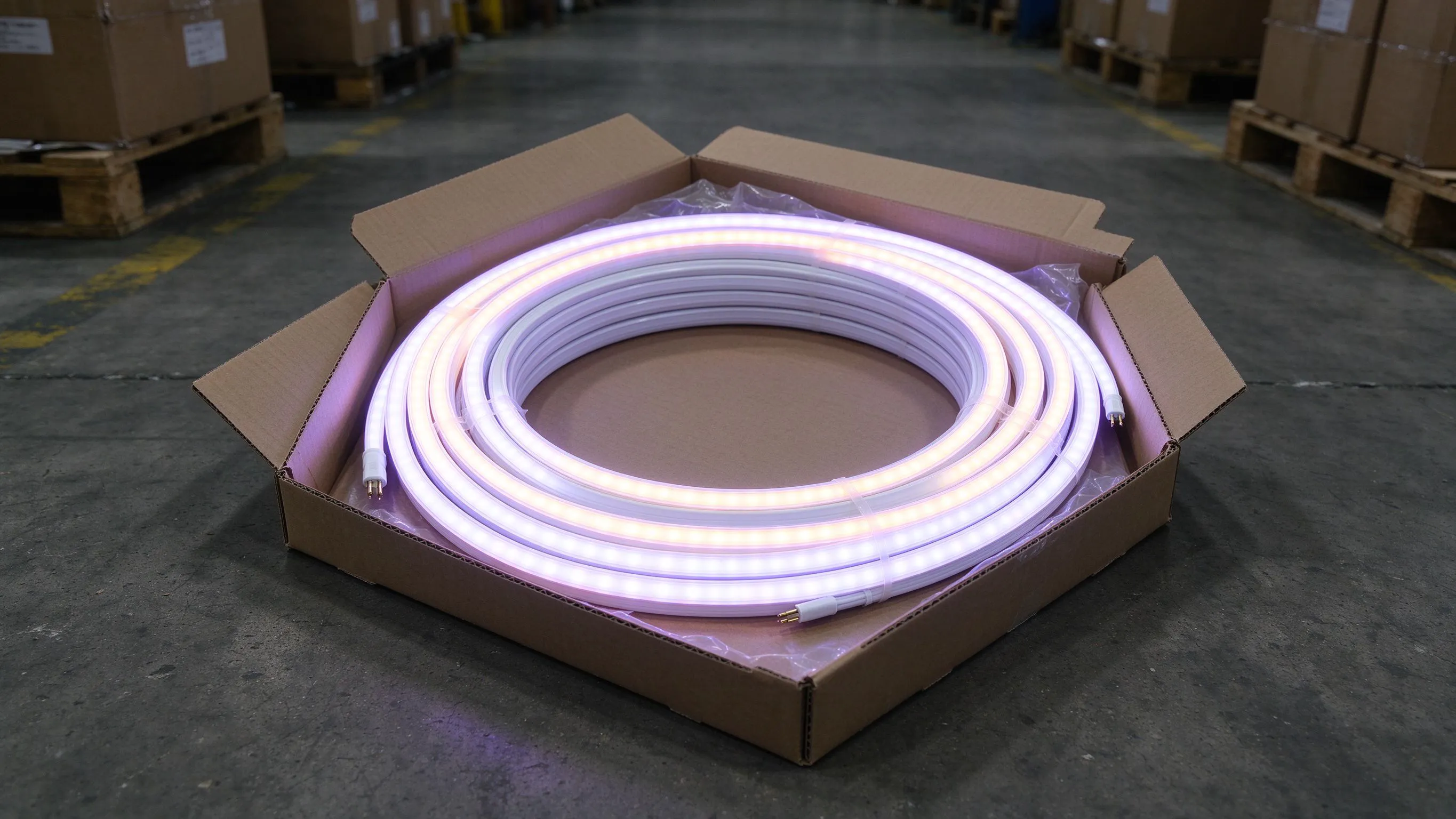
Why couriers simply stop accepting long pieces
Every express network has a dimensional threshold beyond which a parcel stops being a parcel and becomes freight. For a rigid or semi-rigid neon tube, that threshold sits around 1.2 to 1.5 metres on most couriers. Anything longer cannot go through a standard sorting belt, cannot be loaded into a normal sack truck, and cannot be turned around in a van. The depot will refuse it, and your customer will get a missed-delivery card instead of a sign.
I learnt this the expensive way on a hotel fascia job. I ordered a single 5.2 metre run to avoid any joint on the front elevation. The depot phoned to say the reel was too long for their vehicle. It sat in a yard for nine days, and arrived with a flat crease down one side from being wedged against a steel rack.
The two hard limits I plan around now
- Courier parcel limit: roughly 1.2 m total length on most standard services, after which surcharges multiply.
- Freight (pallet/lorry) limit: up to 3 m on a standard pallet, beyond that you need a dedicated van or a carrier that specialises in long goods.
- Anything over 3.2 m by road in most markets is classed as an abnormal load and needs advance notice.
The cut-length ceiling by carrier
I keep a small cheat sheet on the desk because the numbers drift every year. For domestic next-day couriers, the sweet spot is 1.0 to 1.2 metres per parcel. For a road-freight pallet, you can stretch to 2.4 or even 3.0 metres, but the box must be a proper wooden crate, not a cardboard sleeve. Below is the table I quote clients against when they ask why a ten-metre sign cannot arrive in one piece.
Longer pieces jump carrier tier and price fast; plan the cut before you order.
| Carrier tier | Max piece length | Packaging | Typical delivery window |
|---|---|---|---|
| Standard courier | 1.2 m | Cardboard tube + caps | 1-2 days |
| Express long parcel | 2.0 m | Reinforced carton | 2-3 days |
| Road pallet freight | 3.0 m | Wooden crate | 3-5 days |
| Dedicated van | 6 m+ | Strapped to pallet | Same/next day |
The corollary is that a longer piece is not always cheaper. A 3 metre crate on a pallet often costs more than two 1.2 metre courier parcels, and arrives slower. I size runs to the courier limit on purpose.

The joint-in-the-middle trick
Once you accept that long runs have to be cut, the question becomes how to rejoin them on site so the seam disappears. I use an inline silicone connector rated to the same IP as the tube, with a butt-splice that slides over both ends and clamps with a grub screw. The joint sits on the rear face of the sign where the diffuser never looks, and a small dollop of neutral-cure silicone around the exit keeps the weatherproof rating honest.
- Always cut at the manufacturer marked copper pad, never between LEDs.
- Leave 30 mm of service loop on each side of the joint so thermal movement does not pull the splice apart.
- Heat-shrink with adhesive liner over the solder, then slide the silicone connector over the top.
- Test the joint at the bench for two hours before it goes up the ladder; a cold solder shows as a dark segment.
On a two-piece run I put the joint at the horizontal midpoint, not at an end. That way any brightness step lands where no one is looking, and the run still reads as one continuous line from the pavement.
Packing a reel so it survives the depot
Silicone tube ships best on a reel at least ten times the minimum bend radius. Coiling a 16 mm tube onto a 100 mm core invites a permanent kink that shows as a bright hot spot. I ask for a 300 mm minimum reel core on anything 12 mm and above, and I double-box: a thick-walled cardboard tube inside a larger outer carton, with foam ends that take the impact.
- Cap both ends of the shipping tube so silicone dust and insects do not migrate in.
- Mark the carton clearly as fragile and long, with arrow stickers showing upright.
- Include a printed drawing on the outside showing which end is which, so the installer does not have to guess the joint order on site.
- Seal every corner of the carton with parcel tape; depots love to grab a flappy box.

The pre-dispatch checklist
Before a long neon order leaves my workshop, I run a ten-minute check. I uncoil the full length on the bench, power it up, and walk the tube looking for dead segments or a failed joint. Once it is in the crate, I cannot fix it. Photographs go to the client so they can compare what arrives against what left.
- Measure the final cut length twice; the courier charge is calculated from the box dimensions, and a wrong cut cannot be reversed.
- Confirm the carrier tier with the client in writing, with the expected date.
- Label the box with the site address, the project number and a contact phone that actually answers.
- Keep a 200 mm offcut from the same batch; it is the only colour-match evidence you have if a segment fails in year two.
Recommended Products
Frequently Asked Questions
What is the longest neon tube I can send by normal courier?
Plan on 1.2 metres as the hard ceiling for a standard parcel service. A 1.5 m piece may be accepted by one courier and refused by the next, and the surcharge gap is large. If the design needs a longer run, budget for pallet freight and a wooden crate rather than gambling on a depot that might turn it away.
Can neon tube be coiled tightly to fit in a shorter box?
No. The reel core must be at least ten times the tube cross-section. Coiling a 16 mm tube onto a 100 mm core leaves a permanent kink, and the diffuser stretches unevenly so one segment reads brighter than the rest. Use a 300 mm minimum core for anything above 12 mm, and never coil a wall-washer tube tighter than its datasheet bend radius.
Does a joined neon run look worse than a single piece?
Done properly, no. A butt-splice on the rear face, sealed with neutral silicone and clamped in a matching connector, is invisible from the viewing distance. Site the joint at the horizontal midpoint rather than at an end, and test both segments on the bench at the same current so any brightness step is caught first.
How much does pallet freight add to the shipping cost?
Typically two to three times a standard parcel, but that comparison is unfair because a parcel cannot carry a 3 metre piece. A wooden crate on a pallet within a country usually lands between 80 and 180 euros depending on distance, and transit is three to five days. The crate itself adds another 20 to 40 euros; factor it into the quote.
Should I order extra tube as a spare for future repairs?
Yes, always. Keep a 200 to 300 mm offcut from the same batch, sealed in a bag. LED bins drift between production runs, and a year later a replacement bought separately will not colour match. The offcut costs almost nothing and is the only proof the repair matches the original.
Need help with your LED project?
Get factory-direct pricing, free samples and engineering support within 24 hours.
Email: info@arraystarled.com | Phone: +86-0755-2103-6746 | WhatsApp: 0086 1581 8514 077
Need to size your power supply? Use our LED Strip Power Calculator to find the right driver in seconds.