Hanging Neon Tubing from a Ceiling: Cable and Hook Load Limits
- 2026-10-28 10:02
- /
- Arraystar LED
A suspended neon sign looks incredible floating in a void, until the plaster ceiling spits a raw plug out at two in the morning. The tube is the easy part; the cable, the hook and the fixing into the actual structure are where these jobs are won or dropped.
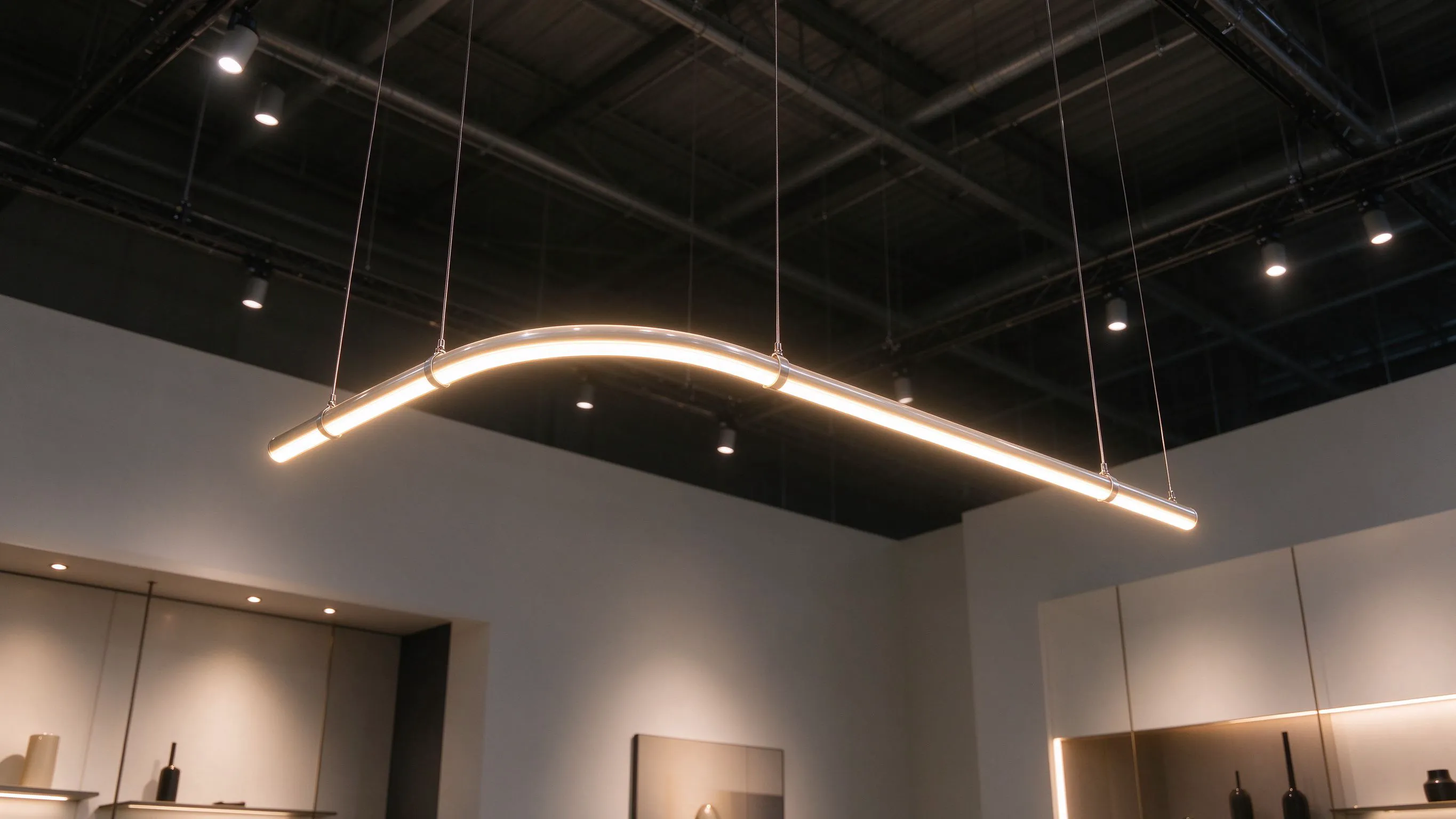
What the sign actually weighs
People quote a hanging sign by the tube weight and forget the aluminium channel, the end caps, the driver and the cable itself. A two-metre run of silicone flex looks light in your hand, but once it is in a channel with mounting extrusions, a hanging kit and a driver junction, the assembly often lands at four to six kilograms. You are not hanging a strip of silicone, you are suspending a rigid neon sign, and every fixing has to carry that with a safety margin.
I weigh the assembled sign on a hook scale before I climb the ladder. The number on the scale decides the cable size, the fixing and how many suspension points I use. Guessing the weight is how a 2 kg sign turns into a 5 kg surprise on install day.
The load I budget for
- Actual assembled weight, measured on a hook scale before install.
- A four times safety factor on the weakest fixing point.
- Two suspension points minimum, three on any run over three metres.

Cable and hook sizing
For a typical interior hanging sign of three to six kilograms, I use 1.5 mm stainless steel wire rope with a rated breaking load around 30 kilograms per strand. Two strands give you roughly 60 kilograms of rated capacity against a 5 kg sign, which is the four-to-one margin I want. I never use braided copper or plastic-coated picture wire for this; it stretches and creeps, and a sign that hangs straight on day one tilts by Christmas.
Always rate the wire rope well above the actual load; creep is the silent killer.
| Sign assembly weight | Wire rope diameter | Suspension points | Ceiling fixing |
|---|---|---|---|
| Up to 3 kg | 1.2 mm stainless | 2 | Cavity anchor or timber |
| 3-6 kg | 1.5 mm stainless | 2-3 | Timber or wall bar |
| 6-12 kg | 2.0 mm stainless | 3-4 | Structural fix only |
At the ceiling end I fix into timber or a proper cavity anchor, never into plaster alone. A rawlplug in solid plasterboard holds surprisingly little, and the ceiling around the hole crumbles as the sign sways. If there is no timber above, I run a steel bar across the joists and fix the cables to that.
Strain relief at the tube end
The suspension wire is not where the power cable hangs. I route the low-voltage feed separately and strain-relieve it at the channel, so the electrical conductor never carries the weight of the sign. If the wire rope does the holding and the power cable just dangles, a little sway will eventually fatigue the solder joint at the tube end. That joint is the weakest point, and it wants no load at all.

Plasterboard, concrete and exposed structure
The ceiling type decides everything. On a concrete slab I use a through-bolt or a chemical anchor. On timber joists I screw straight up into the wood. On a bare plasterboard ceiling with no structure above, I refuse to hang a rigid neon sign from the board and instead lay a wooden or aluminium bar across two joists, hidden above a ceiling hatch if the client can accept it. A sign hanging from plasterboard is a lawyer waiting to happen.
- Concrete slab: through-bolt or chemical anchor, never a plastic plug alone.
- Timber joists: long screw directly into the joist, not the plaster.
- Plasterboard with no structure: span a bar across the joists and fix to that.
The install check I do before walking away
Once the sign is up, I give each cable a sharp downward pull by hand, lean the sign a few centimetres and let go, and watch whether it settles level. Any cable that stretches or any ceiling plug that moves gets re-done before I pack the ladder. I also leave a spare pair of cable grippers and a note of the adjustment length, so the client or a future electrician can level the sign without scaffolding.

Recommended Products
Frequently Asked Questions
How much weight can a plaster ceiling hook hold?
Far less than people assume. A rawlplug in solid plasterboard holds only a few kilograms before the plug pulls through and the plaster crumbles around the hole. For a neon sign, fix into timber joists or span a bar across them. Do not rely on the plasterboard itself; it is a skin, not a structure.
What gauge of wire rope should I use to hang a neon sign?
For a three to six kilogram interior sign I use 1.5 mm stainless steel wire rope, rated around 30 kilograms per strand. Two strands give a four-to-one safety margin. Skip plastic-coated picture wire; it creeps and the sign tilts within months. Match the cable to the measured assembled weight, not the bare tube.
Should the power cable also support the sign?
Never. The suspension wire rope carries the weight; the low-voltage feed just dangles and must be strain-relieved at the channel. If the power conductor carries the sign, sway will fatigue the solder joint at the tube end over time. That joint is the weakest point and it wants zero mechanical load.
How many suspension points do I need?
Two points minimum on any sign, three on a run over three metres. A long run on two points sags in the middle and twists in any air movement. Three points lets you level the centre and keeps the sign rigid. More points than that is overkill and just adds ceiling holes nobody wants to patch.
Can I hang a neon sign from a concrete ceiling?
Yes, and it is the easiest ceiling of all. Use a through-bolt or a chemical anchor into the slab, never a plastic plug alone. Drill the correct depth, blow out the dust, and set the anchor so it bites the concrete rather than the hole wall. Concrete carries enormous load; the only mistake is under-anchoring it.
Need help with your LED project?
Get factory-direct pricing, free samples and engineering support within 24 hours.
Email: info@arraystarled.com | Phone: +86-0755-2103-6746 | WhatsApp: 0086 1581 8514 077
Need to size your power supply? Use our LED Strip Power Calculator to find the right driver in seconds.