Weatherproofing Neon Junction Boxes in Coastal Signs
- 2026-10-28 10:02
- /
- Arraystar LED
A coastal neon sign fails first at the junction box, not on the tube. Salt spray gets past a gland you thought was sealed, condensation forms inside a box you thought was airtight, and the contacts corrode before the silicone shows any sign of trouble.
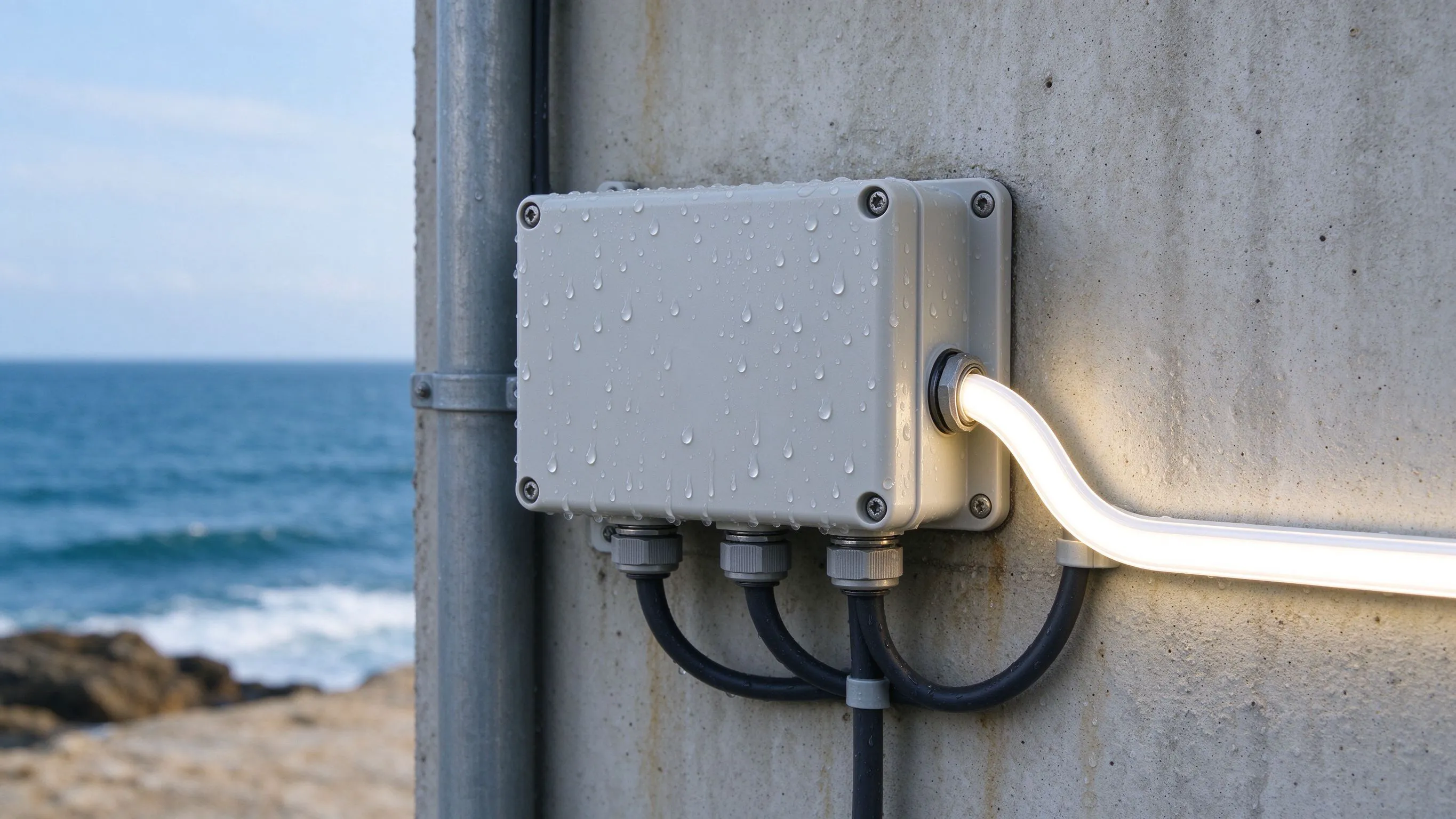
Why coastal signs die at the box
On a normal exterior job, the tube is the weak point. On a coastal job, the tube is usually fine; modern silicone shrugs off salt spray, but the junction box is where the copper contacts breathe salt air. A standard IP65 box on a coast looks the same for 18 months, then the screws seize, the glands crack, and the driver trips on a ground fault.
I treat the junction box as the life-limiting component on coastal signs. Spend on the box, the glands and the silicone, and the tube outlasts them both.
Box material and rating

I do not use cheap ABS boxes within 1 km of the sea. UV and salt turn ABS chalky and brittle in two years. I go for UV-stabilised polycarbonate or 316 stainless steel, IP65 minimum, and I size the box 30 percent bigger than I think I need; heat and cable bends need room.
Coastal exposure drives material and gland choices.
| Distance from sea | Box material | Gland rating |
|---|---|---|
| >5 km | UV-stabilised PC | IP65 nylon |
| 1-5 km | PC or 316 SS | IP65 brass/NBR |
| <1 km / seafront | 316 stainless | IP68 brass/EPDM |
The box needs a drain hole at the bottom (3 to 5 mm) fitted with a breathable Gore-style vent, so condensation can escape without letting sea spray in. A fully sealed box in a coastal climate is a condensation box.
Glands, cable entry and silicone

Glands are where salt gets in. I use double-compression glands with EPDM or NBR seals, not the cheap single-nose ones, and I size them to the cable with no more than 1 mm of spare diameter on either side. A gland on a cable that is too thin is just a hole.
- Use EPDM or NBR seals; neoprene hardens in salt air.
- Bed every gland with neutral-cure silicone on the outside face.
- Aim cable entries downward or sideways, never upward.
- Add a 50 mm drip loop outside the box before the gland.
I never use acetic-cure silicone on coastal jobs; the acetic acid attacks brass glands and 316 fittings over a few seasons. Neutral-cure only.
Contacts, drivers and corrosion

Inside the box, I tin every wire end and use stainless or tinned-copper terminals, never bare brass. Brass holds up inland but goes green by the sea. I also coat the driver's exposed terminals with a thin layer of dielectric grease once the connections are made. That is not waterproofing; it is the difference between a contact that works in year three and one that has turned to powder.
The driver itself should be mounted as high as practical in the box, not on the bottom, because any water that does get in runs to the bottom. On seafront jobs I mount the driver on a small raised rail so it sits 15 mm above the box floor.
The annual open-up
Coastal boxes want an annual visit. I open the box, check the glands, feel the terminals, and look for white or green powder around any connection. Catching corrosion in year one is a five-minute clean; catching it in year three is a new driver and a new box.
- Open the box and inspect at least once a year.
- Tighten glands; UV makes nylon shrink.
- Re-apply dielectric grease on exposed terminals.
- Clear the drain vent; salt blocks it.
On a seafront cafe sign I inherited last year, the previous installer had used a sealed IP66 box with no vent. When I opened it, the driver was sitting in about five millimetres of water and the terminals were already green. I swapped the box for a vented 316 stainless enclosure, raised the driver on a rail, and ran the cable entries down through the floor rather than the back. Eighteen months later it is still dry inside, which on a coast is the whole job.
I also log the box serial and the driver output current on a maintenance sticker inside the lid. When the next person opens it, they know immediately whether the dim end of a run is a driver fault or a 3 percent cable drop, instead of guessing.
Recommended Products
Frequently Asked Questions
What IP rating do I need for a coastal neon junction box?
IP65 is the floor; within 1 km of the sea I go IP68 on the glands and use a 316 stainless or UV-stabilised polycarbonate box. The rating only matters if the box is vented correctly, a sealed IP68 box in a salt climate still condenses inside.
Can I use a normal ABS junction box by the coast?
Not if you want it to last. UV and salt turn ABS chalky and brittle in two seasons, and the lid splits. Use UV-stabilised polycarbonate or 316 stainless steel, sized about 30 percent larger than you think you need.
Why is my coastal junction box full of condensation?
Because it is fully sealed. Temperature swings pump moist air in and out through gland clearance, and a sealed box traps it. Fit a 3 to 5 mm drain hole with a breathable vent at the bottom, mount the driver off the floor, and aim cable entries downward.
What glands should I use on a coastal sign?
Double-compression glands with EPDM or NBR seals, sized snugly to the cable. Avoid single-nose nylon glands and neoprene seals, which harden in salt air. Bed each gland with neutral-cure silicone on the outside; never acetic-cure, which attacks brass.
How often should I service a coastal neon junction box?
Once a year. Open it, check the glands, tighten any slack terminals, re-apply dielectric grease, and clear the drain vent. Salt blocks vents and shrinks nylon glands. A yearly 15-minute check avoids a driver replacement in year three.
Need help with your LED project?
Get factory-direct pricing, free samples and engineering support within 24 hours.
Email: info@arraystarled.com | Phone: +86-0755-2103-6746 | WhatsApp: 0086 1581 8514 077
Need to size your power supply? Use our LED Strip Power Calculator to find the right driver in seconds.