Remote Neon Transformer Placement: Safe Distance from the Tube
- 2026-10-28 10:02
- /
- Arraystar LED
Mount the LED driver too far from the tube and you lose voltage by the time the current gets there; too close and its heat ages the silicone. I size the low-voltage run, vent the box, and treat the distance as a cable-loss problem.
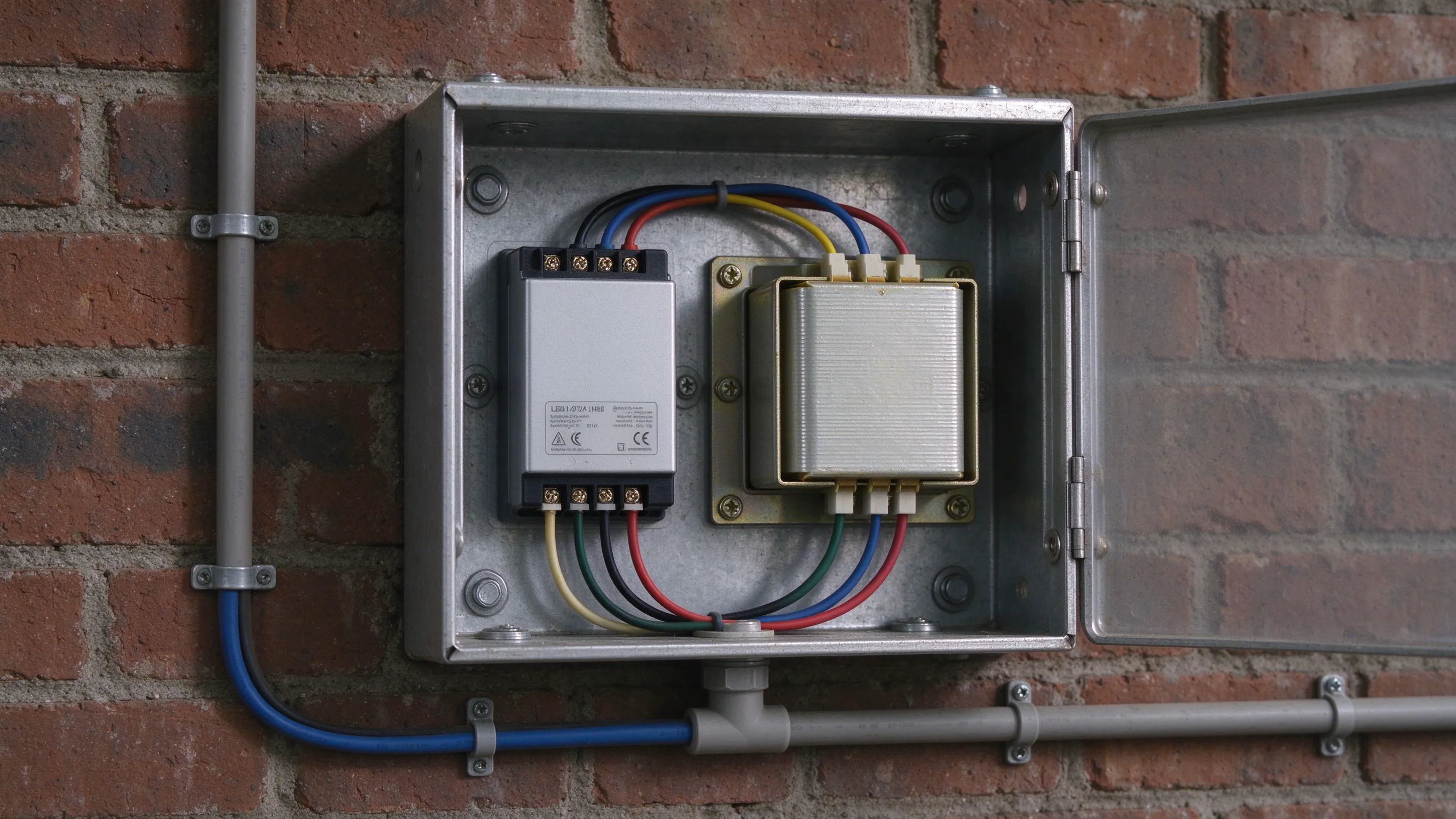
Why the distance matters on a 12/24 V sign
Unlike old glass neon, which ran at kilovolts and could tolerate long high-voltage leads, LED flex runs at 12 or 24 V. A small voltage drop in the feed cable, even 0.5 V, is 4 percent of a 12 V supply, and you see that as a dimmer end of the run or a colour shift on warm white. The driver location is a cable-sizing decision, not a convenience one.
I work backward from the tube. Measure the total current the run will draw (length times watts per metre), pick a target voltage drop under 3 percent, and then the maximum run length tells me where the driver can live.
Sizing the run and the cable

Voltage drop in a pair of wires is roughly (2 x length x current x resistance per metre). At 12 V I keep the drop under 0.36 V; at 24 V under 0.72 V. In practice that means a single 2.5 mm squared (13 AWG) feed handles about 3 to 4 metres at 12 V or 6 to 8 metres at 24 V before I need a second feed point.
24 V roughly doubles the run length for the same cable.
| Voltage | Cable | Max single-feed run | Typical load |
|---|---|---|---|
| 12 V | 1.5 mm2 (16 AWG) | 2-3 m | ~5 A |
| 12 V | 2.5 mm2 (13 AWG) | 3-4 m | ~8 A |
| 24 V | 1.5 mm2 (16 AWG) | 6-8 m | ~5 A |
| 24 V | 2.5 mm2 (13 AWG) | 10-12 m | ~10 A |
If the run is longer, I feed from both ends rather than upsizing the cable again. A dual feed on a 12 metre 24 V strip keeps the middle at full brightness without a fat, expensive main.
Heat and the driver box

Drivers run warm, typically 60 to 80 C case temperature. Mount one inside a sealed junction box above the tube and that heat rises straight into the silicone, ageing it. I keep the driver at least 300 mm below or beside the tube run, in a ventilated box with the vent facing down so rain does not get in. On exterior jobs, the box is IP65 but never sealed tight; condensation kills drivers faster than heat.
- Keep the driver at least 300 mm from the tube in any direction.
- Use a vented, not fully sealed, enclosure; condensation is the enemy.
- Mount out of direct sun; shade the box if it faces west.
- Leave 20 mm clearance around the sides of the driver inside the box.
Earthing, isolation and service access
Remote drivers live where the client cannot get to them, which means the enclosure must be lockable and the cable glands accessible. I always earth the metal box and run a proper earth bond to the sign frame. On exterior work I also fit a surge protector on the mains side; a lightning hit nearby will otherwise take out every driver on the circuit.
Service access matters more than people think. If the driver is inside a roof void, I put a small access hatch and label the box with the model and output current. The next electrician who opens it thanks you.
What I measure on commissioning
After the install, I do not just switch the sign on. I measure.
- Measure voltage at the driver output and at the far end of the strip; drop should be under 3 percent.
- Feel the driver case after 30 minutes; warm is fine, too hot to hold is not.
- Look for a brightness step near the end of the run; that is voltage drop, not a bad LED.
- Check the box vent is clear and the gland is tight.
Recommended Products
Frequently Asked Questions
How far can a 12 V LED driver be from the neon tube?
On a 2.5 mm squared pair, I hold it to about 3 to 4 metres for a typical 5 to 8 A run to keep voltage drop under 3 percent. Beyond that, either move the driver closer, upsize to 4 mm squared cable, or feed the strip from both ends. At 12 V, every extra 0.5 V of drop is 4 percent brightness.
Is 24 V always better for long runs?
Almost always. For the same cable and current, 24 V lets you run about twice as far before voltage drop becomes visible, and the lower current also means thinner, cheaper cable. The trade-off is that 24 V tubes are slightly less forgiving on short circuits, but for a fixed sign that is not a big deal.
Can I mount the driver inside the sign's junction box?
Not if the box is sealed and close to the tube. Driver case temperatures hit 60 to 80 C, and that heat ages silicone. Keep the driver at least 300 mm away, in a vented (not sealed) box, and leave clearance around it. Condensation in a sealed box kills drivers faster than heat does.
What cable size do I use for remote drivers?
I use 1.5 mm squared (16 AWG) for short low-current runs and 2.5 mm squared (13 AWG) for typical 5 to 10 A runs. If the run is longer than about 8 metres at 24 V, I go to 4 mm squared or, more often, split the feed. Oversizing the cable is cheaper than a service visit to swap it.
Why is the end of my strip dimmer than the start?
That is voltage drop, almost certainly. Measure at the far end; if you are losing more than 3 percent, the feed is too thin or too long. Add a second feed point at the far end rather than replacing the whole cable, and keep both feeds on the same driver output.
Need help with your LED project?
Get factory-direct pricing, free samples and engineering support within 24 hours.
Email: info@arraystarled.com | Phone: +86-0755-2103-6746 | WhatsApp: 0086 1581 8514 077
Need to size your power supply? Use our LED Strip Power Calculator to find the right driver in seconds.