Why Neon Tubing Cracks in Winter: Thermal Contraction and End Cap Stress
- 2026-10-28 10:02
- /
- Arraystar LED
A hairline crack at an end cap every January is almost never a tube defect. It is the tube fighting a wall you clamped dead still, and once I started leaving deliberate slack, those warranty call-outs stopped.
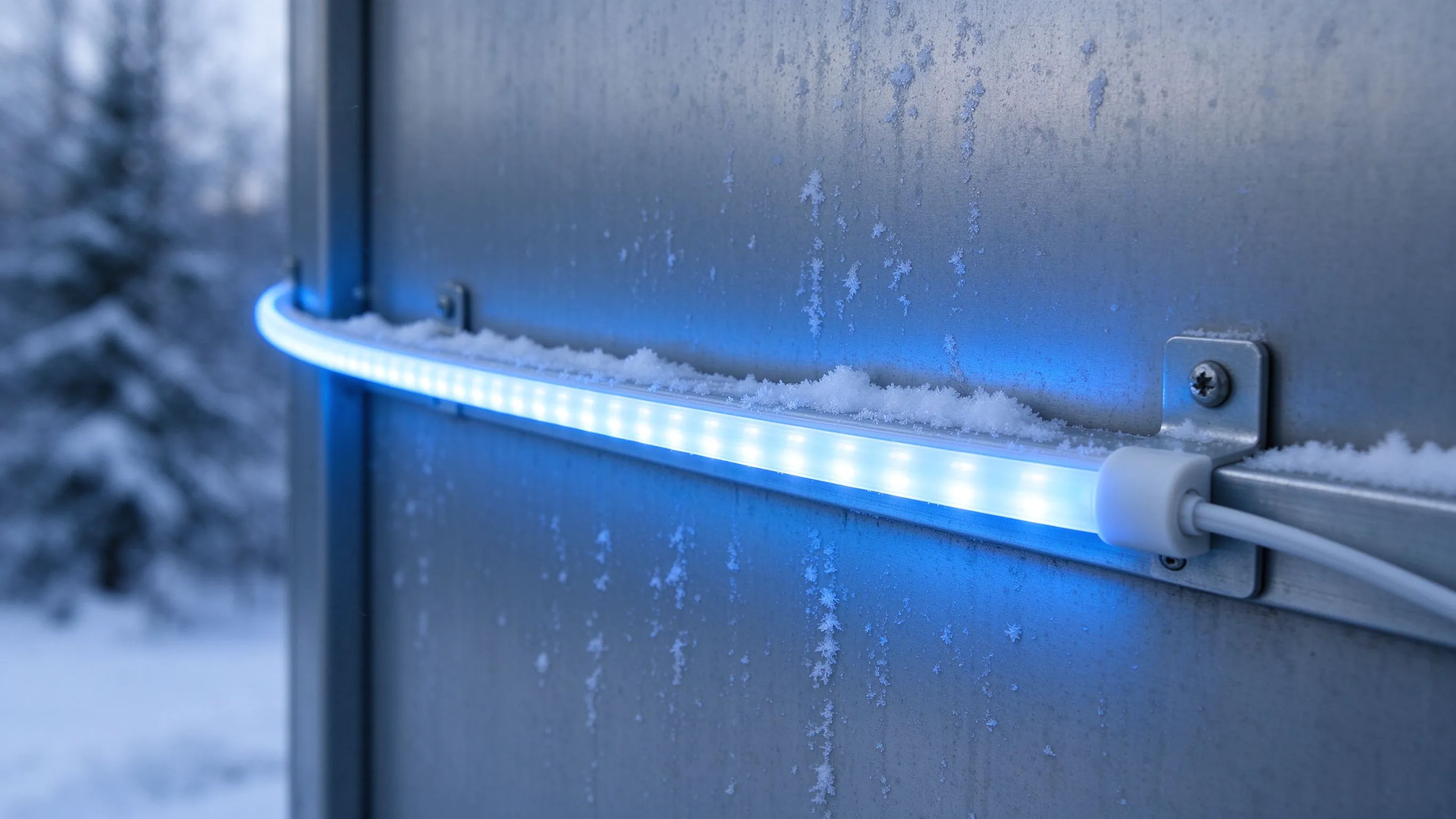
Why end caps crack in cold weather
Silicone and PVC jackets shrink when they get cold, and the copper tape inside shrinks by a different amount. On a long outdoor run, the tube is being pulled at both ends, and the highest stress lands exactly where the jacket is terminated, the end cap. That is why you see the crack millimetres from the cap, not in the middle of the letter.
I used to swap tubes under warranty until I measured a six-metre run on a winter night and saw it shorten by about nine millimetres between midday and midnight. No tube can hold that with both ends glued down. The fix is mechanical, not a better silicone.
How much slack to leave
As a rule of thumb, silicone expands or contracts by roughly 0.15 to 0.20 mm per metre per degree Celsius. Across a 45-degree swing from a summer afternoon to a frosty January morning, a five-metre run wants about 35 to 45 mm of total travel. You cannot build that into a rigid mount, so you leave it at one end.
Slack scales with run length; one end stays rigid.
| Run length | Estimated travel over 45 C swing | Slack to leave at free end |
|---|---|---|
| 2 m | 14-18 mm | 8-10 mm |
| 5 m | 35-45 mm | 18-22 mm |
| 10 m | 70-90 mm | 35-45 mm |
I never fully seat the free-end cap. I push the tube into the standoff slot but leave it free to slide, and I cover the slot with a small silicone boot so dust and rain do not get in.

Clamping one end properly
The rigid end wants a real fixing, not a push-fit. I use a stainless saddle or a glued aluminium channel for the first 50 mm of run, so the contraction force lands on a fixed point. From there out, every standoff is slotted.
- Fix the rigid end at the centre of the sign if possible, so movement splits both ways.
- Avoid rigid clamps on both sides of a bend; the bend is already stressed.
- On aluminium channels, leave the channel screws loose for the first 500 mm at the free end.
Materials that behave worse in the cold

PVC-jacketed flex goes brittle below about minus five, which is why cheap tubes crack on the first cold night after install. Silicone keeps its flexibility to well below minus twenty, but it also stretches more, so the slack calculation matters more. I check the datasheet for the glass-transition temperature; anything above minus ten is a non-starter for an exterior facade in a cold climate.
End caps deserve the same scrutiny. A cap that fits tight at 20 C may pinch the silicone at minus fifteen. I leave a 0.5 mm clearance inside the cap and bed it with neutral-cure silicone rather than cramming it shut.

What I check after the first cold snap
The first winter tells you everything. I ask the client to photograph the sign after the first hard frost, and I look for three things.
- Hairline cracks radiating from a standoff or end cap.
- A bright or dark spot where the tube has pulled away from a solder joint.
- A kinked section where the tube buckled because it was clamped on both sides.
If I see a crack within the first 50 mm of a rigid end, I add a slotted standoff at the next service visit. That is a five-minute fix once you are on the ladder.
I also run a simple measurement on the coldest night of the year if the client lets me: I mark the free end cap position with a pencil in October, then mark it again in January. A 15 to 25 mm shift between the two marks is healthy. No shift at all means the free end is jammed and the stress is going somewhere else, usually into the first solder joint.
Recommended Products
Frequently Asked Questions
Why do neon tubes always crack at the end cap in winter?
The end cap is where the silicone jacket is mechanically locked to a fixed point. When the whole run contracts in cold weather, that lock stops the tube from shortening, so the stress concentrates at the seal. It is a mechanical problem, not a material one, and leaving a sliding free end fixes it.
How much thermal expansion does silicone neon actually have?
Plan on 0.15 to 0.20 mm per metre per degree Celsius. Over a 45-degree swing that is roughly 7 to 9 mm per metre of run, split between both ends. On a five-metre run I build in about 20 mm of slack at the free end.
Can I just heat-shrink the whole run tight and trust the silicone?
No. Heat-shrink locks the jacket to the copper, which is exactly the wrong thing on an outdoor run. You want the jacket free to move over the inner strip. On interior signs where temperature barely moves, you can get away with it; on a facade, it invites a January failure.
Does bending the tube tighter in cold weather cause cracks?
Yes. Silicone and PVC both stiffen as temperature drops, and a bend made at 5 C that looks fine on the bench will sit under permanent stress. I never cold-bend outdoor tubing. Let the tube come up to room temperature for a day, or warm the bend area gently with a heat gun on low before forming.
Should I use aluminium channel or open silicone for cold climates?
Aluminium channel spreads contraction force across a wider length and protects the jacket from UV, but it also locks the tube in place if you screw every clip tight. I use channel, but I leave every other screw loose at the free end and I bed the tube in a thin layer of silicone so it can slide rather than grind.
Need help with your LED project?
Get factory-direct pricing, free samples and engineering support within 24 hours.
Email: info@arraystarled.com | Phone: +86-0755-2103-6746 | WhatsApp: 0086 1581 8514 077
Need to size your power supply? Use our LED Strip Power Calculator to find the right driver in seconds.