
Milky vs Clear Neon Tube Diffusers: Transmittance Explained
- 2026-10-09 18:39
- /
- Arraystar LED
Choosing between a milky and a clear neon tube is a transmittance and uniformity trade-off, not a quality judgement. Clear sleeves pass more lumens but show every LED; milky sleeves hide the chips and smooth the line at the cost of some output. I match the diffuser to whether the tube is seen directly or hidden behind a second diffusing face.
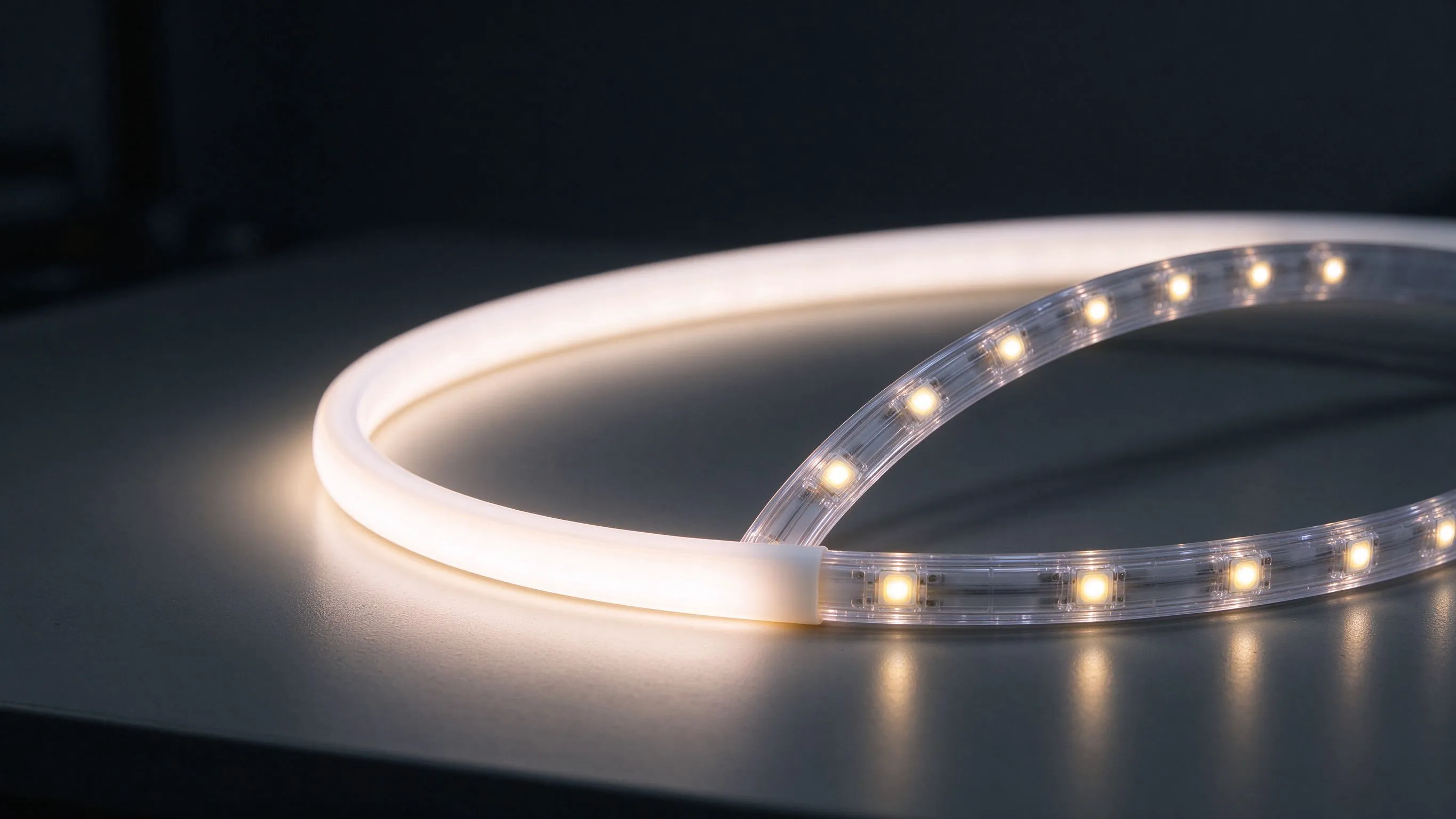
The Two Jobs a Diffuser Does at Once
A neon sleeve has to do two contradictory things: get as much light out as possible, and make that light look like one continuous line instead of a row of dots. Every diffuser formulation is a compromise between those two goals, which is why there is no single 'best' tube, only the right one for how the sign is viewed.
Transmittance is the percentage of light that passes through the sleeve. A crystal-clear tube has high transmittance but almost no diffusion, so the individual chips remain visible. A milky tube sacrifices transmittance to scatter the light and blend the chips into a smooth face. Understanding that balance is the whole decision.
Clear, Semi-Milky and Milky: What Each One Does
More diffusion means fewer visible dots but fewer lumens reaching the eye.
| Diffuser | Transmittance | Appearance when lit | Typical use |
|---|---|---|---|
| Clear / transparent | Highest | Individual LEDs clearly visible | Hidden inside another diffuser or channel |
| Semi-translucent | High | Faint chip texture at close range | Shallow letters viewed from a distance |
| Milky / opal | Moderate | Smooth, dot-free continuous line | Most visible neon signs and outlines |
| Extra-milky / thick | Lower | Very soft, wide glow | Close-viewing and glare-sensitive interiors |
When a Clear Tube Is Actually the Right Choice
People assume clear is always worse, but it is the correct choice in a specific and common situation: when the neon sits behind a second diffusing surface. If the tube is installed inside a channel letter with a frosted acrylic face, or inside an aluminium profile with its own opal cover, the tube does not need to do the diffusing. Using a milky sleeve there wastes lumens twice, because both the tube and the outer face scatter light.
- Clear tube behind a frosted acrylic letter face: maximum light reaches the face, which does the smoothing.
- Clear tube inside an opal aluminium channel: the channel cover provides the diffusion.
- Deep lightboxes where the neon is a light source rather than the visible product.
Where a clear tube is wrong is mounted bare and viewed directly, which is exactly how a lot of budget outline work is installed, and why those signs look dotted and cheap at night.
Why Milky Tubes Dominate Visible Signage
For exposed neon that people look at directly, the milky sleeve is the default because the sign is selling a clean line, not raw lumens. The ART-NT1616 in a standard milky finish is a good example of the balanced middle: enough diffusion to hide the chips at normal viewing distance while still passing a useful amount of light.
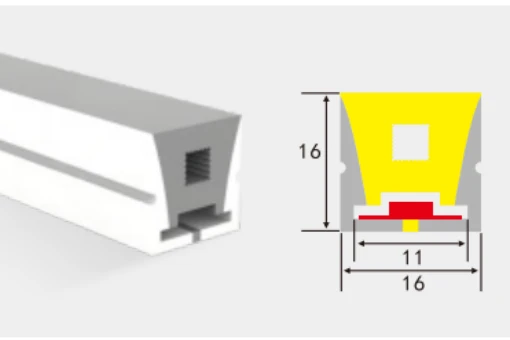
I lean on this balanced grade for most channel letters and outline work. Going extra-milky is rarely necessary outdoors, where viewing distance already hides the chips, but it is useful for close interior features where people stand within a metre of the line.
How Diffuser Choice Interacts With LED Density
Diffuser and LED density are a pair. A clear or lightly milky tube needs high LED density to avoid visible dots; a thick milky tube can smooth a lower density because the scattering fills the gaps. This affects both cost and heat.
- Clear sleeve + low density = obvious dots; only acceptable behind a second diffuser.
- Milky sleeve + moderate density = smooth line with sensible wattage (the common sweet spot).
- Extra-milky sleeve + high density = very soft but you pay for LEDs whose light the diffuser partly absorbs.
I sometimes step the density up one notch and use a slightly clearer tube when maximum brightness is required, rather than driving a milky tube harder to compensate for lost lumens. Overdriving raises heat and shortens life; choosing the density and diffuser together is the cleaner route.
Does the Diffuser Change the Colour Temperature?
It can, slightly. Heavy milky diffusion can take the edge off a cool white and make it look a touch warmer or softer, and coloured light can look slightly desaturated after strong scattering. For brand-critical colours I always approve the exact tube and strip combination as a lit sample rather than trusting the LED bin alone. Two signs using the same strip but different sleeves will not match if the diffusers differ, which matters on multi-site rollouts.
A Simple Bench Test for Transmittance and Uniformity
- Run identical strip through each candidate sleeve and light them side by side.
- View from the closest and farthest real viewing distances.
- Photograph at a fixed exposure to compare brightness and dot visibility objectively.
- Hold each tube over a printed line of text; the more you can read through it, the clearer (less diffusing) it is.
- Check colour consistency between samples if you are matching an existing sign.
Specifying with Confidence
On the enquiry I state whether the tube is visible directly or behind another face, the closest viewing distance and the LED density I plan to use. Those three facts let the correct diffuser grade be matched instead of shipping a one-size tube. We can send clear, semi-translucent and milky samples of the 1616 and other common profiles so you can run the side-by-side test with your own strip and choose the grade that gives the smoothness and brightness the job needs.
Recommended Products
Frequently Asked Questions
Which is brighter, a clear or milky neon tube?
A clear tube has higher transmittance and passes more raw lumens, but it shows individual LEDs and is mainly used behind a second diffusing face. A milky tube outputs slightly less light but produces the smooth dot-free line that most visible signs need, so 'brighter' does not always mean 'better looking'.
When should I use a clear neon sleeve?
Use a clear sleeve when the neon sits behind another diffusing surface, such as a frosted acrylic letter face or an opal aluminium channel cover, which does the smoothing. Avoid bare clear tube viewed directly, because the individual LEDs will be visible as dots.
Does a milky diffuser reduce LED dot visibility?
Yes, that is its purpose. The milky material scatters light to blend adjacent chips into a continuous line. The thicker or more opaque the diffuser, the smoother the face and the lower the LED density you can get away with, though some lumens are lost.
Will a milky tube change my white colour temperature?
Slightly, in some cases. Heavy diffusion can soften a cool white and make it appear a touch warmer, and can mute saturated colours. For brand-critical work, approve the exact strip-and-tube combination as a lit sample and keep the same diffuser across all locations.
How do I compare diffusers objectively?
Run identical strip through each candidate sleeve, light them side by side, view from the real distances and photograph at a fixed exposure. Holding the tube over printed text also reveals how clear or diffusing it is; readable text means a clearer sleeve.
Need help with your LED project?
Get factory-direct pricing, free samples and engineering support within 24 hours.
Email: info@arraystarled.com | Phone: +86-0755-2103-6746 | WhatsApp: 0086 1581 8514 077
Need to size your power supply? Use our LED Strip Power Calculator to find the right driver in seconds.







