Adding a Neon Tube Section Years Later and the Hue Will Not Match
- 2026-11-02 15:54
- /
- Arraystar LED
A replacement tube will never match a five-year-old run exactly. Silicone yellows, phosphor ages, and the diodes drift warm as they lose lumen. I set expectations before I cut the new length, and I order the closest aged-match rather than pretending fresh stock will disappear into the wall.
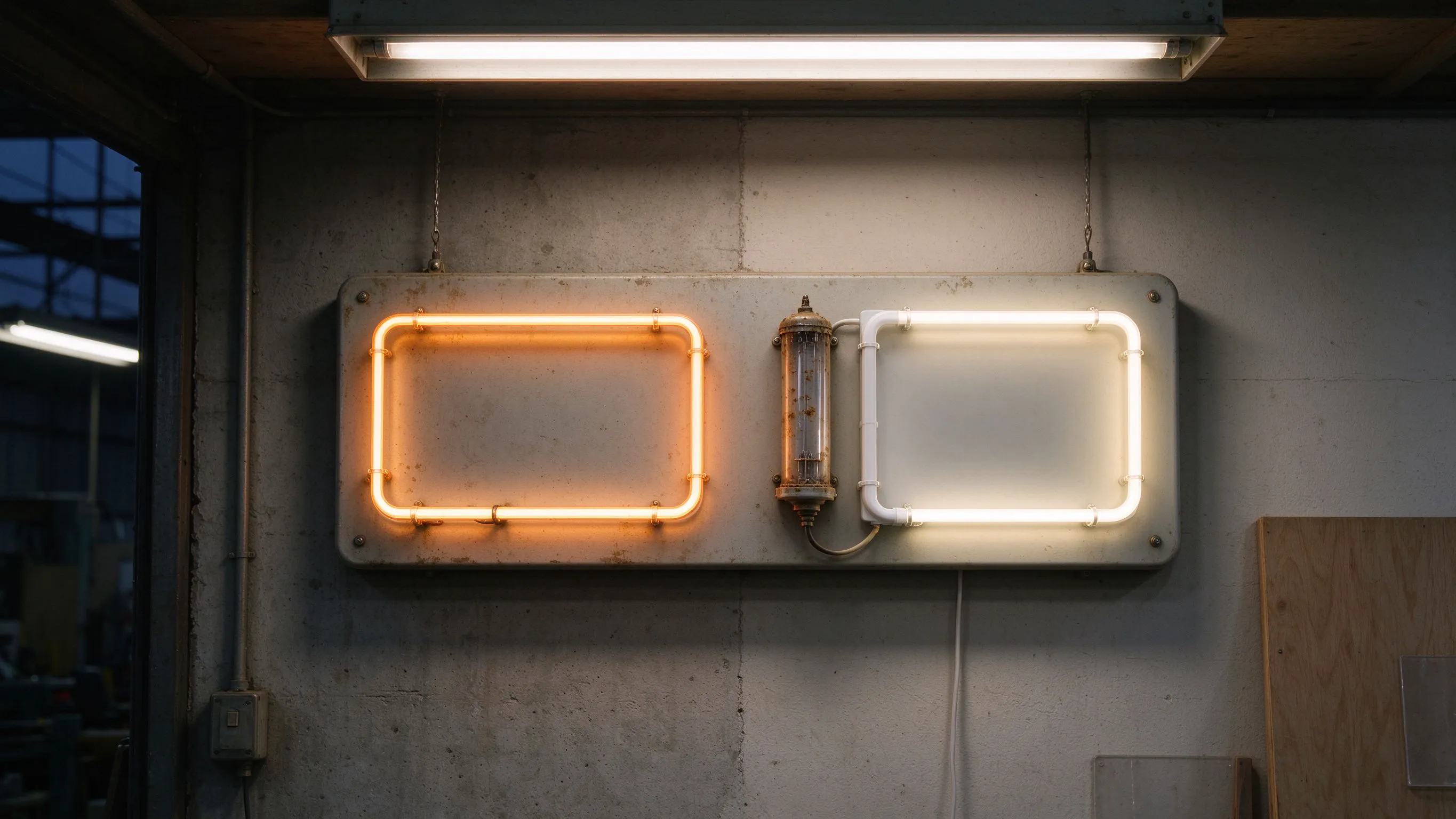
The replacement that glows brand new next to the rest
It is the classic repair call: one letter in a sign goes dark, the client buys a matching tube from the catalog, and the new section lights up like a bulb next to candles. The rest of the sign has aged gently for years, and the fresh silicone and fresh diodes sit there shouting. Nobody thinks the repair looks fixed; they think the sign looks worse.
I used to send out a fresh cut and wait for the complaint. Now I walk the client through what aging actually does before I quote, so they choose between a visible patch and a full re-tube. There is no magic LED code that hides the difference.
What actually changes on an aged sign
Three things drift over time. The silicone diffuser yellows slightly, which warms the glow. The LED chips lose roughly 20 to 30 percent of their initial lumen over 30,000 hours, and the remaining output shifts warm on cool-white parts. And the driver ages, so the rail voltage sits a touch lower than day one. Add them up and a five-year-old run is a different colour temperature than the same SKU bought today.
- Silicone diffuser yellows, pulling white toward warm.
- LED lumen decays, so the old run reads dimmer and slightly amber.
- Driver output drifts down, compounding the dimness on the aged section.
How I choose the closest aged match
I bring the sign into a dark room, light it up, and hold a sample of the target colour next to the aged section at the same distance. On a cool-white run I step up to a 4000 K replacement instead of the 6000 K the sign was probably specced new. On a warm-white run I go one step warmer and slightly lower in lumen output.
Match the aged glow, not the original datasheet value.
| Original spec | Age of sign | Closest replacement choice |
|---|---|---|
| 6000 K cool white | 3-5 years | 4000 K neutral white, lower output |
| 4000 K neutral | 3-5 years | 3500 K warm neutral |
| 3000 K warm white | 3-5 years | 2700 K warm, dimmed 10 percent |
If the sign is eight years old or more, I usually advise replacing the whole word rather than one letter. The mismatch will be obvious no matter what stock I pick.
Repairing one letter versus re-tubing the whole run
A single-letter repair is worth it when the sign is under three years old, when the colour is a saturated red, blue or green (saturated phosphor hides aging far better than white), and when the client accepts a small visible patch. On white lettering older than three years, the patch is rarely invisible enough to be worth the call-out.
Saturated phosphor hides aging; white does not.
| Scenario | Single-letter repair? | Better option |
|---|---|---|
| Sign under 2 years old | Yes, fresh stock matches | Repair |
| Saturated colour, 5 years | Likely close enough | Repair |
| White, over 4 years | Patch will show | Re-tube the whole word |
How I make the patch less obvious after install
Once the new section is in, I do a couple of small tricks to soften the edge. I dial the new section down on its own driver channel by about ten percent, so it sits closer to the dimmer aged run. I also run the sign on a timer rather than leaving it on 24 hours, because accelerated aging in the first month brings the new silicone closer to the old in a few weeks.
- Give the new section its own driver channel so you can trim brightness separately.
- Run the new section 24/7 for the first two weeks to accelerate the silicone aging.
- Photograph the result at night, not in daylight; daylight lies about colour.
Recommended Products
Frequently Asked Questions
Can I match a new neon tube to an old one exactly?
Not exactly, only close. Silicone yellows and LED chips lose lumen over years, so a fresh cut of the same SKU will always read brighter and cooler next to an aged run. The closest match is to step the colour temperature warmer by one step and trim the output down about ten percent on its own driver channel.
Why does white neon age worse than coloured neon?
White LED relies on a blue chip pumping a yellow phosphor, and both drift as they age. Saturated red, green and blue neon flex use a single phosphor colour that ages much more uniformly, so a five-year-old red tube still looks like a new red tube. White drifts warm and dim, which is why patched white signs always show.
Should I replace the whole sign rather than one letter?
If the sign is over four years old and white, yes. A single patched letter will read brighter and cooler no matter which stock you pick, and the client will notice every night. Re-tubing the whole word costs a little more but looks intentional. On saturated colours under three years, a single letter repair is usually fine.
How much lumen do LED neon tubes lose in five years?
Roughly 20 to 30 percent at 30,000 hours of operation, which for a sign on a 12-hour daily timer is about five to seven years. The remaining light also drifts warm on cool-white parts, by 200 to 400 K. That combination is why a fresh 6000 K tube looks almost blue next to an aged white run.
Does running the new tube 24/7 help it age faster?
It helps a little. The silicone diffuser yellows fastest under heat and UV, so running the new section flat-out for two weeks brings it closer in tone to the aged run. It will not match a five-year-old piece in a fortnight, but it shaves off the obvious "fresh" edge. Pair it with a 10 percent brightness trim on the new section.
Need help with your LED project?
Get factory-direct pricing, free samples and engineering support within 24 hours.
Email: info@arraystarled.com | Phone: +86-0755-2103-6746 | WhatsApp: 0086 1581 8514 077
Need to size your power supply? Use our LED Strip Power Calculator to find the right driver in seconds.