Can Neon Tube Even Follow a Script Font's Tight Inner Loops?
- 2026-11-02 15:53
- /
- Arraystar LED
That elegant script logo you love has inner loops tighter than any silicone neon tube can physically turn. I can bend a 6 mm tube to about a 25 mm radius, and your lowercase e wants 12 mm. The fabricator couples two pieces or thins the stroke, and you should know which before you approve the art.
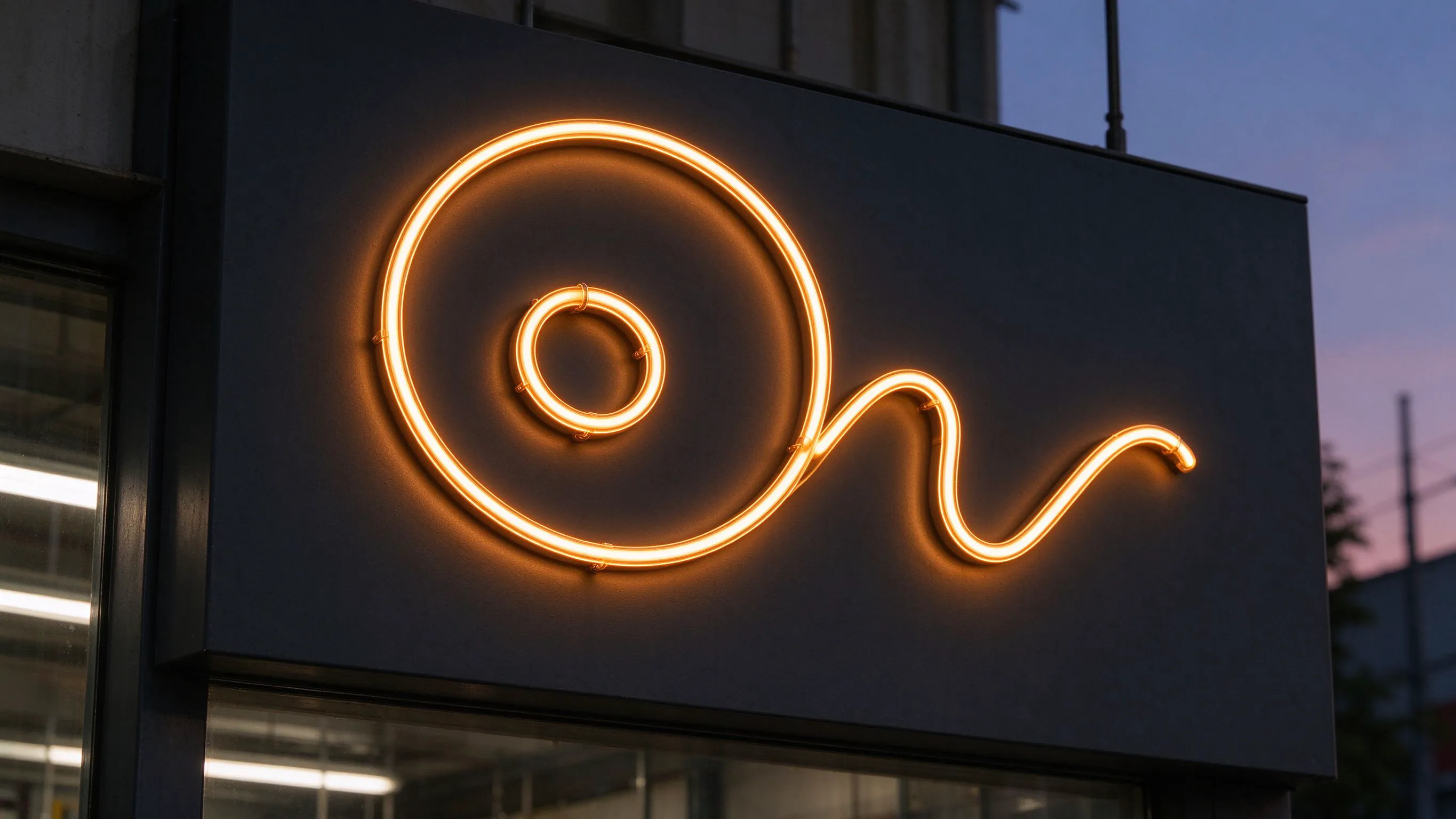
The loop that always breaks the layout
Script and cursive lettering look gorgeous when drawn on a screen, but every tight counter, every lowercase e, g or a, wants the tube to turn in on itself. A silicone neon tube has a copper PCB inside and a silicone diffuser around it, and both have a minimum bend radius they will accept before the copper trace cracks or the diffuser goes cloudy at the crease.
I have had clients send vector art with loops so tight they assumed the tube would just follow the line. It will not. The tube arrives on a reel at a certain diameter, and that reel diameter is roughly the smallest radius you can trust in the field.

What the minimum bend radius actually means
The bend radius on a datasheet is not a suggestion. Bend below it and you risk cracking the PCB trace at the crease, which shows up as a dark segment that flickers when the sign warms up. The radius scales with the cross-section of the tube: a 6 mm tube turns far tighter than a 20 mm tube, but it also throws less light.
Radius is measured to the centreline of the tube, not to the inside edge.
| Tube section | Min bend radius (field) | Loop it can follow |
|---|---|---|
| 4-6 mm | 15-20 mm | Tight script counters, thin single-stroke letters |
| 8-12 mm | 25-40 mm | Normal script with moderate loops |
| 16-20 mm | 50-70 mm | Block lettering and large cursive only |
Side-bend flex and top-bend flex also behave differently. A top-bend tube lays flat and bends left to right; a side-bend tube turns up and down. Pick the wrong orientation and your loop kinks instead of curves.
How I rescue a script logo that wants tighter loops
When the art calls for a loop tighter than the tube can make, I do not fight it. I redraw the letter with the fabricator: open the counter slightly, thicken the stroke, or split the letter into two pieces that meet at the tight point. Nobody sees the joint if it lands on a vertical stroke under the mounting clip.
- Widen the inner loop by about 5 mm on the vector art before quoting.
- Split the letter at the tightest point and couple two pieces with a hidden joint.
- Switch to a thinner tube (6 mm or 8 mm) if the light output still reads well at the viewing distance.
The trick that sells most signs: keep the outer flourish elegant and fat, and thin the stroke only where the loops are tight. The eye reads the overall word, not the width of every stroke.
Where the tube kinks in practice

The failures show up in three places: the inside of a tight curve where the silicone folds, the transition between a straight stem and a loop, and any ninety-degree twist where the fabricator tried to turn a top-bend tube on its side. At those points the diffuser goes slightly white or cloudy within a month, and a dark diode patch appears right at the crease.
Kinks are almost always an art orientation issue, not a tube defect.
| Fault you see | Likely cause | Prevention |
|---|---|---|
| Cloudy crease on a loop | Bent below min radius | Open the loop in the art |
| Dark segment on a curve | PCB trace cracked | Split the piece at the tight point |
| Twisted glow on a letter | Top-bend used sideways | Switch to side-bend flex |
What I ask the client before I quote script lettering
I now ask for the vector art at actual size, and I overlay a circle the size of the minimum bend radius on every inner loop. Any loop smaller than that circle gets a note on the drawing. It takes ten minutes and saves the awkward call when the sign comes back looking nothing like the logo.
- Send the logo as vector outlines, not a JPG, so the loops can be measured.
- Tell me the viewing distance; a sign read from 5 m away can hide a thinner tube.
- Expect one or two hidden joints; they are normal and cheaper than reworking the sign.

Recommended Products
Frequently Asked Questions
Can neon tube follow very tight script lettering?
Not to a screen-true loop. A silicone neon tube has a minimum bend radius set by its cross-section, usually 15 to 70 mm depending on size. Any loop smaller than that radius either kinks the diffuser or cracks the inner PCB. The fix is to open the loop slightly in the art or split the letter at the tight point.
What is the tightest radius a 6 mm neon flex can bend?
A 6 mm silicone neon flex bends to roughly a 15 to 20 mm centreline radius in the field. Below that you risk cracking the inner copper trace, and the diffuser tends to fold and go cloudy at the crease. Reels are typically shipped around a 20 mm core, so treat that as the practical floor.
What is the difference between top-bend and side-bend neon flex?
Top-bend flex is built to curve left and right in the plane of the wall, so the light emits upward through the top of the diffuser. Side-bend flex turns up and down. If you bend a top-bend tube on its side to follow a curve, the LEDs twist and the glow looks off-axis. Match the bend direction to the letter geometry.
Can you join two pieces of neon tube inside a letter?
Yes, and on script logos you usually have to. The joint is made with a small connector or solder sleeve inside the letter body, hidden under a mounting clip. It is electrically clean and lasts as long as the rest of the run if the joint is heat-shrunk and sealed. Plan the joint on a straight stem, never on a curve.
Why does my neon sign have a cloudy spot on a loop?
That cloudy patch is the silicone diffuser folded past its limit. Once the silicone stretches beyond the minimum bend radius, the diffuser thins and goes slightly translucent white at the crease. It is cosmetic at first, but the inner PCB under that crease is also stressed and usually darkens within months. The tube needs reworking with a wider loop.
Need help with your LED project?
Get factory-direct pricing, free samples and engineering support within 24 hours.
Email: info@arraystarled.com | Phone: +86-0755-2103-6746 | WhatsApp: 0086 1581 8514 077
Need to size your power supply? Use our LED Strip Power Calculator to find the right driver in seconds.