Matching Neon Tubing Colour to a Pantone Brand Swatch
- 2026-10-28 10:02
- /
- Arraystar LED
A brand guide that demands exact Pantone on a neon sign is asking for physics to compromise. I never promise a perfect match; I promise the closest standard tube, a lit sample on the bench, and a client sign-off before I order the full run.
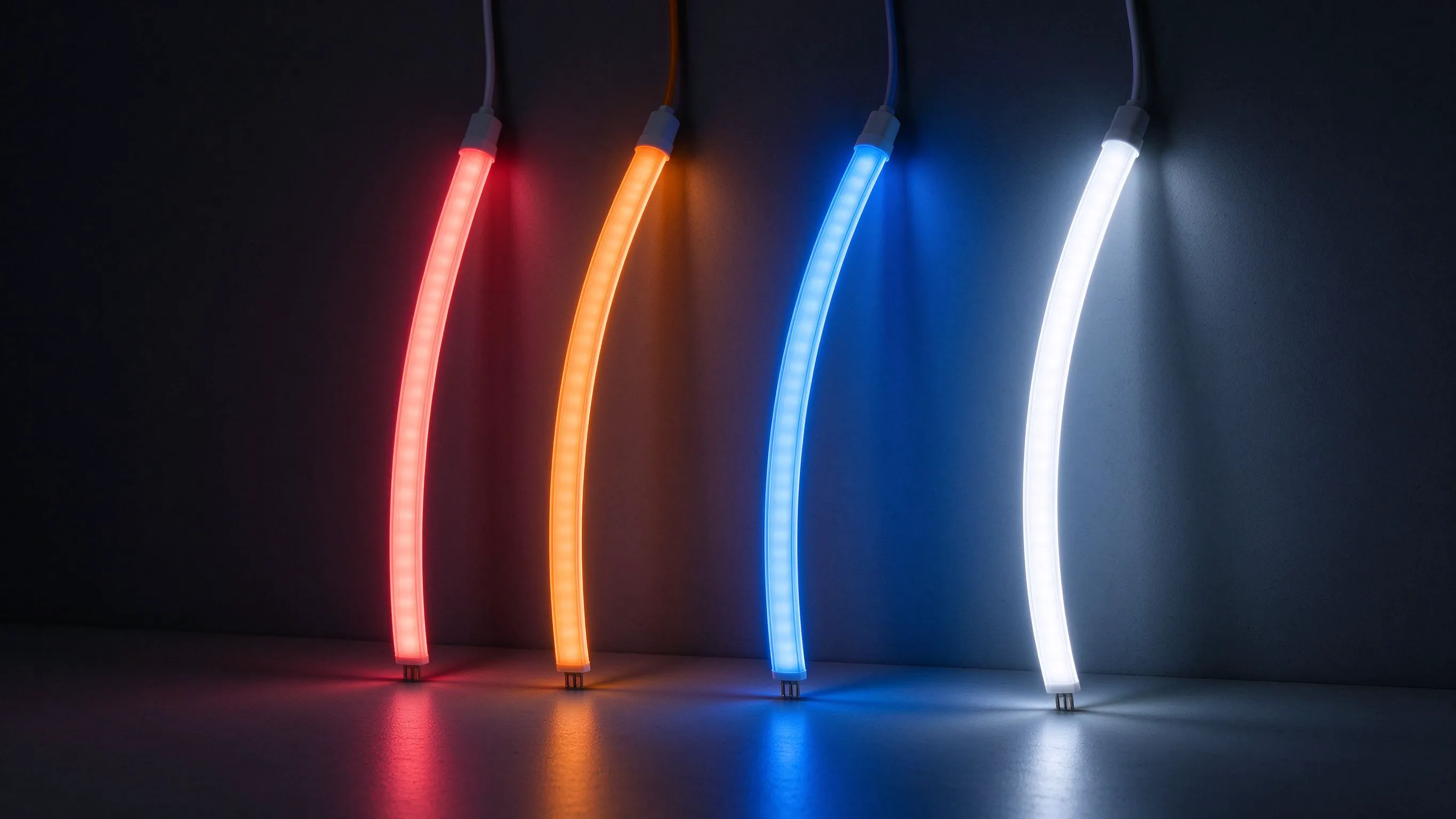
Why Pantone and neon are different animals
A Pantone swatch is printed ink on paper, measured under controlled light. A neon tube is a diffused LED emitting light in a narrow colour band, seen on a wall at night. The two systems measure colour differently: Pantone is reflective, neon is emissive. No amount of LED tuning lands a paper swatch exactly when the source of light is shining rather than reflecting. I have spent twenty minutes with a client holding a swatch next to a powered tube, and the honest answer is always close, never identical.
A coffee chain once insisted on Pantone 185 red for their fascia. I pulled three red tubes from the shelf, lit them on the bench, and let the brand manager pick the closest. She chose the one that read as a slightly deeper crimson than the swatch, because at night on a dark street it matched the other lit signage better than a bright red would have. The swatch is a daytime reference; the lit sign is a night object.
The three reasons a perfect match is impossible
- Paper ink is reflective; neon light is emissive, so brightness and saturation read differently.
- Diffusers scatter light, which desaturates the hue by ten to fifteen percent.
- Surrounding streetlight and other signs shift perceived colour every hour.

Setting expectations before the order
I send the client a one-paragraph note before I order. It says: neon colour is emissive, not printed; the closest standard tube will be matched to your swatch on a lit bench; expect a tolerance of roughly one Pantone step; and if you need an exact match, we will need a custom bin which adds cost and lead time. Once the client reads that, ninety percent of post-install complaints vanish. The other ten percent I handle with a lit sample at site survey.
A standard bin gets you within one Pantone step; exact match means custom LED.
| Swatch family | Closest standard tube | Tolerance to expect |
|---|---|---|
| Warm red (Pantone 185) | 2700K-red / 620 nm bin | Within one step, slightly deeper. |
| Royal blue (Pantone 286) | 460 nm blue bin | Slightly brighter than swatch. |
| Warm white (Pantone Cool Gray) | 2700 K or 3000 K | Pick on site, not on paper. |
| Signal green (Pantone 347) | 520 nm green bin | Nearest, but reads yellowish at distance. |
For white signs, the paper swatch is even less useful. A white neon at night reads very differently depending on CCT, and the only honest reference is a lit sample on the wall at dusk. I bring three CCT samples to every white-sign site survey.

How to compare on the bench
I set up a small rig in the workshop: a black board, a swatch taped at viewing distance, and three lit tube samples mounted at the height the sign will sit. We wait until dusk, turn off the workshop lights, and look. A swatch under a daylight lamp is the wrong comparison; you have to compare in the same ambient light the sign will live in. I photograph the lit comparison and email it to the client for written sign-off before I order the full length.
- Compare at dusk, not under shop lights; colour temperature shifts everything.
- Mount the swatch at the same distance the viewer will stand.
- Photograph the comparison with the phone on auto white balance, then again on locked WB for reference.
- Get written sign-off on the chosen bin; verbal approvals vanish.
Custom bins and when they are worth it
If the client truly needs a tight match, a custom LED bin is possible, but it adds two to three weeks of lead time and roughly thirty to forty percent to the tube cost. I only recommend it when the sign is a hero piece in a flagship store, or when the brand guideline is contractually audited. For a normal fascia, the closest standard bin is closer than anyone standing on the pavement will ever notice.

After installation: managing the light shift
LED bins drift slightly over the first hundred hours, and the diffuser mellows as it ages. I tell the client that the sign will read marginally warmer and slightly softer after the first month, and that this is normal. I return at the six-week mark with a colour swatch and a light meter, and we take one more look. By then the eye has adapted and the sign reads exactly as it should. If it still looks wrong, I swap the driver output or the tube section under warranty.
- Warn the client about the first-hundred-hour drift; it is normal, not a fault.
- Return at six weeks with a swatch and take a reference photo.
- Keep a 200 mm offcut of the chosen bin for future repairs.
- Document the CCT and bin number on the as-built drawing.
Recommended Products
Frequently Asked Questions
Can neon tube be colour-matched exactly to a Pantone swatch?
Not exactly. Pantone is reflective ink on paper; neon is emissive light through a diffuser. The closest standard LED bin lands within roughly one Pantone step, and a custom bin gets you closer but still not identical. Expect a close cousin, not a twin. Always compare lit samples at dusk on a bench before ordering the full run.
How much does a custom LED colour bin cost?
Roughly thirty to forty percent more than a standard bin, and adds two to three weeks of lead time. I only recommend it for flagship hero signs where the brand is audited. For a normal fascia, the closest standard bin is closer than anyone standing on the pavement will notice, and the saving is better spent on better drivers.
Why does the swatch look different from the lit sign?
Because one reflects light and the other emits it. A swatch under a daylight lamp is a daytime object; a neon sign is a night-time object, seen against a dark wall and mixed with streetlight. Compare them only at dusk, on a black board, at the viewing distance the sign will actually be seen from. Any other comparison is misleading.
Will the neon colour shift as the LEDs age?
Slightly. LED bins drift during the first hundred hours, usually warming by a small step, and the diffuser mellows over years. This is normal and expected. I warn clients about it up front and return at six weeks to confirm the sign still reads right. If a segment fails later, use the offcut I kept, not a fresh bin.
Which white neon should I choose for a warm brand?
Compare 2700 K and 3000 K lit samples at dusk on the actual wall. Paper swatches are useless for white neon; the CCT, the wall colour and the surrounding streetlight all change how the white reads. I bring three samples to every white-sign site survey and let the client pick in the evening, not on a printed brochure.
Need help with your LED project?
Get factory-direct pricing, free samples and engineering support within 24 hours.
Email: info@arraystarled.com | Phone: +86-0755-2103-6746 | WhatsApp: 0086 1581 8514 077
Need to size your power supply? Use our LED Strip Power Calculator to find the right driver in seconds.